You are using an outdated browser and your browsing experience will not be optimal. Please update to the latest version of Microsoft Edge, Google Chrome or Mozilla Firefox. Install Microsoft Edge

December 8, 2023

Thailand Extends Payment Deadline for 2024 Land and Building Tax

Thailand’s Ministry of Interior has extended the deadlines for payment of the 2024 land and building tax and related procedures by two months. The announcement was published in the Government Gazette on November 30, 2023.

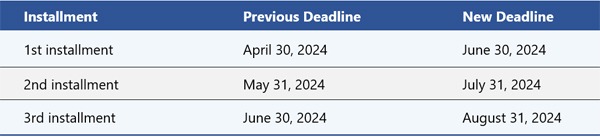
According to the new timeline in the ministry’s announcement, the official land and building tax assessment forms will be sent to taxpayers by the end of April 2024 (extended from February 2024) while the deadline for payment of land and building tax has been extended to June 30, 2024 (from April 30, 2024).

For payments made in installments, the announcement also extended the deadline for each installment as follows:

For more details on these measures, or any aspect of Thailand’s land and building tax, please contact Chaiwat Keratisuthisathorn at [email protected] or Supranee Arjjit at [email protected].

RELATED INSIGHTS​ 

November 25, 2021
On September 30, 2021, Thailand’s Revenue Department released a notification prescribing country-by-country (CBC) transfer pricing reporting requirements for multinational enterprise (MNE) groups that do business in Thailand. The Notification of the Director-General of the Revenue Department Re: Income Tax (No. 408) applies to accounting periods beginning on or after January 1, 2021, with the CBC report submitted at the same time as the annual corporate income tax (P.N.D. 50) filing (i.e., within 150 days of the end of the accounting period). For example, if the accounting period ends on December 31, 2021, the CBC report must be filed by May 30, 2022. Background The CBC report functions as part of a three-tier structure, together with a global master file and a local file, as recommended by the OECD’s Base Erosion and Profit Sharing (BEPS) Action 13 report (Transfer Pricing Documentation and Country-by-Country Reporting). The CBC reporting requirement targets large MNEs, with the aim of encouraging international tax transparency, improving tax authorities’ access to information on MNEs’ global allocation of income and taxes paid, and helping governments to assess high-level transfer pricing risks and conduct economic and statistical analysis. The CBC reporting requirement will allow Thailand to exchange tax and financial information on an automatic basis with other signatories of the Multilateral Convention on Mutual Administrative Assistance on Tax Matters. This goes in tandem with the recently passed Act Amending the Revenue Code (No. 54) B.E. 2564 (2021), which empowers the director-general of the Revenue Department to exchange information with competent authorities in other jurisdictions. Entities Required to Submit CBC Reports The CBC report notification applies to MNE groups that do business in Thailand and at least one other jurisdiction and that have consolidated group revenue of at least THB 28 billion (approx. USD 847.6 million) in a 12-month accounting
November 24, 2021
Attorneys from Tilleke & Gibbins have provided the latest update to the Thailand contribution to Doing Business in…, a Q&A-style guide published by Thomson Reuters Practical Law that presents an overview of the legal framework for doing business in 63 jurisdictions worldwide. The Thailand chapter of the guide outlines Thailand’s legal system and key laws applicable to foreign companies doing business in the country. The chapter specifically covers the following main topics: Legal system: Thailand’s court system and codified legal system. Foreign investment: Lists of reserved business activities, restrictions on doing business with certain jurisdictions, exchange controls and currency regulations, and grants and incentives available to investors. Business vehicles: Ordinary partnerships, registered ordinary partnerships, limited partnerships, private limited companies, and public companies. Environment: Main laws and regulations, factory operation. Employment: Laws, employment contract requirements, work permits, and termination and redundancy. Tax: Taxes on employment, tax and nontax resident employees and businesses, corporate income tax, value added tax, special business tax, municipal tax, stamp duty, dividends, interest, intellectual property royalties. Competition: Important aspects of Thailand’s regulatory regime surrounding competition, centered around the updated Trade Competition Act. Antibribery and corruption: Laws, compliance requirements, regulatory authority. Intellectual property: Patents, trademarks, registered and unregistered designs, and copyright. Marketing agreements and advertising: Regulation of marketing agreements, Thailand’s Consumer Protection Act, direct marketing, role of the Consumer Protection Board and Food and Drug Administration. E-commerce: E-commerce laws and regulations, marketing and sales via online platforms. Data protection: An outline of Thailand’s Personal Data Protection Act. Product liability: Procedures and regulations for product liability and product safety, including the Unsafe Goods Liability Act and the Consumer Case Procedure Act. Product liability: Key regulatory authorities for trade competition, environmental issues, and financial services. To browse, download, or print the Thailand chapter, please visit the Practical Law website.

October 25, 2021
Michael Ramirez, a counsel in Tilleke & Gibbins’ dispute resolution group in Bangkok, has updated the firm’s contribution to the Global Attorney-Client Privilege Guide, published by Lex Mundi. The newly expanded guide provides information on what constitutes attorney-client privilege in over 70 countries around the world. The Thailand section of the guide contains in-depth information on the function and applications of attorney-client privilege in Thailand (or, as explained in the guide, an equivalent concept enshrined in Thai law), including coverage of the following topics: Privilege in corporations Common interest doctrine Litigation funding Crime-fraud exception Work product doctrine/litigation privilege Other privileges including mediation, accountant-client and settlement negotiation The interactive guide features expert contributions by Lex Mundi member firms from jurisdictions worldwide. Readers can browse the contributions, generate country-specific reports, and compare attorney-client privilege in multiple jurisdictions. For more information, please visit the Lex Mundi website.
October 14, 2021
As part of its membership in Lex Mundi, Tilleke & Gibbins has published an updated edition of its Guide to Doing Business in Thailand for 2021. This guide outlines all of the key factors for starting and operating a business in the Thai market. Issues covered include: Investment incentives Financial facilities Exchange controls Import and export regulations Structures for doing business Requirements for the Establishment of a Business Operation of the Business Cessation or Termination of the Business Labor legislation, relations, and supply Tax Immigration requirements This publication is part of Lex Mundi’s Guides to Doing Business series prepared by member firms in more than 100 jurisdictions worldwide. The guides serve as a useful resource when planning an international business strategy or researching a new market.