You are using an outdated browser and your browsing experience will not be optimal. Please update to the latest version of Microsoft Edge, Google Chrome or Mozilla Firefox. Install Microsoft Edge

December 8, 2023

Thailand Extends Payment Deadline for 2024 Land and Building Tax

Thailand’s Ministry of Interior has extended the deadlines for payment of the 2024 land and building tax and related procedures by two months. The announcement was published in the Government Gazette on November 30, 2023.

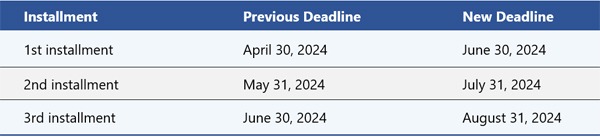
According to the new timeline in the ministry’s announcement, the official land and building tax assessment forms will be sent to taxpayers by the end of April 2024 (extended from February 2024) while the deadline for payment of land and building tax has been extended to June 30, 2024 (from April 30, 2024).

For payments made in installments, the announcement also extended the deadline for each installment as follows:

For more details on these measures, or any aspect of Thailand’s land and building tax, please contact Chaiwat Keratisuthisathorn at [email protected] or Supranee Arjjit at [email protected].

RELATED INSIGHTS​ 

March 22, 2024
Laos has returned its value-added tax rate to 10% from the 7% rate that had been observed for the last two years. The new rate was specified in Ordinance No. 003/PDT, dated March 19, 2024, and announced on the website of the Ministry of Trade and Commerce. Prior to this, the last announcement of an adjustment in the VAT rate came in the last week of December 2021, when the Ministry of Justice published the Law Amending Certain Provisions of the Laws on Tax No. 01/NA, dated August 7, 2021, in the Government Gazette. This law, which entered into force in January 2022, amended the VAT rate from 10% to 7%. Under Lao law, the ordinance is effective from its date of signing by the president of Laos (i.e., March 19, 2024). However, the tax authorities have indicated that the new rate will not be enforced immediately but will be implemented in the near future, such as when it is published in the Lao Official Gazette. This change of the VAT rate to 10% does not come as a surprise. Some international experts and organizations had been recommending that Laos adopt a 10% VAT rate given its current economic challenges, arguing that Laos should prioritize collecting tax and replenishing the state budget. This was, for instance, recommended by the World Bank in the November 2023 Lao PDR Economic Monitor. Tilleke & Gibbins will continue to monitor the situation to determine when the 10% VAT rate will be enforced. For more details on the rate changes, or on any aspect of tax law in Laos, please contact Tilleke & Gibbins at [email protected].
February 28, 2024
Experts on real estate law from Tilleke & Gibbins provided the chapter on Vietnam for Practical Law’s Commercial Real Estate Global Guide 2024, a comparative jurisdictional guide in Q&A format giving a a high-level overview of real estate investment structures, restrictions on foreign ownership, and other important issues of real estate law. The main topics include the following: Real estate investment Title to real estate Sale of real estate Real estate tax Real estate finance Real estate leases Planning and development controls To read the Vietnam chapter, please visit the Practical Law website and enroll in the free Practical Law trial to gain full access.
February 28, 2024
On February 1, 2024, Laos’ Decree on Condominiums No. 352/GOV took effect. This decree expands on the Law on Land (2019), which introduced the concept of condominiums into the Lao regulatory framework and opened the possibility for foreigners to own apartment units (redefined as “condominium units”—see below). The Law on Land revolutionized concepts of property ownership and investment in a country where foreign ownership is still uncommon. The recent Decree on Condominiums elaborates on the law by clarifying definitions, outlining procedures for acquiring a unit, setting requirements for operating a condominium business in Laos, and addressing issues related to ownership of condominiums. Definitions Condominium: The Decree on Condominiums defines a condominium as a multistory building containing several units and various facilities. The construction must be on a parcel of land registered as “condominium land.” The units composing the condominium can be sold or assigned to domestic and foreign individuals, legal entities, or organizations. Unit: This refers to any of the units that compose the condominium and whose ownership can be by Lao or foreign individuals, legal entities, or organizations. The decree classifies units into three categories: Residential units for living in; Office units for working spaces for enterprises; and Commercial and service units that serve as a trade or service center, such as for department stores, restaurants, fitness centers, and so on. Unit owners must register the unit in accordance with its specific purpose, which must be in line with any applicable urban planning restrictions on certain types of units. Apartment building: This is a building composed of several floors and rooms that cannot be sold to Lao or foreign nationals. According to the Decree on Condominiums, rooms composing the apartment building can only be offered for rent by the owner. This is the main difference between “condominium” and

January 12, 2024
Thailand’s Revenue Department (RD) has issued a notification requiring electronic platforms to report their revenue from business operators on their platform. With this information, the RD intends to track business operators’ income from the sale of goods and services through electronic platforms in order to facilitate accurate and efficient tax collection. The notification, which was enacted on December 27, 2023, took effect on January 1, 2024. Under the notification, electronic platforms are required to compile a “special account” containing information on the revenue received from each business operator on their platform and submit it to the RD through the department’s electronic reporting system within 150 days of the end of the fiscal year. The notification defines “electronic platforms” as entities that intermediate between business operators (i.e., sellers of goods or providers of services via the electronic platform) and consumers for the purpose of enabling electronic transactions between the parties. This covers online marketplace operators, ride-hailing operators, food delivery operators, and so on. This reporting requirement applies to electronic platforms registered in Thailand that have (or previously had, starting from the notification’s effective date) annual revenue exceeding THB 1 billion (approx. USD 28.5 million), except for electronic platforms under the supervision of the Bank of Thailand or the Office of the Securities and Exchange Commission, such as payment service providers and cryptocurrency exchanges. Electronic platforms can appoint a third party to prepare and submit the required special account information to the RD on their behalf. Compliance Steps As the requirements established by this notification mean that the RD will now have direct access to information on the income earned by vendors and merchants on electronic platforms, these business operators—whether corporate or individual—should ensure that they faithfully disclose their earnings, submit tax payments correctly, and file income tax returns in a