
You are using an outdated browser and your browsing experience will not be optimal. Please update to the latest version of Microsoft Edge, Google Chrome or Mozilla Firefox. Install Microsoft Edge

February 19, 2026

Thai SEC Issues New Regulation on Material Transactions

Thailand’s Securities and Exchange Commission (SEC) has issued a new regulation on material transactions (MTs) to govern asset acquisitions and disposals by listed companies and their subsidiaries. The new notification on MT criteria (No. TorJor. 45/2568) from the Capital Market Supervisory Board replaces the long-standing notification (No. TorJor. 20/2551) that has governed such matters. The SEC has also introduced parallel amendments to the country’s related-party transaction rules.

The new regulation will take effect on July 1, 2026. Any MT matters approved by a company’s board of directors for shareholders’ approval before that date remain subject to Notification No. TorJor. 20/2551.

Following that date, the new MT rules will introduce several significant changes that market participants should carefully consider.

Expanded Scope of Material Transactions

One of the key changes under the new regulation is the expansion of the definition of MTs, which now expressly covers financial assistance and certain lease and business lease arrangements that are not in the ordinary course of business of the listed company or its subsidiaries.

For financial assistance, this includes lending, granting credit, providing guarantees, or entering into any arrangement that increases the company’s financial obligations, particularly where the recipient is facing liquidity issues or unable to repay debts. Other forms of financial support also fall within scope. However, whether the provision of collateral for others qualifies as an MT remains somewhat unclear, since no disposal of assets occurs for the provider of collateral. This issue remains to be carefully considered.

For lease-related transactions, the MT rules now specifically include the lease or hire-purchase of all or part of a business or assets operated by or belonging to a listed company or its subsidiaries.

New Exemptions

The new regulation introduces clearer exemptions for transactions between a listed company and its subsidiaries or among subsidiaries, which were not explicitly addressed under the old regime. Other exempt transactions include the establishment of a new subsidiary and liquidity management investments by a listed company or its subsidiaries.

In addition, if a subsidiary that is also a listed company fully complies with the MT requirements, the parent listed company is not required to separately comply for that same transaction (dual approval exemption).

Changes to Transaction Aggregation Rules

The new regulation extends the aggregation period from 6 months to 12 months. However, aggregation is now required only for transactions that are related or form part of the same project. Transactions that have already received shareholder approval remain excluded.

Revised Approval Thresholds and Process

The new regulation lowers the shareholder approval triggering threshold, meaning more transactions may now require shareholder approval compared to the previous regulation, as detailed in the table below.
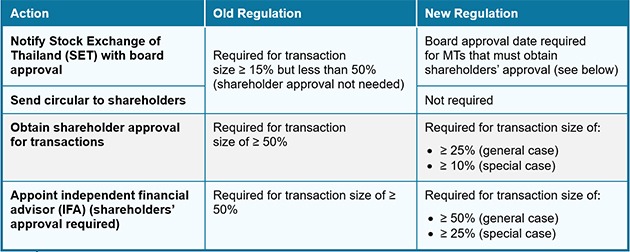
Under the new framework, a key shift is the reduction of the shareholder approval threshold for transactions from 50% to 25% in general cases, with an even lower 10% threshold for companies with negative net assets or operating losses, where the transaction may have an adverse impact (special case). At the same time, certain procedural steps have been streamlined, including the removal of the shareholder circular requirement.

Minority Veto Mechanism

The new regulation introduces a clearer minority protection mechanism. If the audit committee or the independent financial advisor opines that shareholders should not approve the transaction, the transaction cannot proceed if shareholders holding at least 10% of the voting rights present and eligible to vote object to it.

Progress Reporting Requirement

After obtaining shareholder approval, the company must disclose progress reports every six months (by January 31 and July 31) and include such updates in their Form 56-1 One Report until the transaction is completed.

The company must immediately report if it is unable to materially proceed with the transaction as approved, or if the transaction is canceled.

Next Steps

Market participants should review their internal policies, approval processes, and transaction monitoring practices in light of the expanded scope, revised thresholds, and new aggregation rules. In particular, financial assistance arrangements and transaction grouping analyses will require closer scrutiny under the new framework.

Given the scope of the amendments, further clarification from the SEC is expected. A formal guideline is likely to be issued, and both the SEC and the SET are expected to hold seminars to explain the new compliance framework in more detail. We will continue to monitor developments and provide updates as further clarification becomes available.


RELATED INSIGHTS​ 

April 15, 2026
On March 31, 2026, Vietnam’s government issued Decree 102/2026/ND-CP (Decree 102), which amends Decree 75/2019/ND-CP on administrative sanctions for competition law violations (Decree 75). Effective from May 20, 2026, the new decree introduces a number of significant changes aimed at strengthening enforcement, revising penalty structures, and broadening the range of remedial measures, primarily for violations related to economic concentration. Revised Penalties for Economic Concentration Violations Decree 102 significantly revises the penalties for violations related to economic concentration. Failure to notify an economic concentration; implementing an economic concentration before clearance Under the new framework, Articles 14 and 15 of Decree 75 have been amended to impose a range of monetary fines, rather than relying solely on percentage‑based penalties as under the previous regime, for violations involving the failure to notify an economic concentration or the implementation of an economic concentration prior to clearance. The fines range from VND 500 million to VND 1 billion for each enterprise participating in a concentration with combined assets, revenues, or purchase value below VND 3,000 billion in the preceding fiscal year, capped at 5% of the violating enterprise’s total turnover in the relevant market. For concentrations meeting or exceeding the VND 3,000 billion threshold across those same metrics, the fines increase to VND 1 billion to VND 2 billion per enterprise, also subject to the 5% cap. These differentiated thresholds allow penalties to better reflect the size of the transaction and its potential competitive impact. Non-compliance with conditional approvals Enterprises that do not implement or only partially implement the conditions specified in a conditional economic concentration approval decision face fines ranging from 1% to 3% of total turnover in the relevant market during the fiscal year preceding the violation. Decree 102 also adds a new remedial measure requiring enterprises to fully implement all conditions
April 10, 2026
Following Thailand’s recent expansion of the “major shareholder” definition for securities and digital asset businesses, the Securities and Exchange Commission (SEC) launched a public hearing on April 7, 2026, on expanding the major shareholder definition further to cover funding sources behind share acquisitions in licensed securities and digital asset business operators. The public hearing will remain open for 15 days from the launch date, after which the proposed expansion is expected to take effect promptly so that operators can comply with both the earlier and additional requirements within the 180-day transitional period under the earlier regulations. Funding Sources Captured Under Control-Based Test Under the draft rules, persons who fund direct or indirect major shareholders’ acquisition of shares in a licensed operator would be deemed “controlling persons” and subject to SEC approval as major shareholders. This extends beyond traditional lenders to include guarantors, counterparties to derivatives or structured products, and any arrangement that results in a person being, directly or indirectly, a source of funding to a major shareholder. The SEC proposes to exempt three categories of funding arrangements from approval: Loans from Thai licensed financial institutions or BCBS (Basel Committee on Banking Supervision)-jurisdiction foreign banks; Margin loans for securities trading under Thai securities law; and Repurchase agreements under Thai securities law. Exemptions for Funding Sources of Government-Linked Entities The consultation proposes to stop look-through beyond the level of certain government-linked shareholders, including, without limitation, ministries, departments, bureaus, public organizations, independent agencies, and certain state enterprises. The SEC reasons that these entities’ mandates, duties, and funding sources are already subject to government oversight and audit, presenting minimal ownership-structure risk. Practical Implications Licensed securities and digital asset business operators should begin mapping their funding chains under the expanded definition in preparation for filing approval applications for any newly captured funding providers
April 3, 2026
Thailand’s Securities and Exchange Commission (SEC) has established a comprehensive governance framework for the use of artificial intelligence and machine learning (AI/ML) in the capital markets. The framework provides guidance to capital market business operators on understanding the risks associated with AI/ML implementation and adopting appropriate practices to build public confidence in Thailand’s capital markets. While the guidelines are principle-based rather than prescriptive, they reflect the SEC’s expectations for responsible AI/ML governance and are likely to inform supervisory activities and industry standards going forward. Scope The framework applies to capital market business operators supervised by the SEC. This includes, for example, securities and derivatives firms, asset management companies, mutual fund and private fund managers, investment advisors and investment consultants (including robo-advisory service providers), derivatives intermediaries, and other licensed intermediaries and market operators in the Thai capital markets that deploy AI/ML in their operations. Core Principles of the Guidelines The framework is presented as a best-practice manual rather than prescriptive regulation, providing guidance that regulated entities may apply to their AI/ML governance and risk management as appropriate. While currently nonbinding, the guidelines signal the SEC’s expectations for the sector, particularly in relation to other binding SEC regulations such as those covering IT risk management and market conduct. The guidelines name four core principles for AI/ML deployment: Fairness: Design and develop AI/ML with consideration for fairness, equality, and social diversity to prevent discrimination against individuals or groups. Legal and ethical compliance: Ensure AI/ML use aligns with applicable laws, ethical standards, and organizational values and policies. Accountability: Establish clear responsibility—both internally and externally—for AI/ML activities and outcomes. Transparency: Provide adequate disclosure to users about AI/ML use, including explainability of decisions and traceability of activities. AI/ML Best Practices The guidelines prescribe best practices across four stages of the AI/ML lifecycle, as described below.
March 31, 2026
Against the backdrop of Vietnam’s rapid economic and technological transformation and its ambition to build a knowledge-driven economy, the National Assembly of Vietnam adopted Law on Higher Education No. 125/2025/QH15 on December 10, 2025, The new law took effect on January 1, 2026, replacing Law on Higher Education No. 08/2012/QH13 of 2012 and its subsequent amendments after more than a decade of implementation. The new law reflects a significant policy shift toward enhancing the institutional autonomy of higher education institutions (“HEIs”)—universities and other university-level institutions. By granting broader autonomy, Vietnam aims to enable HEIs to operate more proactively, better respond to market needs, and improve the quality and efficiency of education and research activities. Comprehensive Institutional Autonomy in HEIs The new law marks a significant shift by granting HEIs comprehensive autonomy as a statutory right, within the bounds of the licensed scope of educational operation and the legal framework, rather than a conditional right as provided under the former law. Under the new law, HEIs are empowered to exercise autonomy over their academic expertise, training, scientific research, international cooperation, organizational structure, personnel, finance, and other higher education activities. The expansion of institutional autonomy is also accompanied by a correspondingly strengthened framework of institutional accountability. However, Vietnam maintains a certain degree of control and imposes restrictions on institutional autonomy in sensitive and strategically important areas. These controls and restrictions include limitations on training autonomy in the majors of teacher training, national defense, and security; and restrictions on financial and personnel management autonomy for HEIs under the administration of the Ministry of National Defense and the Ministry of Public Security. New Model for Curriculum Development The new law removes the concept of “opening a training major” and focuses regulation on how training programs are developed and delivered. Under the previous regime,