
You are using an outdated browser and your browsing experience will not be optimal. Please update to the latest version of Microsoft Edge, Google Chrome or Mozilla Firefox. Install Microsoft Edge

September 8, 2020

Thai Government Announces Second Phase of Reductions to Social Security Fund Contributions

A new notification from the Thai government will introduce a second phase of reductions to required Social Security Fund (SSF) contribution rates. The new notification will reduce required contributions to 2% of employees’ wages, for both employers and employees, for a period of three months.

This was approved by the cabinet on September 1, 2020, in the Ministry of Labour’s draft Notification Regarding the Criteria, Methods, and Conditions for the Reduction of Employers’ and Insured Persons’ Social Security Fund Contributions, during the Coronavirus 2019 (COVID-19) Outbreak. The draft notification is expected to be enacted soon, well in advance of the October 15 deadline for September 2020 contributions.

This follows the ministry’s March 2020 notification, which reduced the SSF contribution rate for employees and employers for a three-month period, ending in May 2020. From June onwards, therefore, the original SSF contribution rate of 5% for both employers and employees has been reinstated and will remain in place until this latest notification comes into force.

Key Points of the Draft Notification

Employers and employees under section 33 of the Social Security Act (SSA) are entitled to a reduction in SSF contributions for September to November 2020. The reduced rate is equal to 2% of the employee’s wages.

An insured person who is no longer an employee but has registered under section 39 of the SSA is entitled to a reduction in SSF contributions for September to November 2020, during which time their required contributions will be THB 96 per month.

If the remittance exceeds the amount specified in the notification, an employer, employee, or section 39 insured person can submit a request to their relevant Social Security Office to be reimbursed the excess amount.

Contribution Rates Before and During the COVID-19 Outbreak

The table below outlines all changes to the required SSF contribution rate in Thailand that have been implemented during the COVID-19 outbreak so far:
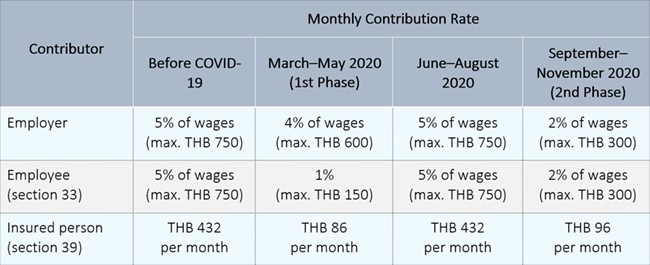
In summary, the first phase of temporary assistance measures for the SSF contribution rate ended in May 2020, after which the original SSF contribution rate was applicable through August 2020. The new cabinet resolution on September 1, 2020, will provide assistance measures to employers, employees, and insured persons once again, albeit at a different rate.

Tilleke & Gibbins will continue to monitor this rapidly evolving situation. For more information on these relief measures, or any other aspect of Thai employment law, please contact Pimvimol (June) Vipamaneerut at [email protected] or Auradee Wongsaroj at [email protected].


RELATED INSIGHTS​ 

December 15, 2023
Employment law specialists from Tilleke & Gibbins’ office in Bangkok provided the Thailand chapter to the Guide to Restructuring a Cross-Border Workforce from International Employment Lawyer. This global guide, which covers 45 jurisdictions worldwide, examines the issue of workplace restructurings, particularly in relation to the needs of multinational companies. The Thailand chapter was written by partners Pimvimol (June) Vipamaneerut and Chusert Supasitthumrong along with associates Chomanut Arif, Dusita Khanijou, and Ketnut Pukahuta. The Q&A-style chapter focuses on key areas related to workplace restructuring, covering each of the following topics in detail: Reduction in workforce; Restructuring or reorganization of the business; Changing terms and conditions; and Areas to watch. A PDF of the Thailand chapter can be downloaded through the button below. Tilleke & Gibbins also provided the Cambodia, Laos, Myanmar, and Vietnam chapters to the Guide to Restructuring a Cross-Border Workforce 2024. To browse the full guide for all 45 jurisdictions, please visit the International Employment Lawyer website.
December 15, 2023
Employment law specialists from Tilleke & Gibbins in Vietnam provided the Vietnam chapter to the Guide to Restructuring a Cross-Border Workforce from International Employment Lawyer. This global guide, which covers 45 jurisdictions worldwide, examines the issue of workplace restructurings, particularly in relation to the needs of multinational companies. The Vietnam chapter was written by partner Kien Trung Trinh, counsel Sarah Galeski, and associate Dung Thi Phuong Le. The Q&A-style chapter focuses on key areas related to workplace restructuring, covering each of the following topics in detail: Reduction in workforce; Restructuring or reorganization of the business; Changing terms and conditions; and Areas to watch. A PDF of the Vietnam chapter can be downloaded through the button below. Tilleke & Gibbins also provided the Cambodia, Laos, Myanmar, and Thailand chapters to the Guide to Restructuring a Cross-Border Workforce 2024. To browse the full guide for all 45 jurisdictions, please visit the International Employment Lawyer website.
December 15, 2023
As part of its membership in Lex Mundi, Tilleke & Gibbins has published an updated edition of its Guide to Doing Business in Thailand for 2023. This guide outlines the key factors for starting and operating a business in the Thai market. Issues covered include: Investment incentives Financial facilities Exchange controls Import and export regulations Structures for doing business Requirements for the Establishment of a Business Operation of the Business Cessation or Termination of the Business Labor legislation, relations, and supply Tax Immigration requirements This publication is part of Lex Mundi’s Country Guides series prepared by member firms in more than 100 jurisdictions worldwide. The guides serve as a useful resource for planning international business strategy and researching new markets. The full Guide to Doing Business in Thailand is available through the button below.
October 20, 2023
On September 18, 2023, the Vietnamese government issued Decree No. 70/2023/ND-CP (“Decree 70”) amending and supplementing certain provisions of Decree No. 152/2020/ND-CP (“Decree 152”), which regulates foreign workers working in Vietnam and the recruitment and management of Vietnamese workers working for foreign entities in Vietnam. While Decree 70 relaxes some conditions relating to foreign workers, the general goal of protecting and prioritizing domestic labor over foreign labor remains. The major changes introduced in Decree 70 are summarized below. 1. Amended Definitions and Requirements for Worker Classifications Decree 70 introduces several changes to the requirements for foreign workers to be classified as “experts” and “technical workers.” Under Decree 152, foreign workers needed to hold bachelor’s degrees or receive training directly related to their intended job positions in Vietnam. However, under Decree 70, experts are only required to have a university degree or higher and at least three years of relevant work experience suitable for their intended positions in Vietnam. Similarly, it is no longer necessary for technical workers to have training in a specific technical field to be eligible to work in Vietnam. Instead, a technical worker is defined as someone who has undergone at least one year of training and possesses at least three years of working experience suitable for their intended job position. Additionally, Decree 70 clarifies and expands the scope of the term “executive director”. Accordingly, an executive director can be (i) the head of a branch, representative office, or business location of an enterprise (which helps clarify the previous definition of “executive director” in Decree 152); or (ii) an individual who oversees at least one field within an agency, organization, or enterprise while being under the direct supervision of the head of that agency, organization, or enterprise. 2. Application for Work Permit The general procedure for