You are using an outdated browser and your browsing experience will not be optimal. Please update to the latest version of Microsoft Edge, Google Chrome or Mozilla Firefox. Install Microsoft Edge

December 28, 2021

Thai Cabinet Approves New Draft Amendments to the Anti-Money Laundering Act

Since 2017, Thailand’s Anti-Money Laundering Office (AMLO) has been developing an amendment to the Anti-Money Laundering Act B.E. 2452 (1999) (AML Act) to improve Thailand’s anti-money laundering framework and make it more consistent with the internationally accepted anti-money laundering policies and practices recommended by the Financial Action Task Force (FATF). The most recent development came on November 4, 2021, when the Thai Cabinet approved, in principle, a draft amendment to the existing AML Act.

The key amendments under this latest draft amendment to the AML Act are summarized below.
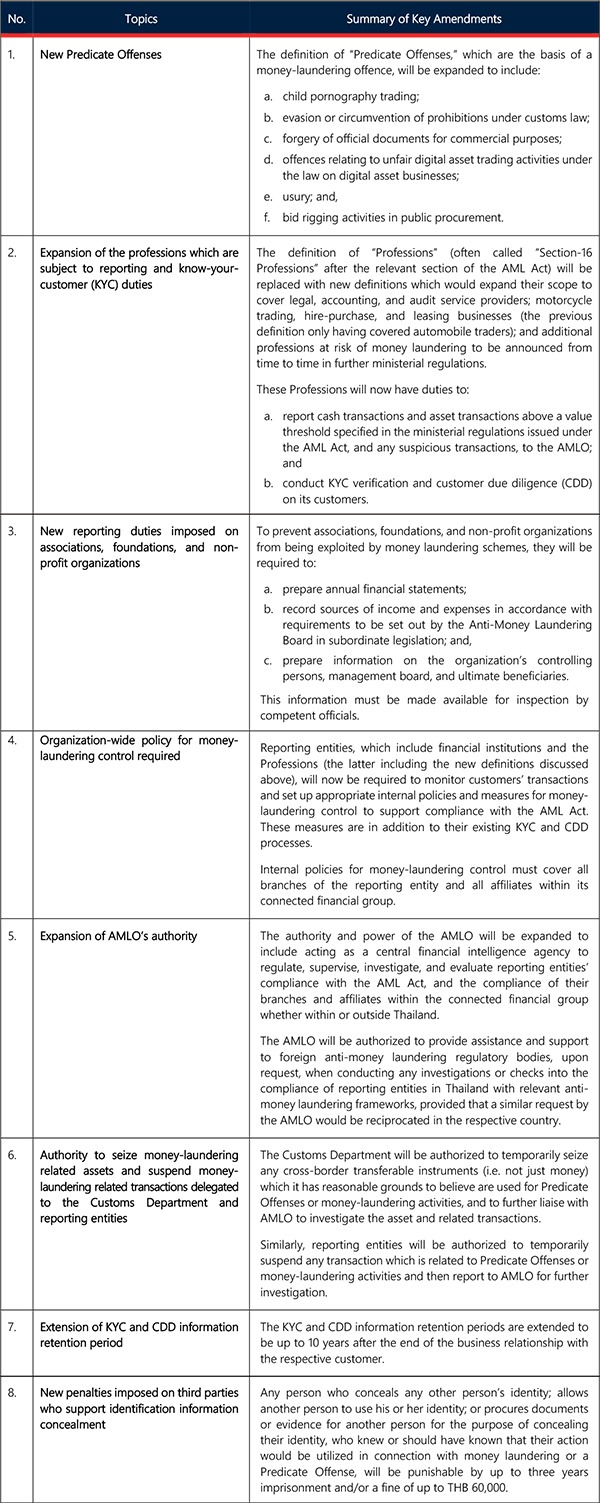
These amendments would allow for more robust regulation and investigation processes to better combat increasingly complex money laundering schemes, and would also be an important step for Thailand to satisfy one of the key qualifications for becoming an FATF member.

At the date of this publication, the Draft Amendment Act is currently under an additional public hearing process which will continue until the end of January 2022. We will closely monitor the legislation process of this Draft Amendment Act and will continue to report on any significant developments as they become available.

For more information on anti-money laundering law in Thailand, please contact Mr. Kobkit Thienpreecha at [email protected] or +66 2056 5534, Mr. Niti Muangkote at [email protected] or +66 2056 5542, and Ms. Chutikarn Boonnark at [email protected] or +66 2056 5536.

RELATED INSIGHTS​ 

January 10, 2025
Tilleke & Gibbins’ project finance team in Vietnam has contributed the Vietnam chapter to the 2025 edition of The Legal 500’s Project Finance guide. As part of The Legal 500’s Country Comparative Guides series, this publication provides businesses and investors with crucial information about the legal and regulatory aspects of project finance across jurisdictions worldwide. The Q&A-format chapters deliver detailed insights into the legal regimes governing an array of project finance topics, including: Ownership structures and corporate governance; Security interests, regimes, and enforcement; Regulatory requirements and consents; Foreign exchange considerations; Environmental, social, and governance (ESG) issues; Public-private partnerships; Foreign judgments; Tax considerations; Common funding structures; and Insurance law principles. Tilleke & Gibbins also prepared the Thailand chapter for this edition. The Vietnam chapter is available as a PDF via the button below, with the full guide freely accessible on The Legal 500 website.
January 9, 2025
Thailand’s Fiscal Policy Office (FPO) has released a draft of its planned Financial Business Hub Act, which is in line with the government’s aim of positioning Thailand as a regional financial hub and a critical player in the global economy. The draft act, on which the FPO is accepting comments until January 9, 2025, details the framework for promoting and attracting international financial businesses and related services to operate in Thailand, proposes various incentives, and outlines supervisory guidelines. This article examines key elements of the draft Financial Business Hub Act relevant to financial business operators. Incentivized Financial Businesses The draft act identifies the financial businesses to be promoted and incentivized. These target businesses include: Commercial banking businesses, Payment service businesses, Securities businesses, Derivatives businesses, Digital assets businesses, Insurance and reinsurance brokerage businesses, and Other financial-related businesses as determined by the Committee for the Supervision and Promotion of Financial Centers. Thailand’s finance minister explained that initially, the draft law intends to target businesses using an “out-out” model, which describes the raising of capital abroad for investment abroad, before expanding to an “out-in” model, in which capital is raised abroad for investment domestically. Therefore, the draft law currently specifies that the target businesses must only provide services to nonresidents without soliciting residents of Thailand to use their services. Authorization Targeted financial business operators will need to receive authorization from the Committee for the Supervision and Promotion of Financial Centers. The main eligibility criteria for authorization are the incorporation an entity (e.g., a company registered in Thailand, a branch of a foreign juristic person) with an office in designated areas to be specified in a royal decree (currently expected to be Bangkok and adjacent provinces) and the possession of other qualifications as prescribed in the draft act. Target businesses in Thailand will
December 11, 2024
On October 16, 2024, Thailand’s Anti-Corruption Cooperation Committee (ACCC) issued a notification to enhance anticorruption standards in public procurement. The new notification (officially “Notification of the Anti-Corruption Cooperation Committee on the Procurement Budget and Minimum Standards of the Policy and Directions for Anticorruption in Relation to Procurement according to Section 19 of the Public Procurement and Supplies Administration Act B.E. 2560”) supersedes previous guidelines and imposes stricter compliance requirements on business entities involved in the government procurement processes. The updates not only align with the goals of Thailand’s Public Procurement and Supplies Administration Act B.E. 2560 (2017) but also reflect the government’s resolution to mitigate corruption, particularly in high-value public contracts. The ACCC’s new notification introduces additional definitions, lowers budget thresholds for compliance, and strengthens business obligations. Key Components The new notification continues the previous guidelines’ requirement that businesses seeking to bid on government procurement projects meet the specified minimum standards—such as communicating and implementing anticorruption policies at all organizational levels, establishing a code of conduct, and providing related training programs to employees. The notification also introduces a number of changes, the most notable of which are detailed below. “Entrepreneur” definition. The definition of this term is narrowed to entities involved in the public procurement bidding process. Previously, the definition broadly applied to all business entities engaged in selling goods or services. Threshold for mandatory compliance. The project budget threshold that necessitates compliance with the minimum standards is  THB 300 million—a reduction from the previous threshold of THB 500 million. Minimum standards to prevent unfair competition. The new notification introduces a specific definition for “disturbing fair competition,” establishing clear parameters around actions that disrupt competitive fairness within public procurement. Continued compliance requirements. Businesses’ compliance with the minimum standards must now extend from the date of bid submission to the
December 4, 2024
Tilleke & Gibbins has contributed the Cambodia, Laos, Myanmar, Thailand, and Vietnam chapters to Restructuring in Southeast Asia, a comparative guide produced by Drew Network Asia (DNA). The publication outlines the principal debt restructuring processes available to corporate debtors across nine Southeast Asian jurisdictions and provides an accessible overview for lenders, creditors, and companies navigating financial distress in the region. Structured in a question-and-answer format, each jurisdictional chapter addresses the same core topics, allowing readers to compare approaches across markets. The guide covers key issues such as available restructuring mechanisms, court-supervised and out-of-court options, the roles and powers of creditors, and the implications of restructuring on ongoing business operations. As with other DNA resources, the guide aims to provide practical orientation rather than exhaustive analysis. Legislative developments and jurisdiction-specific considerations may affect the applicability of certain procedures, and readers requiring tailored advice are encouraged to contact the practitioners listed at the end of each chapter. The full guide is available for download using the button below or directly from the DNA website.