You are using an outdated browser and your browsing experience will not be optimal. Please update to the latest version of Microsoft Edge, Google Chrome or Mozilla Firefox. Install Microsoft Edge

December 28, 2021

Thai Cabinet Approves New Draft Amendments to the Anti-Money Laundering Act

Since 2017, Thailand’s Anti-Money Laundering Office (AMLO) has been developing an amendment to the Anti-Money Laundering Act B.E. 2452 (1999) (AML Act) to improve Thailand’s anti-money laundering framework and make it more consistent with the internationally accepted anti-money laundering policies and practices recommended by the Financial Action Task Force (FATF). The most recent development came on November 4, 2021, when the Thai Cabinet approved, in principle, a draft amendment to the existing AML Act.

The key amendments under this latest draft amendment to the AML Act are summarized below.
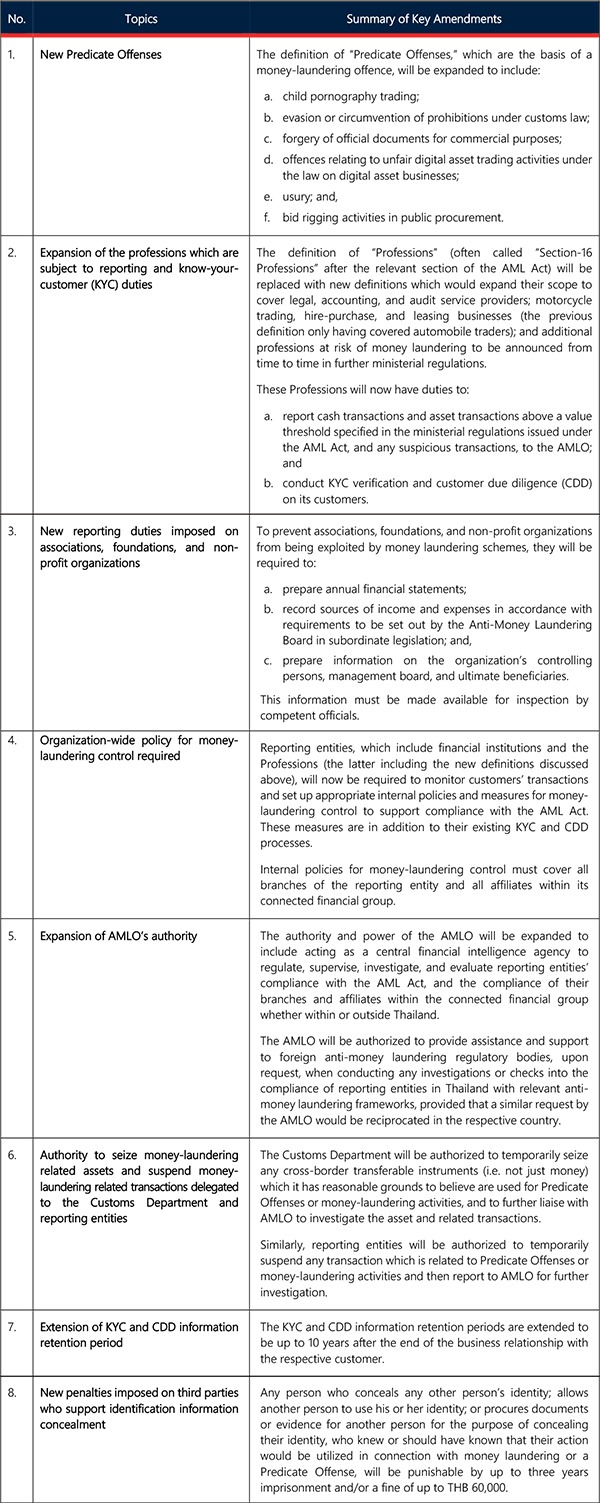
These amendments would allow for more robust regulation and investigation processes to better combat increasingly complex money laundering schemes, and would also be an important step for Thailand to satisfy one of the key qualifications for becoming an FATF member.

At the date of this publication, the Draft Amendment Act is currently under an additional public hearing process which will continue until the end of January 2022. We will closely monitor the legislation process of this Draft Amendment Act and will continue to report on any significant developments as they become available.

For more information on anti-money laundering law in Thailand, please contact Mr. Kobkit Thienpreecha at [email protected] or +66 2056 5534, Mr. Niti Muangkote at [email protected] or +66 2056 5542, and Ms. Chutikarn Boonnark at [email protected] or +66 2056 5536.

RELATED INSIGHTS​ 

May 2, 2025
Attorneys from Tilleke & Gibbins have updated the latest edition of Doing Business in Thailand, a Q&A-style guide from Thomson Reuters Practical Law that offers an overview of key legal considerations for companies operating in jurisdictions worldwide. The contribution outlines the country’s legal and regulatory framework for foreign investment and business operations and reflects the latest legislative developments. The chapter addresses the following core topics: Legal system: Structure of the courts and the codified nature of Thai law. Foreign investment: Business restrictions under the Foreign Business Act, sector-specific regulations, exchange control rules, and investment incentives. Business vehicles: Overview of partnerships, private and public limited companies, and other legal entities. Employment: Labor protections, employment contracts, foreign worker requirements, and termination procedures. Tax: Corporate and personal income tax, indirect taxes, and tax obligations for residents and non-residents. Intellectual property: Registration and enforcement of patents, trademarks, designs, and copyrights. Data protection: Key provisions of the Personal Data Protection Act and related compliance obligations. Competition law: Regulatory framework under the Trade Competition Act. Anti-bribery and corruption: Relevant legislation and enforcement mechanisms. E-commerce and digital business: Legal regime for online transactions and digital platforms. Marketing and advertising: Consumer protection laws and regulations affecting advertising and marketing practices. Product regulation and liability: Safety standards, liability regimes, and roles of enforcement authorities. Practical Law, a legal reference resource from Thomson Reuters, publishes a range of guides for hundreds of jurisdictions and practice areas. The insurance and reinsurance guide is a valuable resource for legal practitioners, covering numerous jurisdictions worldwide. To view the latest version of the guide, please visit the Practical Law website and enroll in the free Practical Law trial to gain full access.
April 28, 2025
In recent years, Vietnam has positioned itself among the leading countries in the world in terms of digital asset ownership and trading volume. This rapid adoption reflects the country’s growing digital economy and the increasing engagement of individuals and businesses in blockchain-based financial activities. Central to this growth are Resolution No. 57-NQ/TW of the Politburo dated December 22, 2024, on breakthroughs in science, technology, innovation, and national digital transformation with a vision to 2045 (“Resolution 57”) and Resolution No. 03/NQ-CP of the Government dated January 9, 2025, promulgating the Action Plan to Implement Resolution 57 (“Resolution 03”), which outline a flexible and innovative policy framework that embraces pilot programs for emerging technologies to lay the groundwork for Vietnam’s legislative framework concerning cryptocurrency and blockchain technologies. Regulatory clarity in terms of digital assets and blockchain technologies is now more critical than ever for businesses and investors. In light of this, Vietnam is currently in the process of introducing three key legal instruments, with drafts of the Law on Digital Technology Industry (“Draft DTI Law”), Resolution of the National Assembly on the Establishment of Regional and International Financial Centers in Vietnam (“Draft Financial Center Resolution”), and Resolution of the Government on the Pilot Implementation of Crypto Asset Markets in Vietnam (“Draft Crypto Pilot Resolution”) nearing promulgation. Current Regulatory Direction and Schedule Vietnam’s regulatory framework for crypto assets and blockchain has been in a developmental stage since 2017, focusing on directions, plans, and schedules rather than established regulations. In February 2024, under Decision No. 194/QD-TTg of the Prime Minister, the Ministry of Finance (MOF) was assigned to draft a legal framework to either prohibit or regulate virtual assets and service providers by May 2025, signaling a clearer regulatory direction. In March 2025, Directive No. 05/CT-TTg of the Prime Minister directed the MOF
April 3, 2025
Thailand has proposed amendments to the Anti-Money Laundering Act B.E. 2542 (1999) as the country steps up its efforts to combat economic crimes and corruption. One of the primary objectives of the amendments is to enhance the effectiveness of measures curbing the use of nominees to help foreign nationals operate restricted or prohibited businesses in violation of the law. If these proposed updates are implemented, they will substantially strengthen existing legislation related to the use of nominees and bribing government officials, including officials of foreign governments and international organizations. These offenses would be treated as predicate violations under the amended legislation. The draft amendments are currently open for a public comment period, which is set to conclude on April 25, 2025. Highlights of the proposed amendments are detailed below. Predicate Offenses The draft amendments propose adding the concept of a “predicate offense” covering the following: Bribery: Giving, offering, or promising to give assets or benefits to Thai or foreign public officials, or officials of international organizations. Acting as a nominee: Assisting, supporting, or engaging in the business operations of a foreign national who is not permitted to operate that business; jointly operating a business with a foreign national under the guise that it is solely owned by the Thai national; or holding shares on behalf of a foreign national in a partnership, limited company, or any other legal entity to help the foreign national conduct business without the permits required under the Foreign Business Act. Under the draft amendments, Thai individuals or juristic persons who have agreed to take any of these actions, as well as foreign nationals who allow such assistance in their business operations, will be liable for committing a predicate offense under the Anti-Money Laundering Act. The draft proposes a prescription period of 15 years from
April 3, 2025
On February 26, 2025, Thailand’s National Anti-Corruption Commission (NACC) issued a notification titled “Criteria for Individuals Living Together as Husband and Wife that Are Considered as De Facto Spouses (No. 2) B.E. 2568 (2025).” This new notification, published in the Government Gazette on March 7, 2025, took effect retroactively from January 22, 2025. Prior to this notification, the term “spouses” specifically included “individuals living together as husband and wife” without registering marriage, referring to similar language at the time in Thailand’s Civil and Commercial Code. However, it was unclear whether this term included same-sex and other nontraditional couples. After the Marriage Equality Act revised this language in the Civil and Commercial Code to only refer to “spouses” (with a gender-neutral Thai word), the NACC took the opportunity to issue a new notification that simply replaces any mention of “husband and wife” with “spouses,” thereby removing the ambiguity. As a result, this new notification covers same-sex de facto spouses of politicians and high-ranking officials. These spouses’ assets must now be declared together with the officials’ assets. Additionally, same-sex de facto spouses of state officials are prohibited from engaging in business with the Thai government that may present conflicts of interest. Importantly, the notification also impacts the interpretation of the Office of the Prime Minister’s (OPM) Regulation on the Giving or Receiving of Gifts by Public Officials B.E. 2565 (2022). In this regard, same-sex de facto spouses of government officials are now also prohibited from accepting gifts or other benefits related to official duties. This is because the OPM regulation references the NACC definitions when defining “family members” to include “de facto husband and wife.” Under the OPM regulation, public officials and their supervisors are strictly prohibited from permitting or condoning family members’ acceptance of gifts or other benefits related to