You are using an outdated browser and your browsing experience will not be optimal. Please update to the latest version of Microsoft Edge, Google Chrome or Mozilla Firefox. Install Microsoft Edge

May 2, 2024

Thai Arbitration Institute Launches Pilot Project for In-Court Arbitration

The Thai Arbitration Institute (TAI) announced on April 19, 2024, that it has jointly set up an in-court arbitration pilot project with five courts in Thailand—namely, the Civil Court, Taling Chan Civil Court, Central Intellectual Property and International Trade Court, Samut Prakan Provincial Court, and Samut Prakan Khwaeng Court. The pilot project launched on May 1, 2024.

Pilot Project

This project is designed to encourage the parties in cases submitted to these courts to consider having parts of the case, or even the entire case, heard and determined by arbitrators under the Civil Procedural Code (CPC). The objective of the project is to provide faster and more efficient judicial services to the public by reducing the number of cases to be fully tried in the courts through providing an option for parties to engage in in-court arbitration. Still, the court remains largely involved in the process, as the court will consider the award in detail before determining whether to render a judgment in accordance with the award without any edits. Therefore, in-court arbitration favors parties who prefer to have a court judgment instead of an out-of-court arbitral award, which could lead to enforcement challenges under the Arbitration Act.

Parties who participate in this pilot project will pay the TAI a fee for its administrative assistance and related services. The TAI will assist in setting up and facilitating meetings, witness hearings, and the necessary logistics pertaining to case files involving the arbitrators, the parties, and the court. After the arbitrators hear the case, the case files, including the witness statements, exhibits, and reports during the arbitration proceedings, are collected and sent back to the respective court along with the award. Under the pilot project, the arbitrators will issue awards within 30 days of the last day of the trial or the date the closing statements are received, with the total timeframe for the TAI having an award issued set at 180 days from the date on which the latest arbitrator is appointed.

The TAI has noted that appropriate cases for the in-court arbitration pilot program would be civil disputes requiring expertise in complex legal or factual matters. Such cases would include, for example, disputes with a high claim value, medical malpractice, large construction disputes, liability for defects, patent disputes, international contract disputes, international logistics disputes, and cases that would require more than six months for court trial dates.

The benefits provided by in-court arbitration include having the case heard sooner, maintaining trade secrets and confidentiality, having experts in the relevant field decide on the issue, and retaining good relations among the parties.

Considerations

There are a number of key factors that a party should consider before agreeing to participate in the in-court arbitration pilot project:

  • Although the court may encourage the parties to agree not only to the arbitration clause but also to the arbitrator, it is still up to the parties themselves whether to agree to these terms. The court cannot force the parties into participating in the pilot project. This means the parties have the option of agreeing to in-court arbitration that does not fall within the scope of the pilot project, and are not limited to choosing only arbitrators from the court’s list. Parties can also agree to an in-court arbitration clause even if the court handling the dispute is not one of the five courts mentioned above.
  • Although it is possible that portions of the court fees could be returned after the court renders a judgment in accordance with the award, the parties should carefully consider the TAI fees and expenses before agreeing to in-court arbitration. These fees vary depending on the amount claimed and whether a single or multiple arbitrators are sought, as indicated in the table below.
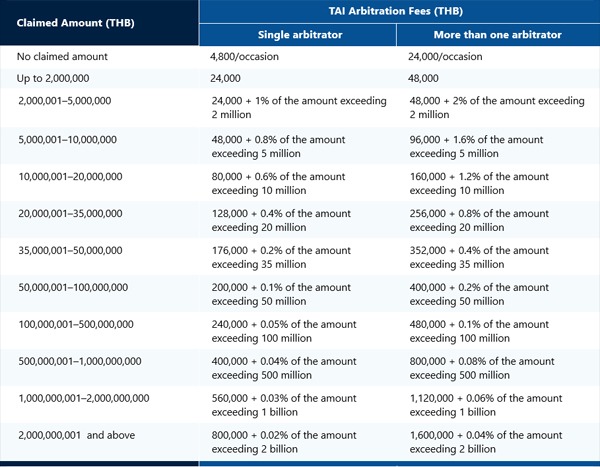
  • If a case is complex, it may take more than 180 days to complete the in-court arbitration process. Therefore, the timeframe may be flexible in practice. This flexibility can potentially benefit the parties, as the additional time would allow the parties to present their cases well and would also provide the arbitrator with additional time to go through the details of the case thoroughly and to issue a well-drafted and well-reasoned award of high quality. While in-court arbitration may allow the parties to have a case decided more quickly than if the case proceeded through the usual civil trial process, it is also important to keep in mind that speed is not always the ultimate objective for the stakeholders.

For more information on the in-court arbitration pilot project, or on any aspect of arbitration or litigation in Thailand, please contact Suruswadee Jaimsuwan at [email protected] or Eric M. Meyer at [email protected].

RELATED INSIGHTS​ 

June 16, 2026
The president of Thailand’s Supreme Court has issued new recommendations providing courts with criminal jurisdiction with a comprehensive framework for identifying and dismissing criminal cases brought in bad faith. Published in the Government Gazette on May 29, 2026, after being signed on May 25, the Recommendations of the President of the Supreme Court Concerning Bad-Faith Litigation in Criminal Cases B.E. 2569 were issued under Section 5 of the Act on the Organization of Courts of Justice. The recommendations took effect upon publication and represent a significant step in Thailand’s efforts to curb abusive criminal litigation, including strategic lawsuits against public participation (SLAPP). Background Section 161/1 of Thailand’s Criminal Procedure Code empowers courts to dismiss criminal cases filed dishonestly or with the intent to harass or take unfair advantage of a defendant. The new recommendations provide detailed guidance that courts previously lacked on identifying and handling such prosecutions. Definition of Bad-Faith Litigation Under recommendation 1, filing a criminal case in bad faith is defined broadly to encompass three categories: Harassment-type filings involving intimidation, threats, or creating unreasonable hardship for the defendant; Coercive filings designed to pressure the defendant into acting or refraining from acting for illegitimate benefit; and False or misleading filings that deliberately assert incorrect material facts or conceal such facts. Circumstances Indicating Bad Faith Recommendation 2 sets out specific circumstances that should raise a court’s suspicion that a filing may violate section 161/1. These include: Filing in a distant court far from the defendant’s domicile without benefiting the adjudication; Retaliation against the defendant’s advocacy for human rights, environmental protection, consumer rights, labor rights, or other public interests—effectively establishing an express anti-SLAPP framework; Retaliation against whistleblowers who disclosed corruption or unlawful conduct; Retaliation against individuals responsible for investigating the plaintiff’s wrongdoing or who concluded such an investigation; Filing multiple
June 10, 2026
For multinational franchisors operating in Thailand, a key risk after franchise termination is that former outlets may continue operating in ways that could easily mislead consumers into believing they remain within the authorized network. To justify such operations, former franchisees often argue that the termination was invalid or ineffective. As a result, these cases are often treated as contractual disputes, making it difficult for franchisors to obtain injunctive relief before a final judgment confirms that the termination was lawful. Franchisors face significant commercial and reputational harm during lengthy proceedings, including consumer confusion, disruption to franchise restructuring, and damage to brand reputation and customer trust. In an encouraging development, the Thai court in a 2025 case responded to the problem of unauthorized post-termination franchise operations by granting interim relief, recognizing broader brand and consumer harm, and awarding substantial damages, highlighting a successful litigation strategy of framing the dispute not merely as a contractual termination issue but as trademark infringement causing ongoing commercial injury. The Subway Case From December 2024 to mid-2025, an unauthorized “Subway®” franchise operation in Thailand attracted substantial public and media attention. Reports and online discussions about unauthorized Subway® stores circulated widely after complaints arose about food quality and customer experience at certain outlets that were allegedly operating after their franchise rights had expired. Because these stores continued to use Subway® trademarks, trade dress, and overall commercial appearance, many consumers were unable to distinguish them from authorized operations, resulting in reputational risks and customer confusion that affected the franchisor’s brand and franchise system in Thailand. Subway treated this matter with the utmost seriousness and moved promptly to protect its brand, franchise system, and customers. It filed a civil action with the IP&IT Court seeking a permanent injunction and damages. During the proceedings, the court granted a preliminary injunction
May 25, 2026
Thailand published new rules on May 1, 2026, establishing clear procedures for how the Anti-Money Laundering Office (AMLO) handles digital assets seized during criminal and money laundering investigations. Taking effect the following day, the Regulation of the Anti-Money Laundering Board on the Custody and Management of Seized or Frozen Assets (No. 3) B.E. 2569 applies to digital asset businesses, cryptocurrency holders, and anyone subject to asset seizure under Thailand’s anti-money laundering laws. For the first time, authorities now have a detailed roadmap for transferring seized digital property from private or foreign control into secure state custody. Digital asset businesses holding customer assets under investigation must be prepared to comply with these rules compelling repatriation of such assets in enforcement actions. Expanded Definition of Digital Assets The regulation defines digital assets to include not only those covered by Thailand’s existing digital asset business law but also any other property that can be stored using the same methods as digital assets. This broad formulation means the custody rules will apply to emerging blockchain-based assets and tokenized property that may not yet fall within the statutory definition of a digital asset business, giving authorities flexibility as the technology evolves. Mandatory Transfer to Domestic Custody When digital assets are held with service providers outside Thailand, AMLO will first attempt to transfer them to an account the office maintains with a licensed domestic digital asset business operator. If the domestic operator does not support that particular asset, the office will instead move the assets to its own cold wallet (offline, internet-isolated storage system). If neither option is feasible, the seizing official will report the situation to the Anti-Money Laundering Committee for alternative instructions. A similar hierarchy governs assets held in an accused party’s private wallet or by any third party that is not a
April 29, 2026
Is arbitration only as good as the arbitrator? Undoubtedly. Choosing an arbitrator is therefore one of the most pivotal decisions a party makes in the arbitration proceedings. In practice in Vietnam, many arbitration proceedings have been significantly prolonged because of multiple unsuccessful appointments arising from conflicts of interest, challenges by the opposing party, or subsequent unavailability. In other cases, additional expenses were incurred where appointed arbitrators were located far from the hearing venue or were unfamiliar with the arbitration language or applicable law. To preempt these issues and secure a more efficient and cost-effective appointment, this article proposes a practical, step-by-step approach to arbitrator selection. Step 1: Know Your Own Case At the outset, it is essential to develop a clear understanding of the dispute by addressing the following key considerations: Nature of the dispute: From which sector does it arise (e.g., construction, international trade, investment, banking and finance, technology, intellectual property)? Value and complexity: Is the dispute high or low in value? Does it involve multiple parties, multiple legal systems, or foreign elements? Is its crux related to multiple legal matters? Existing arbitration agreement: Does the agreement specify the seat, language, and governing law? If not, what would be appropriate considering the parties’ conduct and the applicable arbitration rules? Having clear answers to these questions in mind will help identify, from the outset, the core criteria for selecting an appropriate arbitrator. Step 2: Form Your Candidate Pool Based on the understanding developed in Step 1, a candidate pool should be formed through a structured and careful process: Researching Arbitrator Profiles At the initial stage, comprehensive research should be conducted via reliable sources to ensure both accuracy and diversity of candidates. Official sources, such as lists of arbitrators published by arbitral institutions, most notably the Vietnam International Arbitration Centre