The Thai Arbitration Institute (TAI) announced on April 19, 2024, that it has jointly set up an in-court arbitration pilot project with five courts in Thailand—namely, the Civil Court, Taling Chan Civil Court, Central Intellectual Property and International Trade Court, Samut Prakan Provincial Court, and Samut Prakan Khwaeng Court. The pilot project launched on May 1, 2024.
Pilot Project
This project is designed to encourage the parties in cases submitted to these courts to consider having parts of the case, or even the entire case, heard and determined by arbitrators under the Civil Procedural Code (CPC). The objective of the project is to provide faster and more efficient judicial services to the public by reducing the number of cases to be fully tried in the courts through providing an option for parties to engage in in-court arbitration. Still, the court remains largely involved in the process, as the court will consider the award in detail before determining whether to render a judgment in accordance with the award without any edits. Therefore, in-court arbitration favors parties who prefer to have a court judgment instead of an out-of-court arbitral award, which could lead to enforcement challenges under the Arbitration Act.
Parties who participate in this pilot project will pay the TAI a fee for its administrative assistance and related services. The TAI will assist in setting up and facilitating meetings, witness hearings, and the necessary logistics pertaining to case files involving the arbitrators, the parties, and the court. After the arbitrators hear the case, the case files, including the witness statements, exhibits, and reports during the arbitration proceedings, are collected and sent back to the respective court along with the award. Under the pilot project, the arbitrators will issue awards within 30 days of the last day of the trial or the date the closing statements are received, with the total timeframe for the TAI having an award issued set at 180 days from the date on which the latest arbitrator is appointed.
The TAI has noted that appropriate cases for the in-court arbitration pilot program would be civil disputes requiring expertise in complex legal or factual matters. Such cases would include, for example, disputes with a high claim value, medical malpractice, large construction disputes, liability for defects, patent disputes, international contract disputes, international logistics disputes, and cases that would require more than six months for court trial dates.
The benefits provided by in-court arbitration include having the case heard sooner, maintaining trade secrets and confidentiality, having experts in the relevant field decide on the issue, and retaining good relations among the parties.
Considerations
There are a number of key factors that a party should consider before agreeing to participate in the in-court arbitration pilot project:
- Although the court may encourage the parties to agree not only to the arbitration clause but also to the arbitrator, it is still up to the parties themselves whether to agree to these terms. The court cannot force the parties into participating in the pilot project. This means the parties have the option of agreeing to in-court arbitration that does not fall within the scope of the pilot project, and are not limited to choosing only arbitrators from the court’s list. Parties can also agree to an in-court arbitration clause even if the court handling the dispute is not one of the five courts mentioned above.
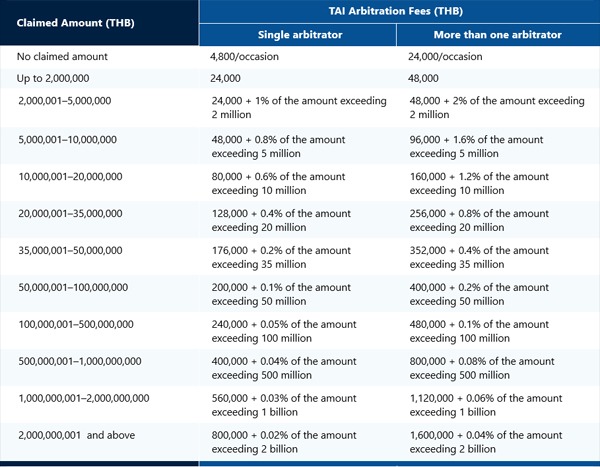
- Although it is possible that portions of the court fees could be returned after the court renders a judgment in accordance with the award, the parties should carefully consider the TAI fees and expenses before agreeing to in-court arbitration. These fees vary depending on the amount claimed and whether a single or multiple arbitrators are sought, as indicated in the table below.
- If a case is complex, it may take more than 180 days to complete the in-court arbitration process. Therefore, the timeframe may be flexible in practice. This flexibility can potentially benefit the parties, as the additional time would allow the parties to present their cases well and would also provide the arbitrator with additional time to go through the details of the case thoroughly and to issue a well-drafted and well-reasoned award of high quality. While in-court arbitration may allow the parties to have a case decided more quickly than if the case proceeded through the usual civil trial process, it is also important to keep in mind that speed is not always the ultimate objective for the stakeholders.
For more information on the in-court arbitration pilot project, or on any aspect of arbitration or litigation in Thailand, please contact Suruswadee Jaimsuwan at [email protected] or Eric M. Meyer at [email protected].