
You are using an outdated browser and your browsing experience will not be optimal. Please update to the latest version of Microsoft Edge, Google Chrome or Mozilla Firefox. Install Microsoft Edge

August 27, 2026

Text, Trademarks, and Symbols in Representations in Thai Design Patent Applications

It is generally understood that patents are granted for new designs that have not been widely known or used in Thailand and not been disclosed anywhere prior to the date of the patent application.

It is trite law that design law protects the distinctive appearance or products. Under Section 3 of the Thai Patent Act B.E. 2522, as amended by the Patent Act (No. 2) B.E. 2535 and the Patent Act (No. 3) B.E. 2542, a design is defined as “any form or composition of lines or colors that gives a product a special appearance and can serve as a pattern for an industrial or handicraft product.”

This raises an important question. Can a patent be issued for a product design that contains text, numerals, trademarks, or symbols that do not fall under the definition of a design? This issue commonly arises when attempting to register packaging, labels, and graphical user interfaces (GUIs).

Until a few years ago, applicants could file design applications with the Thai Patent Office for designs that contained such elements, provided that an appropriate disclaimer was included. This practice was generally accepted by Thai design examiners at that time, but the Patent Office has since implemented a change in its practice that could have a significant impact on applicants for design patents. Where design representations are submitted as line drawings or computer-aided design (CAD) drawings, the examiner may now issue an office action requiring their removal.

This practice, however, appears to be applied inconsistently, as some examiners still exercise their own discretion in determining whether drawings containing these elements are acceptable.

Below are examples of a GUI design, a CAD drawing design, and a photographic design representation that illustrates issues relating to the presence of nonallowable elements.
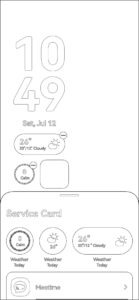
GUI design

For this GUI design, the submitted representations included text, numerals, and symbols. During examination of the application, the examiner issued an office action requiring the removal of the text, numerals, and commonly used symbols, while allowing only newly created symbols to remain.

In response, the applicant submitted an explanation that these elements were incorporated solely to illustrate their placement within the product design and that no claim of exclusivity was made with respect to them. The applicant further clarified that protection was sought only for the novel arrangement, configuration, and positioning of the graphical elements shown in the design. The applicant also amended the claim to include a disclaimer stating this explicitly.

Following the amendment, the application was determined to satisfy all official requirements and was subsequently allowed.

Nonetheless, recent experience indicates that Thai design examiners have adopted a markedly stricter approach. Examiners now have consistently maintained that line drawings and CAD drawings must not include any text, numerals, trademarks, or symbols. In contrast to past practice, explanatory letters or arguments stating that protection is not claimed for such elements are generally no longer accepted by the Thai Patent Office.

As illustrated by the above example, GUI design proprietors may question the practical scope of protection available if all text, numerals, and symbols are removed from the drawings, leaving only basic graphical features such as rounded-corner rectangles. How Thai design examiners will approach the examination of GUI design drawings under the stricter standard remains uncertain; also uncertain is whether additional guidance will become available once proposed amendments to the current Patent Act relating to GUI protection are adopted and come into effect.

The next example below a CAD drawing filed for a label design in which no text, numerals, trademarks, or symbols appear in the design representation. If the original design incorporates any such elements, they should be removed before filing; otherwise, the examiner will likely raise an objection and issue an office action requiring their removal as a condition for further prosecution of the application.

CAD drawing

Lastly, by contrast, where photographs of the design are submitted, such elements are generally permitted to appear in the photographs. An example of such a design representation is shown below.

Photograph of a design

In such cases, however, applicants are typically required to include a disclaimer excluding those elements from the scope of protection.

Practical Takeaways

When a design incorporates text, numerals, trademarks, or symbols, applicants should carefully assess the most appropriate form of design representations to be filed. If such elements constitute part of the product’s visual appearance, photographic representations may be advantageous, as they are generally accepted when accompanied by a suitable disclaimer. By contrast, line drawings and CAD drawings should not contain any text, numerals, trademarks, or symbols.

Taking these considerations into account at the filing stage may reduce the likelihood of objections being raised during examination, streamline prosecution, and increase the prospects of obtaining registration in a timely manner.

RELATED INSIGHTS​ 

June 20, 2025
In a decisive move to strengthen its trade position and reinforce commitments under ongoing tariff negotiations with the United States, the government of Vietnam has made a concerted effort to improve intellectual property enforcement within the country. A key catalyst for this was the prime minister issuing a decision requesting all authorities to initiate sweeping enforcement actions to crack down on counterfeit goods across all provinces. Our firm has been actively involved in these operations. Working in close coordination with Vietnam’s Market Surveillance Authority, Customs, and Border Police, the firm has been instrumental in planning, intelligence gathering, and on-site enforcement. Key operations were conducted in major commercial hubs, including Hanoi and Ho Chi Minh City. In Hanoi, we collaborated with Market Surveillance Team No. 1 to inspect a major wholesaler in Hang Giay. These inspections resulted in the seizure of a significant volume of counterfeit perfumes and the identification of key suppliers within the illegal trade network. In Ho Chi Minh City, our firm supported large-scale inspection campaigns at well-known markets, including Saigon Square. Acting on intelligence, authorities executed multiple raids targeting shops and stalls notorious for selling counterfeit branded products. Specialists from our firm provided logistical support and real-time analysis to ensure swift and effective intervention. Beyond Vietnam’s urban centers, efforts extended to critical border zones in northern and central Vietnam. We worked with Customs and Border Police at major checkpoints to inspect high-risk shipments suspected of containing counterfeit goods. These operations led to the interception of several container loads of illicit products. The nationwide campaign also included targeted actions in several provinces known as hubs for storage and distribution. In Bac Giang, Da Nang, Hai Phong, Kien Giang, and Dong Nai, we assisted in coordinated raids on medium- to large-scale warehouses and distribution centers. These inspections uncovered
June 17, 2025
On January 9, 2025, the Lao official gazette published the newly amended Decision on Trade Inspection Implementation No. 0019/MOIC, dated January 6, 2025. This decision aims to establish principles and rules for trade officers to inspect, fine, and take measures against violators of trade laws and their related regulations on business competition, business operations, and intellectual property rights to protect consumers and business operators in Laos. Changes in Trade Inspection Procedures Previously, trade inspection officers, operating independently under the central Ministry of Industry and Commerce (MOIC) or the provincial-level Department of Industry and Commerce (DOIC), were responsible for administrative raid actions focusing exclusively on intellectual property issues. However, following the enactment of Decision No. 0019/MOIC, trade inspection officers will now be grouped into the Trade Officers Unit, which will also include business competition officers and consumer protection officers. This unit will conduct and participate in raids, considering not only intellectual property laws but also competition and consumer protection laws when imposing penalties on infringers. Trade Inspection Authority Levels Trade inspection implementation is overseen by authorities at three levels: Central level: Department of Business Competition and Trade Inspection, MOIC. The MOIC handles trade inspection work covering all provinces in Laos. Provincial level: DOIC offices in provinces and Vientiane handle trade inspections covering two or more districts. District level: Office of the Industry and Commerce offices in districts. Violations Individuals, legal entities, and organizations violating the newly amended trade inspection decision, the Decree on Trade Inspection, or other related regulations will be educated about the issue, warned, disciplined (for government servants), fined, subject to compensation for damage incurred, or punished by the relevant laws, depending on the gravity of the violation. Trade Violations Violations of trade laws and regulations concerning business operations will result in fines and additional measures. Examples include:
June 4, 2025
The growth of Vietnam’s vibrant digital economy offers tremendous potential but is also a driver of the persistent problem of online intellectual property (IP) infringement. The spectrum of issues faced by IP rights holders runs from copyright piracy on digital services (such as streaming and torrent sites) to the sale of counterfeit goods via e-commerce sites and social platforms to the misuse of rights through misleading use of trademarks. These infringements do not only eat into profits; they damage brand reputation and mislead consumers. As a result, site blocking and keyword blocking have become increasingly important components of the enforcement toolkit available in Vietnam. Legal Framework for Blocking Actions Site and keyword blocking in Vietnam is supported by a growing legal framework, particularly following the 2022 amendment to the IP Law. Prior to this, the legal basis for blocking was scattered across various laws, and internet service providers (ISPs) were only obligated to block access to infringing content upon official requests from authorities. The introduction of Article 198b under the amended IP Law marked a significant shift, establishing a clearer mechanism for rights holders to request site blocking directly. This provision obliges them to act upon valid takedown or blocking requests. In addition to the IP Law, other key legislation includes the Law on Information Technology, the Law on Cybersecurity, the Law on Advertising, and various decrees. Together, these laws provide a more structured and enforceable basis for blocking actions in Vietnam, though practical enforcement still depends on ISP cooperation and the clarity of the infringement evidence. Competent Authorities Previously, rights holders could pursue administrative actions through specialized inspectorates under the Ministry of Science and Technology, the Ministry of Culture, Sports and Tourism, or the Vietnam E-Commerce and Digital Economy Agency (iDEA). However, due to a recent government restructuring,
May 28, 2025
Tilleke & Gibbins attorneys in Vietnam have contributed the 2025 edition of Doing Business in Vietnam, a comprehensive Q&A-style resource from Thomson Reuters Practical Law that provides essential insights for companies navigating business operations in Vietnam. The guide presents a detailed overview of the country’s legal framework and regulatory environment, reflecting recent updates in Vietnamese legislation and practice. This annually updated guide offers key information on the following areas: Legal system: Structure of the Vietnamese judiciary and the role of codified law. Foreign investment: Conditions for market access, licensing requirements, foreign ownership restrictions, and investment incentives. Business vehicles: Formation and operation of legal entities, including limited liability companies, joint-stock companies, and representative offices. Employment: Employment contracts, social insurance, labor rights, and procedures for hiring foreign nationals. Tax: Overview of corporate income tax, personal income tax, value-added tax, and other tax obligations. Intellectual property: Procedures for protecting and enforcing patents, trademarks, copyrights, and other IP rights. Data protection: Compliance requirements under Vietnam’s data privacy laws, including the Personal Data Protection Decree. Competition law: Antitrust rules and regulatory oversight under the Law on Competition. Anti-bribery and corruption: Legal framework and enforcement practices aimed at curbing corrupt activities. E-commerce and digital business: Regulations governing online platforms, digital content, and cross-border services. Marketing and advertising: Laws and guidelines on advertising standards and consumer protection. Product regulation and liability: Safety requirements, product liability issues, and roles of relevant authorities. Doing Business in Vietnam is part of Practical Law’s global series of legal guides designed to support international practitioners and businesses. To access the most recent edition of the Vietnam guide, visit the Practical Law website and sign up for a free trial.