
You are using an outdated browser and your browsing experience will not be optimal. Please update to the latest version of Microsoft Edge, Google Chrome or Mozilla Firefox. Install Microsoft Edge

March 24, 2020

Tax Incentives for Investment in Thailand’s Super Savings Fund Scheme

On March 13, 2020, the Revenue Department of Thailand issued Notification of the Director General of Revenue Concerning Income Tax (No. 369) Re: Criteria, Methods and Conditions for Income Tax Exemption on the Purchase of Investment Units of Super Savings Funds (SSFs).

The tax incentives for investment in SSFs are intended as a substitute for the tax incentives for investment in Long-Term Equity Funds (LTFs), which were discontinued at the end of last year. The criteria and conditions for tax exemption under the SSF scheme are summarized below:

  • In any tax year, a taxpayer may not make SSF investments in excess of 30% of their total taxable income for that year, capped at THB 200,000.
  • The taxpayer’s total SSF, Provident Fund, Government Pension Fund, Private Teacher Aid Fund, Retirement Mutual Fund (RMF), Annuity Insurance Premium, and National Savings Fund investments and contributions must not exceed THB 500,000 in a single tax year.
  • Taxpayers may invest in an SSF from January 1, 2020, to December 31, 2024 (5 years). There is no requirement for continual purchase of SSF units, unlike the rules for LTF or RMF investments. Taxpayers are eligible to receive tax incentives in any year that they invest in an SSF.
  • There is no restriction on the holding period for SSF units. However, to enjoy tax benefits, the taxpayer must hold SSF units for a continual period of not less than 10 years from the date of purchase (except where the taxpayer becomes incompetent or deceased). If a taxpayer sells the SSF units before 10 years have elapsed, they will have to file an amended personal income tax return for the period that the tax exemption was claimed and pay additional tax with a surcharge of 1.5% per month (capped at the additional tax payment amount). Capital gains derived from the sale of SSF units will also be subject to tax in the year that they are sold.
  • The taxpayer must retain the certificate of investment in the SSF issued by the asset management company to support the tax exemption.
  • The taxpayer may transfer an investment in one SSF to another SSF. The transfer must be made within five working days of the SSF receiving an order to transfer from the taxpayer; otherwise, the investment period of 10 years will not be continued.

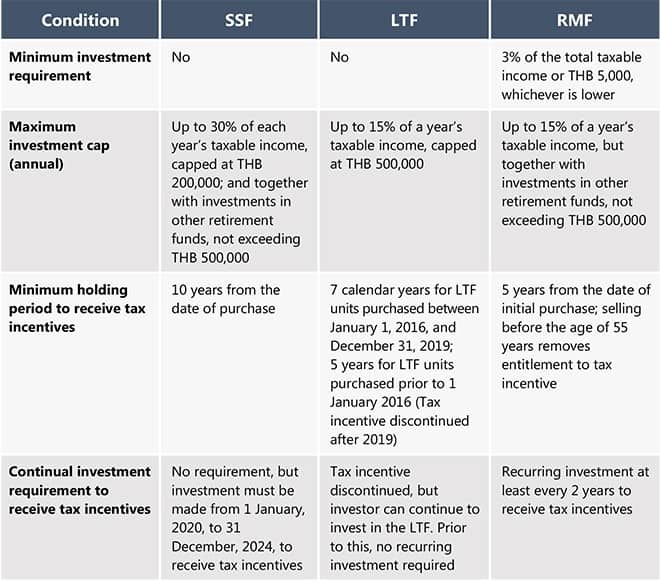
The major differences in the tax incentive conditions of SSF, LTF, and RMF investments are summarized in the table below.
RELATED INSIGHTS​ 

December 25, 2013
The key to developing a successful business lies not only with having good entrepreneurial spirit and skills, but also with having sound knowledge of the laws and regulations that affect you and your company. To help business owners understand and navigate the ever-shifting legal landscape, Practical Law Company, in association with Lex Mundi, has published the latest edition in its series of multi-jurisdictional question-and-answer guides to doing business worldwide.
March 20, 2013
Published by Tilleke & Gibbins in association with Lex Mundi, the Guide to Doing Business in Thailand  provides a comprehensive overview of the legal environment for investors entering the Thai market. Topics covered in the guide include the political and economic situation, import and export regulations, exchange controls, tax, requirements for establishment of a business, structures for doing business, cessation or termination of a business, labor legislation, and immigration requirements. The guide provides an invaluable primer for investors new to Thailand.
March 6, 2013
The streets of Hanoi and Ho Chi Minh City are being filled with popular brand names of international franchises like KFC, Lotteria, and Circle K. Yet a foreign tourist wishing to find the nearest McDonald’s for a quick bite or a corner 7-Eleven for forgotten travel necessities would be rather surprised to find that these brands, so common in Asia and around the world, are still absent from the Vietnamese market (at the time of this writing).
February 14, 2013
In association with Lex Mundi, Practical Law Company has now published the latest edition in its series of guides on how to do business in jurisdictions worldwide. The Thailand chapter, written by attorneys at Tilleke & Gibbins, provides an overview of the legal system and key laws for foreign companies doing business in the Kingdom. Presented in a question-and-answer format, the chapter examines the rules governing foreign investment, business vehicles, employment, tax, competition, intellectual property, marketing agreements, e-commerce, data protection, and product liability.