
You are using an outdated browser and your browsing experience will not be optimal. Please update to the latest version of Microsoft Edge, Google Chrome or Mozilla Firefox. Install Microsoft Edge

March 24, 2020

Tax Incentives for Investment in Thailand’s Super Savings Fund Scheme

On March 13, 2020, the Revenue Department of Thailand issued Notification of the Director General of Revenue Concerning Income Tax (No. 369) Re: Criteria, Methods and Conditions for Income Tax Exemption on the Purchase of Investment Units of Super Savings Funds (SSFs).

The tax incentives for investment in SSFs are intended as a substitute for the tax incentives for investment in Long-Term Equity Funds (LTFs), which were discontinued at the end of last year. The criteria and conditions for tax exemption under the SSF scheme are summarized below:

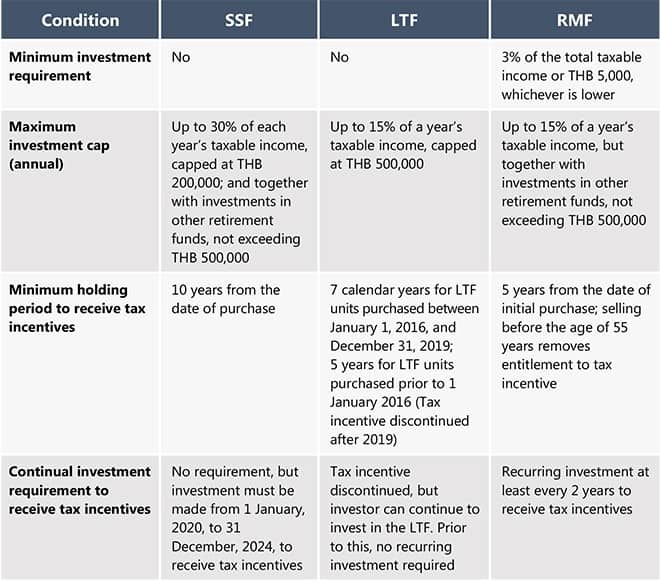
  • In any tax year, a taxpayer may not make SSF investments in excess of 30% of their total taxable income for that year, capped at THB 200,000.
  • The taxpayer’s total SSF, Provident Fund, Government Pension Fund, Private Teacher Aid Fund, Retirement Mutual Fund (RMF), Annuity Insurance Premium, and National Savings Fund investments and contributions must not exceed THB 500,000 in a single tax year.
  • Taxpayers may invest in an SSF from January 1, 2020, to December 31, 2024 (5 years). There is no requirement for continual purchase of SSF units, unlike the rules for LTF or RMF investments. Taxpayers are eligible to receive tax incentives in any year that they invest in an SSF.
  • There is no restriction on the holding period for SSF units. However, to enjoy tax benefits, the taxpayer must hold SSF units for a continual period of not less than 10 years from the date of purchase (except where the taxpayer becomes incompetent or deceased). If a taxpayer sells the SSF units before 10 years have elapsed, they will have to file an amended personal income tax return for the period that the tax exemption was claimed and pay additional tax with a surcharge of 1.5% per month (capped at the additional tax payment amount). Capital gains derived from the sale of SSF units will also be subject to tax in the year that they are sold.
  • The taxpayer must retain the certificate of investment in the SSF issued by the asset management company to support the tax exemption.
  • The taxpayer may transfer an investment in one SSF to another SSF. The transfer must be made within five working days of the SSF receiving an order to transfer from the taxpayer; otherwise, the investment period of 10 years will not be continued.

The major differences in the tax incentive conditions of SSF, LTF, and RMF investments are summarized in the table below.
RELATED INSIGHTS​ 

February 2, 2021
The Royal Decree on Land and Building Tax Reduction (No. 2) B.E. 2564, which we previously noted was under consideration, has been officially promulgated. The royal decree, which was announced and published in Thailand’s Government Gazette on January 31, 2021, and came into effect the following day, will effectively reduce land and building tax payments by 90% in 2021 for the following types of land and buildings: Land or buildings used for agricultural purposes; Land or buildings used for residential purposes; Land or buildings used for other purposes; and Vacant or unused land or buildings. Owners of the above types of land or buildings are therefore only required to pay 10% of the land and building tax normally owed for 2021. The royal decree follows the Ministry of Interior’s recent announcement of an extension for the payment of land and building tax in 2021, which will now be due by June 30, 2021 (extended from April 30, 2021). For more details on these measures, or on any aspect relating to Thailand’s land and building tax, please contact Chaiwat Keratisuthisathorn at [email protected] or +66 2056 5507.
January 27, 2021
In 2019, Thailand introduced an online system for payment of stamp duty (e-Stamp Duty) and a requirement for e-Stamp Duty to be paid on the following five instruments when executed electronically (e-Instruments): hire of work service instrument; loan instrument or bank overdraft instrument; powers of attorney (POA); proxy letters for voting at company meetings; and guarantee instrument. However, given the strict financial penalties on those who fail to pay stamp duty, the government implemented a grace period until December 31, 2020, to allow people to become familiar with the e-Stamp Duty system before the requirement is strictly enforced. During the grace period, taxpayers could pay stamp duty for the five e-Instruments at an area revenue office, rather than via the e-Stamp Duty system, and could also pay stamp duty for traditional paper versions of those five instruments through the e-Stamp Duty system. On January 19, 2021, the Revenue Department issued Notifications of the Director-General of Revenue Re: Stamp Duty (Nos. 61 and 62) B.E. 2564 (2021) further extending that grace period until December 31, 2021. The following table summarizes the revised methods of stamp duty payments available for the five instrument categories mentioned above under the new notifications. The e-Stamp Duty system allows taxpayers to pay stamp duty online by filing the prescribed form (Form Or.Sor.9) through (i) the website of the Revenue Department (www.rd.go.th), or (ii) the Application Programming Interface (API) of the Revenue Department before or within 15 days from the date of instrument execution. Taxpayers can currently file a request to pay for e-Stamp Duty no earlier than 30 days before the date of instrument execution. Taxpayers should note that the e-Stamp Duty system does not currently support late payment. Therefore, late filing and stamp duty payments will have to be made at an area revenue
January 22, 2021
The renewed spread of COVID-19 in Thailand since December 2020 has led to additional tax relief measures to lessen the economic impact of the outbreak. Most recently, it has prompted the Ministry of Finance to propose a draft Royal Decree on Land and Building Tax Reduction B.E. 2564 (2021), which is expected to be similar to the 2020 measures that reduced land and building tax payments by 90 percent. In the meantime, on January 21, 2020, the Ministry of Interior announced an extension for the payment of land and building tax in 2021, which is now due by June 30, 2021 (extended from April 30, 2021). In light of the new land and building tax payment deadline for 2021, the Bangkok Metropolitan Administration, or the relevant municipality or local administrative office, will now send land and building tax assessment forms to taxpayers by April 30, 2021 (extended from February 28, 2021). For more details on these measures, or on any aspect of Thailand’s land and building tax, please contact Chaiwat Keratisuthisathorn at [email protected] or +66 2056 5507.
January 8, 2021
At a meeting on December 21, 2020, the Thai Board of Investment (BOI) approved a series of stimulus packages aimed at encouraging local and foreign investment, as the government seeks to boost Thailand’s economic recovery from the COVID-19 pandemic. The additional investment incentives, which will be promoted by the BOI in the upcoming year, include a number of sector- and project-specific stimulus measures.   Additional Tax Incentives for Large-Scale Projects Projects in target industries with investment of at least THB 1 billion (approx. USD 33 million) over a 12-month period, starting from the issuance of the BOI promotion certificate, will be entitled to an additional 50% corporate income tax (CIT) deduction for a period of five years, calculated on top of the standard 5–8 year CIT exemptions offered under the normal BOI tax-incentive scheme. To obtain this special tax incentive, eligible projects may apply to the BOI from January 4 to December 30, 2021.   Stimulus Package for Digital Economy and Software Industry Projects that support digital technology adoption, such as software integration, artificial intelligence, machine learning, or big data analytics, may benefit from 50% CIT exemptions on profits generated from their existing BOI projects for an additional three years. Applications for the exemption must be submitted by the end of 2022.   Application Deadline Extensions for Special Economic Zones and Five Southern Provinces Measures relating to special economic zones cover more than 300 investment promotion categories, with both tax and non-tax incentives, including an additional tax incentive for target industries such as textiles, agriculture, home furniture, jewelry, and others. These incentives are available to projects located in the border areas of Thailand (i.e., the 10 special economic zones in the provinces of Chiang Rai, Kanchanaburi, Mukdahan, Nakhon Phanom, Narathiwat, Nong Khai, Sa Kaeo, Songkhla, Tak, and Trat), with the