
You are using an outdated browser and your browsing experience will not be optimal. Please update to the latest version of Microsoft Edge, Google Chrome or Mozilla Firefox. Install Microsoft Edge

March 24, 2020

Tax Incentives for Investment in Thailand’s Super Savings Fund Scheme

On March 13, 2020, the Revenue Department of Thailand issued Notification of the Director General of Revenue Concerning Income Tax (No. 369) Re: Criteria, Methods and Conditions for Income Tax Exemption on the Purchase of Investment Units of Super Savings Funds (SSFs).

The tax incentives for investment in SSFs are intended as a substitute for the tax incentives for investment in Long-Term Equity Funds (LTFs), which were discontinued at the end of last year. The criteria and conditions for tax exemption under the SSF scheme are summarized below:

  • In any tax year, a taxpayer may not make SSF investments in excess of 30% of their total taxable income for that year, capped at THB 200,000.
  • The taxpayer’s total SSF, Provident Fund, Government Pension Fund, Private Teacher Aid Fund, Retirement Mutual Fund (RMF), Annuity Insurance Premium, and National Savings Fund investments and contributions must not exceed THB 500,000 in a single tax year.
  • Taxpayers may invest in an SSF from January 1, 2020, to December 31, 2024 (5 years). There is no requirement for continual purchase of SSF units, unlike the rules for LTF or RMF investments. Taxpayers are eligible to receive tax incentives in any year that they invest in an SSF.
  • There is no restriction on the holding period for SSF units. However, to enjoy tax benefits, the taxpayer must hold SSF units for a continual period of not less than 10 years from the date of purchase (except where the taxpayer becomes incompetent or deceased). If a taxpayer sells the SSF units before 10 years have elapsed, they will have to file an amended personal income tax return for the period that the tax exemption was claimed and pay additional tax with a surcharge of 1.5% per month (capped at the additional tax payment amount). Capital gains derived from the sale of SSF units will also be subject to tax in the year that they are sold.
  • The taxpayer must retain the certificate of investment in the SSF issued by the asset management company to support the tax exemption.
  • The taxpayer may transfer an investment in one SSF to another SSF. The transfer must be made within five working days of the SSF receiving an order to transfer from the taxpayer; otherwise, the investment period of 10 years will not be continued.

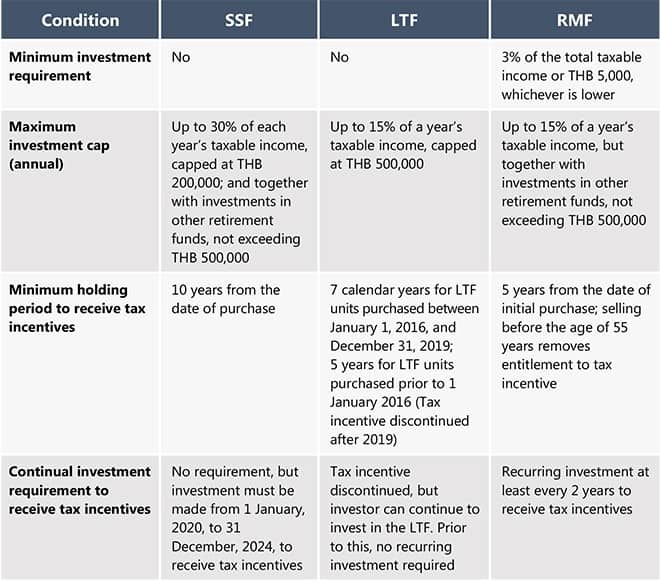
The major differences in the tax incentive conditions of SSF, LTF, and RMF investments are summarized in the table below.
RELATED INSIGHTS​ 

March 8, 2022
On February 15, 2022, Thailand’s cabinet approved in principle a package of incentives to promote electric vehicle (EV) adoption in Thailand, with the aim of making the country an EV manufacturing hub in Asia. A week later, the cabinet approved further draft regulations including specific information on customs duty reductions and exemptions for certain types of imported EVs. The plan includes both tax and non-tax incentives from 2022 until 2025. In the first two years (2022–2023), the package incentivizes the widespread use of EVs in Thailand by providing exemption or reduction of import duties and excise tax, as well as subsidies to increase the demand for EVs and attract investment in the EV industry. These incentives will cover the importation of completely built up (CBU) cars and motorcycles, and the local manufacturing of completely knocked down (CKD) vehicles in Thailand. For the following two years (2024–2025), the plan promotes the use of domestically produced EVs by eliminating the exemption or reduction of import duties for CBU vehicles while maintaining the other incentives (e.g., reduced excise tax rates, and subsidies). The aim of this is to make the cost of CBU vehicles higher than locally produced vehicles to encourage operators to produce EVs in the country to meet increasing demand. Additional measures encourage the manufacturing of EVs in Thailand, including exemption of import duties for parts imported between 2022 and 2025, and treatment of the value of imported battery cells as a cost of local manufacturing (up to 15% of an EV’s retail price). This is beneficial to local manufacturers of EVs, as their activities will be entitled to a more generous incentive package than importation of EVs. At their meeting on February 22, 2022, Thailand’s cabinet further approved draft subordinate regulations, including specific reductions and exemptions of customs duty
January 28, 2022
On January 28, 2022, the government of Vietnam issued Decree No. 15/2022/ND-CP guiding the tax reduction and exemption policies to support post-pandemic recovery (Decree 15). Decree 15 was issued to implement the National Assembly’s Resolution No. 43/2022/QH15 dated January 11, 2022, on fiscal and monetary policies for the recovery of the national economy from the complications of the ongoing COVID-19 pandemic. Notably, Decree 15 sets out tax relief for value-added tax (VAT) and corporate income tax (CIT). Various kinds of goods and services will be entitled to a reduced VAT rate of 8% (instead of the current 10%) for the period from February 1 until December 31, 2022. The reduction is applicable for both methods of VAT payment (i.e., the deduction method and the direct method). It is worth noting, however, that telecom services, banking and financial services, real estate business, as well as goods and services subject to special consumption tax are not eligible for this relief measure. Details of the goods and services which are not entitled to VAT rate reduction are listed in the appendices attached to Decree 15. With regard to CIT, grants and donations of enterprises and organizations to COVID-19 control operations in Vietnam will be deducted from taxable income when calculating the CIT of the tax period of 2022. The amount of grants or donations must be confirmed in writing (including via electronic means) by the receiving authority or agency. Decree 15 takes effect on February 1, 2022. It should be noted that there may be further guiding circulars after the enactment of the decree. Therefore, it is recommended that businesses keep a close watch on any further implementing guidance of Decree 15.
December 31, 2021
In the last week of December, 2021, the Ministry of Justice published the Law Amending Certain Provisions of the Laws on Tax No. 01/NA, dated August 7, 2021, in the Government Gazette. The Law will come into force on January 1, 2022. The most notable amendments relate to Value Added Tax (VAT), which are summarized below. The new law also makes changes to the laws on tax management, income tax, and excise tax, which Tilleke & Gibbins will provide updates on in due course.