
You are using an outdated browser and your browsing experience will not be optimal. Please update to the latest version of Microsoft Edge, Google Chrome or Mozilla Firefox. Install Microsoft Edge

December 6, 2018

Successful Online-to-Offline Enforcement Action Leads to Huge Seizure of Counterfeits

Informed Counsel

The ease with which counterfeiters are able to hide their identity online, simply by hiding behind a username, can often complicate the protection of IP rights. However, if an infringer’s anonymity can be pierced, it can yield huge seizures of counterfeit products, make great strides in protecting valuable intellectual assets, and close major distribution channels.

In a recent example, Panasonic Corporation successfully uncovered the identity of a Chinese infringer operating in Thailand, raided the infringer’s physical location, and seized more than 30,000 counterfeit Panasonic products (primarily bat- teries). The raid has had a deep impact on the market, disrupting the distribution channels for these counterfeit goods, removing the fake goods from online marketplaces, and protecting the Thai public from dangerous counterfeit goods.

Identifying the Online Infringers

Many e-commerce websites are open to anyone wanting to sell their goods, creating a platform for fake goods to be easily offered for sale by infringers. Using anonymous usernames, infringers can create store pages containing enticing and convincing statements, luring end-users into believing that the cheaper goods are genuine.
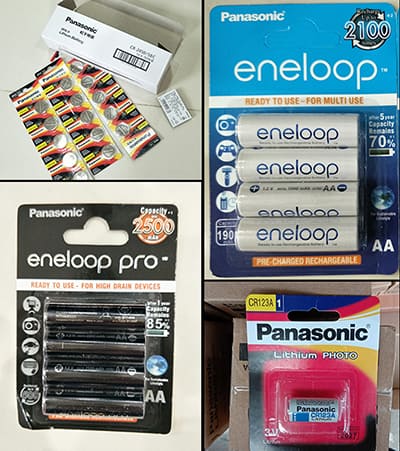
In this case, three such pages were found to be selling counterfeit Panasonic batteries on one of Thailand’s most popular online marketplaces. After contacting the online marketplace operators to request that the advertisements be taken down, two pages closed but one remained active.

An in-depth private investigation into the remaining online shop uncovered that all three pages were owned by the same entity—a Chinese national with two houses in Bangkok, from which he actively sold various types of fake Panasonic batteries in large quantities.

Warning Letter vs. Raid Action   

Sending a warning letter is usually the preferred enforce- ment action against small-scale online infringers. If the dispute can be settled after sending the warning letter, this option is more time- and cost-efficient than other legal actions.    

However, infringers with large inventories may be less receptive to this approach, either ignoring warning letters entirely, or only ceasing sales temporarily. Either way, infringers with large inventories are very likely to continue sales eventually, as they need to clear out their stock.   

In addition, attempts to negotiate with foreign nationals operating in Thailand often backfire, as they are not usually permanently established in Thailand. It is common for such infringers to simply move to another location upon receipt of a warning letter.   

In this instance the targeted infringer clearly had a large stock, was a foreign national, and was quite cautious in his activities, using the marketplace platform to hide his identity and not disclosing his name on his shop pages. A warning letter was therefore considered to pose a high risk, and a strong raid action against the target in order to seize the fake goods was considered a better solution. In addition, such action would penalize the infringers and spread the message that Panasonic takes serious legal action against infringers in order to protect its consumers.    

A criminal raid action was therefore initiated at the identified houses in order to seize the products.

Search and Seizure    

Based on investigation reports, strong evidence, and coordination with a police raid team, the court granted search warrants to gain entry to the suspect’s houses. No counterfeit Panasonic products were found at the first house, although other branded mobile phone chargers, earphones, mobile phone holders, and various unbranded products were on site. The police seized those goods for non-payment of import taxes.
The suspect and one of his staff (a Thai citizen) were found inside the second house, and they granted entry when presented with the search warrant. The search confirmed that the residential property was being used as a warehouse for commercial purposes. Batteries, chargers, watches, and other products were stored in every room, including the living room, kitchen, bedrooms, and even bathrooms. A large number of fake Panasonic products were found, along with other branded products.    

The police seized more than 30,000 counterfeit Panasonic products, including stickers labeled “Panasonic” that were obviously going to be attached to infringing products before sale. 

Arresting the Counterfeiters

The police filed charges of trademark infringement and importation tax evasion under the Customs Act against both people found in the house. In respect of the stickers labelled “Panasonic,” intended to convince the public that counterfeit goods were genuine Panasonic goods, the infringers were charged with using a mark without authorization in order to mislead the public, under the Thai Penal Code. In addition, the foreign national was charged with working without a work permit under Thailand’s immigration regime.   

This successful raid action prevented the distribution of fake goods to end-users, and will serve as a deterrent to other potential infringers in the market in accordance with Panasonic’s anticounterfeiting and customer protection policies.    

This raid is a prime example of the level of commitment necessary in order to protect Thai consumers from dangerous counterfeit products. Actions like these are rarely a one-off, and typically form part of a broader anticounterfeiting campaign. In that context, raids can also help to identify the sources of fake batteries being distributed in Thailand, and ultimately eliminate the counterfeit products once and for all.

RELATED INSIGHTS​ 

February 23, 2025
On January 6, 2025, the government of Vietnam issued Decree No. 05/2025/ND-CP amending and supplementing Decree No. 08/2022/ND-CP detailing the Law on Environmental Protection (“Decree 05”). Decree 05 came into effect immediately upon issuance and provides several changes to the regulations governing extended producer responsibility (“EPR”) for applicable manufacturers and importers, outlining their obligations concerning the recycling and treatment of discarded products and packages. (See our previous article on Vietnam’s EPR regulations here.) Outlined below are some critical amendments in Decree 05. Entities Subject to EPR Regulations Previously, Decree 08 limited the responsibility for recycling to manufacturers and importers of products and packaging specified in statutory lists. Decree 05 expands this scope by also including entities responsible for the quality and labeling of the regulated products and goods in Vietnam. Decree 05 inherits the regulations from Decree 08 that manufacturers and importers, if they produce and import products and packaging as stipulated by law, must fulfill their responsibility to recycle or support waste treatment activities. However, Decree 05 amends the lists of products/packaging that must be recycled or undergo waste treatment, and new products/packaging and recycling methods. Notably, rechargeable batteries (including those used in vehicles or for electrical and electronic devices) have been added to the list of regulated products and self-propelled vehicles and construction machinery have been removed from the list. Decree 05 also not only streamlines the recycling methods required for each type of product/packaging, but also removes the minimum requirement on the mass of products/packaging that must be recovered when recycling. Manufacturers and importers now have more flexibility in selecting recycling methods that are more suitable for actual recycling conditions in Vietnam. Decree 05 has revised the cases of exemption from recycling and waste treatment obligations, clarifying that both packaging manufacturers and importers with annual product
November 18, 2024
A new notification on required labeling and packaging for alcoholic beverages was published in Thailand’s Government Gazette on November 8, 2024, taking full effect the following day. The notification (Notification of the Alcoholic Beverage Control Committee Re: Criteria, Methods, and Conditions for Packaging of Alcoholic Beverages and Warning Statements of Alcoholic Beverages Both Produced Domestically and Imported into Thailand 2024) essentially reaffirms a mandatory requirement for packaging and warning statements for alcoholic beverages, which echoes existing regulations from 2009 and 2017. Under the authority of the Alcoholic Beverage Control Act B.E. 2551 (2008) (ABCA), the notification reinforces the Alcoholic Beverage Control Committee’s objective of promoting consumer awareness through standardized warning labels. The notification addresses the following key aspects: Packaging definitions. The notification defines packing-related terms for the first time under the ABCA. These terms include (1) packaging, (2) containers (also known as primary packaging), and (3) outer packaging (secondary packaging). Packaging requirements. Containers for alcoholic beverages produced or imported for sale in Thailand must be at least 0.175 liters each. Warning statements. Although alcoholic beverages are classified as food under the Food Act B.E. 2522 (1979), the notification exempts alcoholic beverages from general food labeling requirements prescribed in the Food Act. Instead, it mandates that the following warning statements be prominently displayed: Sale of liquor to persons under 20 years old is prohibited; Drinking reduces driving ability; and Not suitable for persons under 20 years old. Format. The notification specifies that these warning statements must be written in Thai, in bold characters, with a minimum type size of five millimeters. The warning must be enclosed in a box that contrasts with the label background and surrounding content. Exemptions. Certain products, such as alcoholic beverages imported as samples or otherwise not intended for commercial sale, are exempt from the warning
November 1, 2024
Tilleke & Gibbins has contributed the Thailand chapter to Franchise 2025 from the International Comparative Legal Guides (ICLG) series published by Global Legal Group. This comprehensive guide provides detailed analysis of franchise laws and regulations across multiple jurisdictions worldwide. Each chapter of the guide follows a Q&A format, organized into key sections covering critical aspects of franchise law and operations, including: Relevant legislation and rules governing franchise transactions Business organization options for franchised operations Competition law considerations Protection of intellectual property and brands Liability issues and risk mitigation Governing law and dispute resolution Real estate matters Online trading regulations Termination requirements Joint employer risks and vicarious liability Currency controls and taxation Commercial agency considerations Good faith obligations and fair dealing requirements Ongoing relationship management Franchise renewal processes Franchise migration procedures Electronic signatures and document retention The Thailand chapter, authored by Alan Adcock and Kasama Sriwatanakul, examines these topics in detail, with particular attention to recent developments like the Trade Competition Commission’s Franchising Guidelines which introduced new disclosure requirements and protections for franchisees. The complete Thailand chapter is available as a PDF below. The Thailand chapter—and the full Franchise 2025 guide—are also freely available on the ICLG website.
October 8, 2024
Thailand’s Electronic Transactions Development Agency (ETDA) issued guidelines for managing advertisements on digital platform services (DPSs) earlier this year. These guidelines aim to prevent fraud, illegal product or service offerings, and inducements to commit illegal acts, and are likely to provide a basis for greater regulation of this issue in the future. Key obligations for DPS business operators under the guidelines are detailed below. Advertiser Screening and Data Collection Verification and collection: Business operators must establish processes for verifying and collecting advertiser data. This includes steps, methods, and required information for advertiser registration. Identity verification: Business operators should follow identity verification requirements for advertiser registration. This may include using identity verification results from other identity providers or conducting their own identity verification processes with a minimum identity assurance level (IAL) of IAL2. Data storage: Advertiser data must be stored in a machine-readable format. Business operators must maintain records for watchlists, blacklists, and whitelists. Prepublication Advertisement Review Review process: Business operators should review advertisements before publication. This review should consider factors such as prohibited or restricted advertisements, required permissions, and avoiding sensitive user data. Postpublication Monitoring Advertisement monitoring: Business operators must monitor published advertisements using automated systems, staff, or contracted personnel. Criteria for prioritizing reviews should be established. Reporting channels: Business operators must provide channels for users to report illegal or inappropriate advertisements. Reports must be promptly addressed, prioritizing cases involving intellectual property owners or multiple credible reports. Advertiser account monitoring: Business operators must monitor advertiser accounts. This includes considering factors such as the number of reports/flags received and compliance with service agreements and community standards. For more information on this initiative from the ETDA, or on any aspect related to Thailand’s regulations for DPSs, please contact Athistha (Nop) Chitranukroh at [email protected], Thammapas Chanpanich at [email protected], Pornpan Wichawut at [email protected],