
You are using an outdated browser and your browsing experience will not be optimal. Please update to the latest version of Microsoft Edge, Google Chrome or Mozilla Firefox. Install Microsoft Edge

December 6, 2018

Successful Online-to-Offline Enforcement Action Leads to Huge Seizure of Counterfeits

Informed Counsel

The ease with which counterfeiters are able to hide their identity online, simply by hiding behind a username, can often complicate the protection of IP rights. However, if an infringer’s anonymity can be pierced, it can yield huge seizures of counterfeit products, make great strides in protecting valuable intellectual assets, and close major distribution channels.

In a recent example, Panasonic Corporation successfully uncovered the identity of a Chinese infringer operating in Thailand, raided the infringer’s physical location, and seized more than 30,000 counterfeit Panasonic products (primarily bat- teries). The raid has had a deep impact on the market, disrupting the distribution channels for these counterfeit goods, removing the fake goods from online marketplaces, and protecting the Thai public from dangerous counterfeit goods.

Identifying the Online Infringers

Many e-commerce websites are open to anyone wanting to sell their goods, creating a platform for fake goods to be easily offered for sale by infringers. Using anonymous usernames, infringers can create store pages containing enticing and convincing statements, luring end-users into believing that the cheaper goods are genuine.
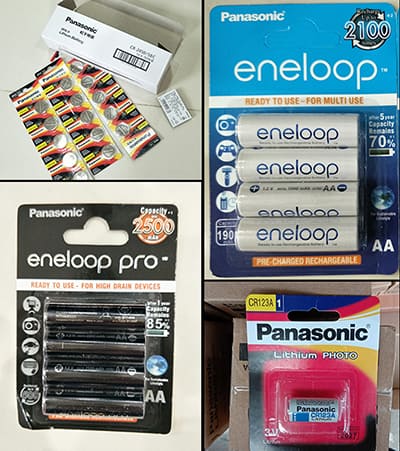
In this case, three such pages were found to be selling counterfeit Panasonic batteries on one of Thailand’s most popular online marketplaces. After contacting the online marketplace operators to request that the advertisements be taken down, two pages closed but one remained active.

An in-depth private investigation into the remaining online shop uncovered that all three pages were owned by the same entity—a Chinese national with two houses in Bangkok, from which he actively sold various types of fake Panasonic batteries in large quantities.

Warning Letter vs. Raid Action   

Sending a warning letter is usually the preferred enforce- ment action against small-scale online infringers. If the dispute can be settled after sending the warning letter, this option is more time- and cost-efficient than other legal actions.    

However, infringers with large inventories may be less receptive to this approach, either ignoring warning letters entirely, or only ceasing sales temporarily. Either way, infringers with large inventories are very likely to continue sales eventually, as they need to clear out their stock.   

In addition, attempts to negotiate with foreign nationals operating in Thailand often backfire, as they are not usually permanently established in Thailand. It is common for such infringers to simply move to another location upon receipt of a warning letter.   

In this instance the targeted infringer clearly had a large stock, was a foreign national, and was quite cautious in his activities, using the marketplace platform to hide his identity and not disclosing his name on his shop pages. A warning letter was therefore considered to pose a high risk, and a strong raid action against the target in order to seize the fake goods was considered a better solution. In addition, such action would penalize the infringers and spread the message that Panasonic takes serious legal action against infringers in order to protect its consumers.    

A criminal raid action was therefore initiated at the identified houses in order to seize the products.

Search and Seizure    

Based on investigation reports, strong evidence, and coordination with a police raid team, the court granted search warrants to gain entry to the suspect’s houses. No counterfeit Panasonic products were found at the first house, although other branded mobile phone chargers, earphones, mobile phone holders, and various unbranded products were on site. The police seized those goods for non-payment of import taxes.
The suspect and one of his staff (a Thai citizen) were found inside the second house, and they granted entry when presented with the search warrant. The search confirmed that the residential property was being used as a warehouse for commercial purposes. Batteries, chargers, watches, and other products were stored in every room, including the living room, kitchen, bedrooms, and even bathrooms. A large number of fake Panasonic products were found, along with other branded products.    

The police seized more than 30,000 counterfeit Panasonic products, including stickers labeled “Panasonic” that were obviously going to be attached to infringing products before sale. 

Arresting the Counterfeiters

The police filed charges of trademark infringement and importation tax evasion under the Customs Act against both people found in the house. In respect of the stickers labelled “Panasonic,” intended to convince the public that counterfeit goods were genuine Panasonic goods, the infringers were charged with using a mark without authorization in order to mislead the public, under the Thai Penal Code. In addition, the foreign national was charged with working without a work permit under Thailand’s immigration regime.   

This successful raid action prevented the distribution of fake goods to end-users, and will serve as a deterrent to other potential infringers in the market in accordance with Panasonic’s anticounterfeiting and customer protection policies.    

This raid is a prime example of the level of commitment necessary in order to protect Thai consumers from dangerous counterfeit products. Actions like these are rarely a one-off, and typically form part of a broader anticounterfeiting campaign. In that context, raids can also help to identify the sources of fake batteries being distributed in Thailand, and ultimately eliminate the counterfeit products once and for all.

RELATED INSIGHTS​ 

December 30, 2025
On December 17, 2025, Laos’ Ministry of Industry and Commerce (MOIC) issued a notice introducing a new digital system that allows e-commerce businesses to obtain required certificates and licenses through an online, application-based platform. Notice No. 3988, which will take effect on February 1, 2026, introduces the E-Trust platform, a downloadable application that allows e-commerce businesses to remotely obtain acknowledgement certificates and business operating licenses. New Digital Registration Options Under the previous framework established by the Decree on E-commerce (2021), businesses were required to complete registration exclusively through paper-based submissions. The new system now offers businesses two registration options: Traditional paper-based process at the Division of E-commerce Management within the MOIC; or Electronic registration and renewal through the E-Trust platform. This change is expected to streamline procedures, reduce administrative burdens, and enhance accessibility for businesses operating outside Vientiane. The E-Trust platform facilitates compliance for both individuals and legal entities required to submit applications and renewals for required certificates and licenses. The development is particularly beneficial for businesses located in remote provinces, as it eliminates the need for physical travel and significantly accelerates processing times. Compliance Requirements and Penalties Businesses must obtain or renew the required certificates and licenses to avoid sanctions under the Decision on Fines and Other Measures for Violation of the Decree and Regulations on E-commerce (No. 2828/MOIC, dated November 11, 2025). Penalties for noncompliance may include monetary fines and other enforcement measures.
December 5, 2025
One morning, a California-based company mapping its Southeast Asia rollout opened an unexpected cease-and-desist letter from a Vietnamese IP firm. To the company’s surprise, the letter asserted that a local client already owned the company’s brand in Vietnam and threatened legal action. This is not an isolated incident. In another recent matter in the sports industry, a squatter demanded at least USD 48,000 from our client to “resolve” a similar conflict. For brands entering Vietnam or expanding distribution there, these tactics can create acute risk at precisely the point at which market momentum is building. Vietnam’s rapid economic growth and deepening integration into global trade have made it an increasingly attractive destination for multinational brands. Those same dynamics have intensified a longstanding issue: trademark squatting. Vietnam has modernized its IP framework over the past decade, but its strict first-to-file trademark system continues to incentivize opportunistic filings by parties with no legitimate interest in a mark. As more foreign brands build their reputation abroad before turning to Vietnam, squatters remain alert to timing gaps and enforcement frictions. The First-to-File System: Advantages and Vulnerabilities Vietnam adheres closely to the first-to-file principle under its Law on Intellectual Property. In practice, exclusive trademark rights belong to whoever submits the earliest valid application to the Vietnam Intellectual Property Office, regardless of prior use in Vietnam. This approach offers administrative clarity and reduces evidentiary burdens compared to use-based jurisdictions. Yet it also creates fertile conditions for squatting. Bad-faith actors regularly monitor foreign markets, identify brands gaining traction, and move quickly to register those marks domestically, often long before the genuine owner enters the market or prioritizes local filings. By the time the true brand seeks protection, the squatter’s application (or registration) stands as a legal obstacle, pushing businesses toward costly oppositions, cancellations, or uncomfortable negotiations
November 26, 2025
On November 21, 2025, Myanmar’s Ministry of Commerce (MOC) issued Notification No. 103/2025 promulgating the Geographical Indication Rules (GI Rules), establishing a comprehensive framework for the registration and administration of geographical indications (GI), which are primarily governed by the Trademark Law of 2019. On the same day, the MOC released Notification No. 104/2025 specifying the required forms for GI-related matters. The GI Rules establish a comprehensive set of procedures for the entire GI application process, including filing applications, oppositions, cancellations, and invalidations, and appointing a local representative for GI-related matters. Under the Trademark Law and the GI Rules, domestic and foreign legal entities (organizations) that formally represent a defined group of stakeholders (such as producers or manufacturers of natural products or resources, agricultural products, handicrafts, or industrial products) and other competent authorities from government departments are eligible to apply for GI registration with the Intellectual Property Department (IPD) in Myanmar. Application A GI application can be submitted in either English or Myanmar language electronically, in person, or via post. Foreign applicants seeking to register a GI in Myanmar are required to submit a copy of the registration certificate from their country of origin with the GI application. This certificate must explicitly state the GI name of the protected product. Notably, foreign applicants are mandated to appoint a local representative in Myanmar to act on their behalf for GI-related matters with the IPD and appeal-related matters with the IP Agency. The form for appointing the local representative must be duly notarized in the applicant’s home country to ensure its legal validity and acceptance in accordance with the GI Rules. Application for Use of GI Logo Pursuant to the GI Rules, any interested individual, local or foreign, may submit an application to the IPD for authorization to use the GI logo,
November 13, 2025
Tilleke & Gibbins has contributed the Thailand chapter to Franchise 2026, part of the International Comparative Legal Guides (ICLG) series published by Global Legal Group. This annual guide offers comparative analysis of franchise laws and regulations across jurisdictions worldwide, providing practical insights for businesses and legal practitioners operating in the global franchise sector. Each country chapter in the 12th edition follows a Q&A format covering key aspects of franchise law and operations, including: Relevant legislation and rules governing franchise transactions Business organization options for franchised operations Competition law considerations Protection of intellectual property and brands Liability issues and risk mitigation Governing law and dispute resolution Real estate matters Online trading regulations Termination requirements Joint employer risks and vicarious liability Currency controls and taxation Commercial agency considerations Good faith obligations and fair dealing requirements Ongoing relationship management Franchise renewal processes Franchise migration procedures Sustainability commitments Electronic signatures and document retention Current developments in the franchise sector The Thailand chapter, authored by Alan Adcock and Kasama Sriwatanakul, provides an in-depth overview of the legal landscape for franchising and franchising-related activities in Thailand. The complete Thailand chapter is available as a PDF below. The Thailand chapter—and the full Franchise 2026 guide—are also freely available on the ICLG website.