
You are using an outdated browser and your browsing experience will not be optimal. Please update to the latest version of Microsoft Edge, Google Chrome or Mozilla Firefox. Install Microsoft Edge

December 6, 2018

Successful Online-to-Offline Enforcement Action Leads to Huge Seizure of Counterfeits

Informed Counsel

The ease with which counterfeiters are able to hide their identity online, simply by hiding behind a username, can often complicate the protection of IP rights. However, if an infringer’s anonymity can be pierced, it can yield huge seizures of counterfeit products, make great strides in protecting valuable intellectual assets, and close major distribution channels.

In a recent example, Panasonic Corporation successfully uncovered the identity of a Chinese infringer operating in Thailand, raided the infringer’s physical location, and seized more than 30,000 counterfeit Panasonic products (primarily bat- teries). The raid has had a deep impact on the market, disrupting the distribution channels for these counterfeit goods, removing the fake goods from online marketplaces, and protecting the Thai public from dangerous counterfeit goods.

Identifying the Online Infringers

Many e-commerce websites are open to anyone wanting to sell their goods, creating a platform for fake goods to be easily offered for sale by infringers. Using anonymous usernames, infringers can create store pages containing enticing and convincing statements, luring end-users into believing that the cheaper goods are genuine.
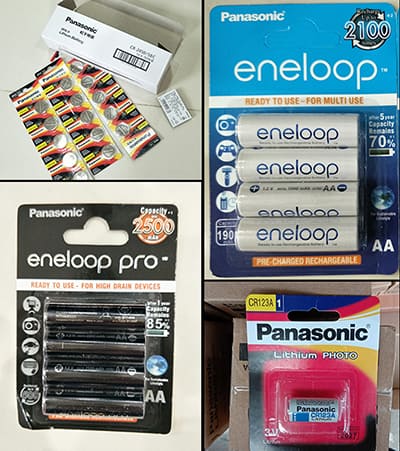
In this case, three such pages were found to be selling counterfeit Panasonic batteries on one of Thailand’s most popular online marketplaces. After contacting the online marketplace operators to request that the advertisements be taken down, two pages closed but one remained active.

An in-depth private investigation into the remaining online shop uncovered that all three pages were owned by the same entity—a Chinese national with two houses in Bangkok, from which he actively sold various types of fake Panasonic batteries in large quantities.

Warning Letter vs. Raid Action   

Sending a warning letter is usually the preferred enforce- ment action against small-scale online infringers. If the dispute can be settled after sending the warning letter, this option is more time- and cost-efficient than other legal actions.    

However, infringers with large inventories may be less receptive to this approach, either ignoring warning letters entirely, or only ceasing sales temporarily. Either way, infringers with large inventories are very likely to continue sales eventually, as they need to clear out their stock.   

In addition, attempts to negotiate with foreign nationals operating in Thailand often backfire, as they are not usually permanently established in Thailand. It is common for such infringers to simply move to another location upon receipt of a warning letter.   

In this instance the targeted infringer clearly had a large stock, was a foreign national, and was quite cautious in his activities, using the marketplace platform to hide his identity and not disclosing his name on his shop pages. A warning letter was therefore considered to pose a high risk, and a strong raid action against the target in order to seize the fake goods was considered a better solution. In addition, such action would penalize the infringers and spread the message that Panasonic takes serious legal action against infringers in order to protect its consumers.    

A criminal raid action was therefore initiated at the identified houses in order to seize the products.

Search and Seizure    

Based on investigation reports, strong evidence, and coordination with a police raid team, the court granted search warrants to gain entry to the suspect’s houses. No counterfeit Panasonic products were found at the first house, although other branded mobile phone chargers, earphones, mobile phone holders, and various unbranded products were on site. The police seized those goods for non-payment of import taxes.
The suspect and one of his staff (a Thai citizen) were found inside the second house, and they granted entry when presented with the search warrant. The search confirmed that the residential property was being used as a warehouse for commercial purposes. Batteries, chargers, watches, and other products were stored in every room, including the living room, kitchen, bedrooms, and even bathrooms. A large number of fake Panasonic products were found, along with other branded products.    

The police seized more than 30,000 counterfeit Panasonic products, including stickers labeled “Panasonic” that were obviously going to be attached to infringing products before sale. 

Arresting the Counterfeiters

The police filed charges of trademark infringement and importation tax evasion under the Customs Act against both people found in the house. In respect of the stickers labelled “Panasonic,” intended to convince the public that counterfeit goods were genuine Panasonic goods, the infringers were charged with using a mark without authorization in order to mislead the public, under the Thai Penal Code. In addition, the foreign national was charged with working without a work permit under Thailand’s immigration regime.   

This successful raid action prevented the distribution of fake goods to end-users, and will serve as a deterrent to other potential infringers in the market in accordance with Panasonic’s anticounterfeiting and customer protection policies.    

This raid is a prime example of the level of commitment necessary in order to protect Thai consumers from dangerous counterfeit products. Actions like these are rarely a one-off, and typically form part of a broader anticounterfeiting campaign. In that context, raids can also help to identify the sources of fake batteries being distributed in Thailand, and ultimately eliminate the counterfeit products once and for all.

RELATED INSIGHTS​ 

April 19, 2021
Thailand has made significant changes to its statutory interest rate framework for the first time in almost a century. Since 1925, the statutory interest rate codified in Thailand’s Civil and Commercial Code (the CCC) has remained at 7.5% per year. But with Covid-19 having an unprecedented impact on the Thai economy, the Thai Government, via emergency decree, has reduced the statutory rate. While the decree is largely aimed at providing relief to hard-hit SMEs and individual debtors, the amendments have broader implications for doing business in Thailand. Main Changes The new interest rate revisions are contained within the Emergency Decree Amending the Civil and Commercial Code B.E. 2564 (2021) (the Emergency Decree), which was published in the Government Gazette on April 10, 2021 and came into effect on April 11, 2021. The Emergency Decree amends Sections 7 and 224 of the CCC, which stated the previous statutory interest rate of 7.5% per year. The Emergency Decree makes three major changes. The first involves a reduction of the statutory interest rate from 7.5% per year to 3% per year in Section 7. The new 3% annual rate is subject to review every three years by the Ministry of Finance. The interest rate is subject to further change later by a royal decree. The second change concerns money debts under Section 224 of the CCC. The previous version of Section 224 stated, among other things, that a money debt based on a default bears interest of 7.5% per year. Under the Emergency Decree, the new actual statutory default interest rate is the statutory interest rate stated in Section 7 with an additional rate of 2% per year. The result is a 5% annual statutory default interest rate. Since the statutory default interest rate is based in part on the Section 7
March 4, 2021
E-commerce platforms have become some of the most significant marketplaces in Thailand, with millions of daily business transactions and huge numbers of online users. The increasing number of online shops operating on e-commerce platforms requires new techniques to be employed in online IP rights infringement cases. Both the private sector and the government have developed tools to enhance online IP enforcement, including ones using the latest legal technologies and artificial intelligence (AI). Many legal technologies and AI operations are still nascent and typically do not yet offer the best approach for online IP rights enforcement. For example, AI and other technologies available today are still unable to consistently differentiate between original and counterfeit products from the images and information displayed on the e-commerce platforms and the internet. Therefore, some of the most effective measures for online IP enforcement still involve manual online searches by experienced local investigators with deep understanding of the behaviors of local users (both sellers and buyers) and the ability to link relevant information across online platforms. Thailand’s Department of Intellectual Property (DIP), as the governmental office responsible for IP-related matters in Thailand, has initiated its new Memorandum of Understanding on the Protection of Intellectual Property Rights on the Internet. This memorandum of understanding (MOU) does not create additional rights for IP owners, but acts as a mechanism to gather all the relevant stakeholders to address issues related to online IP infringement in a unified, mutually agreeable manner. The signatories of the MOU fall into four categories: Governmental authorities: DIP, Department of Business Development, and Department of International Trade Promotion; E-commerce platform operators: Lazada, Shopee, and JD Central (the most popular e-commerce platforms in Thailand); IP rights holders: Particularly including trademark owners facing ongoing counterfeiting problems in Thailand; and Law firms. Although the MOU is not
March 4, 2021
Vietnam has become a big player in the global fashion industry. Garments made in Vietnam now appear all over the world, especially in the U.S. and the EU. In this value chain, however, Vietnamese companies usually play the role of garment processors, fulfilling the orders of big brands for immediate export purposes. While the goods bearing the registered marks are made in Vietnam by local companies, the brand owners are often overseas or global corporations. As a brand owner can lose protection of its mark in Vietnam due to non-use, this situation leads to the question of what constitutes “use” of a mark when the mark-bearing goods are processed for export only, and not sold in the Vietnam market. Article 124.5 of Vietnam’s IP Law provides that: Use of a mark means the performance of the following acts: Affixing the protected mark on goods, packaging, business facilities, means of service provision, or transaction documents in business activities; Circulating, offering, advertising, or stocking for sale goods bearing the protected mark; Importing goods or services bearing the protected mark. At first glance, the above provision seems quite clear. While importing goods appears on the list, exporting goods is conspicuously absent, and therefore it is not an act of use. However, it is also clear that for the purpose of exporting, a product should go through a manufacturing or processing stage in which the mark will be physically affixed to the product or its packaging. For fashion goods, this could be in the form of a removable tag or package, a tag sewn onto the item, or a fundamental part of the garment’s design (such as a T-shirt emblazoned with a brand name, or a shoe featuring a distinctive logo). Then, the question becomes whether this act of affixing the mark on