
You are using an outdated browser and your browsing experience will not be optimal. Please update to the latest version of Microsoft Edge, Google Chrome or Mozilla Firefox. Install Microsoft Edge

December 6, 2018

Successful Online-to-Offline Enforcement Action Leads to Huge Seizure of Counterfeits

Informed Counsel

The ease with which counterfeiters are able to hide their identity online, simply by hiding behind a username, can often complicate the protection of IP rights. However, if an infringer’s anonymity can be pierced, it can yield huge seizures of counterfeit products, make great strides in protecting valuable intellectual assets, and close major distribution channels.

In a recent example, Panasonic Corporation successfully uncovered the identity of a Chinese infringer operating in Thailand, raided the infringer’s physical location, and seized more than 30,000 counterfeit Panasonic products (primarily bat- teries). The raid has had a deep impact on the market, disrupting the distribution channels for these counterfeit goods, removing the fake goods from online marketplaces, and protecting the Thai public from dangerous counterfeit goods.

Identifying the Online Infringers

Many e-commerce websites are open to anyone wanting to sell their goods, creating a platform for fake goods to be easily offered for sale by infringers. Using anonymous usernames, infringers can create store pages containing enticing and convincing statements, luring end-users into believing that the cheaper goods are genuine.
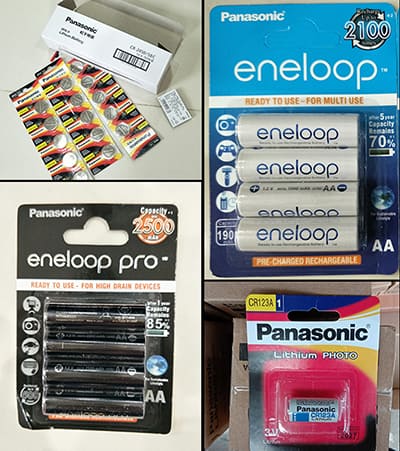
In this case, three such pages were found to be selling counterfeit Panasonic batteries on one of Thailand’s most popular online marketplaces. After contacting the online marketplace operators to request that the advertisements be taken down, two pages closed but one remained active.

An in-depth private investigation into the remaining online shop uncovered that all three pages were owned by the same entity—a Chinese national with two houses in Bangkok, from which he actively sold various types of fake Panasonic batteries in large quantities.

Warning Letter vs. Raid Action   

Sending a warning letter is usually the preferred enforce- ment action against small-scale online infringers. If the dispute can be settled after sending the warning letter, this option is more time- and cost-efficient than other legal actions.    

However, infringers with large inventories may be less receptive to this approach, either ignoring warning letters entirely, or only ceasing sales temporarily. Either way, infringers with large inventories are very likely to continue sales eventually, as they need to clear out their stock.   

In addition, attempts to negotiate with foreign nationals operating in Thailand often backfire, as they are not usually permanently established in Thailand. It is common for such infringers to simply move to another location upon receipt of a warning letter.   

In this instance the targeted infringer clearly had a large stock, was a foreign national, and was quite cautious in his activities, using the marketplace platform to hide his identity and not disclosing his name on his shop pages. A warning letter was therefore considered to pose a high risk, and a strong raid action against the target in order to seize the fake goods was considered a better solution. In addition, such action would penalize the infringers and spread the message that Panasonic takes serious legal action against infringers in order to protect its consumers.    

A criminal raid action was therefore initiated at the identified houses in order to seize the products.

Search and Seizure    

Based on investigation reports, strong evidence, and coordination with a police raid team, the court granted search warrants to gain entry to the suspect’s houses. No counterfeit Panasonic products were found at the first house, although other branded mobile phone chargers, earphones, mobile phone holders, and various unbranded products were on site. The police seized those goods for non-payment of import taxes.
The suspect and one of his staff (a Thai citizen) were found inside the second house, and they granted entry when presented with the search warrant. The search confirmed that the residential property was being used as a warehouse for commercial purposes. Batteries, chargers, watches, and other products were stored in every room, including the living room, kitchen, bedrooms, and even bathrooms. A large number of fake Panasonic products were found, along with other branded products.    

The police seized more than 30,000 counterfeit Panasonic products, including stickers labeled “Panasonic” that were obviously going to be attached to infringing products before sale. 

Arresting the Counterfeiters

The police filed charges of trademark infringement and importation tax evasion under the Customs Act against both people found in the house. In respect of the stickers labelled “Panasonic,” intended to convince the public that counterfeit goods were genuine Panasonic goods, the infringers were charged with using a mark without authorization in order to mislead the public, under the Thai Penal Code. In addition, the foreign national was charged with working without a work permit under Thailand’s immigration regime.   

This successful raid action prevented the distribution of fake goods to end-users, and will serve as a deterrent to other potential infringers in the market in accordance with Panasonic’s anticounterfeiting and customer protection policies.    

This raid is a prime example of the level of commitment necessary in order to protect Thai consumers from dangerous counterfeit products. Actions like these are rarely a one-off, and typically form part of a broader anticounterfeiting campaign. In that context, raids can also help to identify the sources of fake batteries being distributed in Thailand, and ultimately eliminate the counterfeit products once and for all.

RELATED INSIGHTS​ 

October 26, 2021
Attorneys from Tilleke & Gibbins’ Bangkok office have written the Thailand chapter of the newly released Fashion Law 2021, a guide to law surrounding the business of fashion in jurisdictions around the world. The guide covers 18 key jurisdictions for the global fashion industry, offering insights into local legal frameworks surrounding vital issues such as brand enforcement and protection, e-commerce and marketing, and sustainability considerations. The Thailand chapter of Fashion Law 2021 provides detailed information on the following topics: Trademarks, designs, copyright, and other intellectual property types, as well as the main intellectual property legal tools available to protect fashion products in Thailand. Strategic local contractual arrangements for manufacturing, distributing, and advertising fashion products. Overview and application of online marketing regulations and consumer protection regulations in Thailand. The most relevant unfair competition rules for fashion businesses and local courts’ interpretation and enforcement of the rules. ESG (environmental, social, and governance) concerns and sustainability issues for the fashion industry. Customs monitoring and local import and export guards against counterfeit products. Frequently asked questions and common concerns regarding fashion business operations in Thailand. The full Thailand chapter is available for free on the Global Legal Post website, or it can be downloaded as a PDF through the button below. Tilleke & Gibbins also contributed the Vietnam chapter to the guide.
October 25, 2021
Michael Ramirez, a counsel in Tilleke & Gibbins’ dispute resolution group in Bangkok, has updated the firm’s contribution to the Global Attorney-Client Privilege Guide, published by Lex Mundi. The newly expanded guide provides information on what constitutes attorney-client privilege in over 70 countries around the world. The Thailand section of the guide contains in-depth information on the function and applications of attorney-client privilege in Thailand (or, as explained in the guide, an equivalent concept enshrined in Thai law), including coverage of the following topics: Privilege in corporations Common interest doctrine Litigation funding Crime-fraud exception Work product doctrine/litigation privilege Other privileges including mediation, accountant-client and settlement negotiation The interactive guide features expert contributions by Lex Mundi member firms from jurisdictions worldwide. Readers can browse the contributions, generate country-specific reports, and compare attorney-client privilege in multiple jurisdictions. For more information, please visit the Lex Mundi website.
October 14, 2021
As part of its membership in Lex Mundi, Tilleke & Gibbins has published an updated edition of its Guide to Doing Business in Thailand for 2021. This guide outlines all of the key factors for starting and operating a business in the Thai market. Issues covered include: Investment incentives Financial facilities Exchange controls Import and export regulations Structures for doing business Requirements for the Establishment of a Business Operation of the Business Cessation or Termination of the Business Labor legislation, relations, and supply Tax Immigration requirements This publication is part of Lex Mundi’s Guides to Doing Business series prepared by member firms in more than 100 jurisdictions worldwide. The guides serve as a useful resource when planning an international business strategy or researching a new market.
August 26, 2021
The Ministry of Health of Vietnam recently issued Circular No. 10/2021/TT-BYT dated June 30, 2021, stipulating the list of substances prohibited from use in the production and trading of health supplements (“Circular 10”). Circular 10 will come into effect on September 1, 2021. Accordingly, substances found on the following lists will be prohibited from use in health supplements: The list of drugs and drug materials prohibited from importation and production found in Annex V of Decree No. 54/2017/ND-CP of the Government dated May 8, 2017, guiding the implementation of Law on Pharmacy (Decree 54). Lists promulgated with Decree No. 73/2018/ND-CP of the Government dated May 15, 2018, stipulating the list of narcotic substances and precursors, including: List I: Narcotic substances banned from use in healthcare and daily life, the use of which for analysis, testing, scientific research, and criminal investigation is subject to permission by competent authorities. List II: Narcotic substances restricted from analysis, testing, scientific research, criminal investigation, or healthcare as regulated by competent authorities. List III: Narcotic substances permitted in analysis, testing, scientific research, criminal investigation, healthcare, and veterinary medicine as regulated by competent authorities. List IVA: Essential precursors involved in forming the structure of narcotic substances. The list of narcotic active ingredients found in Annex I of Circular No. 20/2017/TT-BYT of the Ministry of Health, detailing articles of the Law on Pharmacy and Decree 54 related to drugs and drug materials under special control. The list of toxic drugs and toxic drug materials under Circular No. 06/2017/TT-BYT of the Ministry of Health dated May 3, 2017. Lists under Circular No. 42/2017/TT-BYT of the Ministry of Health dated November 13, 2017, stipulating the lists of toxic herbal materials, including: Annex I: List of toxic herbal materials of plant origin. Annex II: List of toxic herbal materials of