
You are using an outdated browser and your browsing experience will not be optimal. Please update to the latest version of Microsoft Edge, Google Chrome or Mozilla Firefox. Install Microsoft Edge

March 2, 2021

Resolving Domain Name Disputes in Indonesia

Informed Counsel

Since 2014, Indonesia’s domain name registry (PANDI) has overseen the registration of .id domain names, following the earlier country code top-level domains (ccTLDs), such as .co.id, .or.id, and .go.id. PANDI has recently reported on the growth of .id domain names in 2019, which saw an increase in registrations of about 45%, reaching a total of 135,000 registrants.

An Indonesian Internet Providers Association (APJII) nationwide survey found that the number of internet users in Indonesia increased by 14.6 percent to 196 million people in the period between 2019 and Q2 2020, up from 171 million in 2018. The survey also revealed that Indonesia’s internet penetration rate has gone up to 73.7 percent. This means that the country is catching up with neighboring Brunei, Singapore, and Thailand, whose internet penetration rates exceeded 70 percent last year. Part of this increase seems to be related to the limitation of in-person activity in the wake of the COVID-19 outbreak.

This internet usage growth has also meant a higher incidence of cybercrimes and online disputes, including over domain names. According to the domain name dispute statistics from WIPO, there have been 274 generic top-level domain name disputes involving Indonesian respondents to date. Meanwhile, 18 cases have so far been decided by PANDI’s Domain Name Dispute Resolution (PPND) in fights against Indonesian ccTLD cybersquatters, third parties who attempt to register domain names using the trademarks of others. PPND, a non-litigation dispute settlement body for disputes over Indonesian internet domain names, handles domain name disputes related to trademarks, registered names or regarding matters of decency. The examination of such disputes is conducted by PPND panel(s).

PANDI’s Domain Name General Policy version 6.0, dated February 25, 2019, explains the five categories of.id domain names: normative, trademark-related, product- or service-related, distributorship-related, or institutional.

Ministry of Communication Regulation No. 23 of 2013 regarding Domain Name Management stipulates that a registered trademark holder is entitled to register, use, and benefit from Indonesian ccTLDs. Based on PANDI’s naming guidelines, a trademark registration or application is required if the applicant claims that the domain name is related to their trademark. However, in practice, the registrar typically only requires a copy of the registrant’s ID card to proceed with the .id domain name registration, because the registrar may choose another naming criterion that does not require a trademark or other IP ownership. This may lead to the registration of .id domains by cybersquatters.

Procedures

PPND welcomes any trademark holder to file a complaint regarding domain names violating their registered trademark, before filing litigation with the court.

The current PPND policy (version 7.0) requires that every claimant file a pre-objection as the first step. The pre-objection phase includes a request for the whois data, which reveals the owner of a domain. Obtaining the results takes around three days after the pre-objection documents are completed and accepted by PPND. Upon receiving the pre-objection result, the next step is filing an objection laying out pertinent arguments. PPND may then proceed to mediation, followed by examination of the objection.

The simplified timeline below shows the key steps in the process.
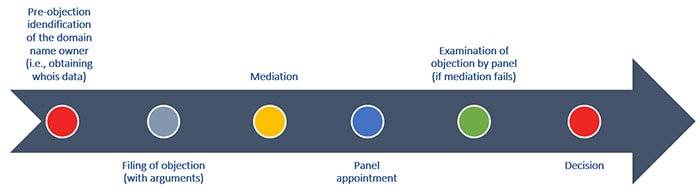
Under normal circumstances, the whole process may take around 2–3 months to be decided. An unsatisfied party that disagrees with the PPND decision may file a lawsuit with the court.

Possible Arguments

A claimant requesting a domain name take-down or transfer in accordance with the PPND policy must prove all of the following conditions:

  • The domain name is identical or confusingly similar to a trademark;
  • The registrant has no rights or legitimate interests in the domain name; and
  • The domain name has been registered and is being used in bad faith.

Of these three concurrent claims, the most challenging one to prove is the bad-faith intent. Nonetheless, it is essential. Even if a claimant can show valid trademark ownership and prove that the domain name in question was filed by an unauthorized entity, the PPND panels will refuse the claim if evidence of bad faith is lacking.

The strongest evidence of bad faith is any request (e.g. text message, email, etc.) by the registrant for compensation for transferring the domain name. Such evidence is straightforward proof that the registrant intended to sell, lease, or transfer the domain name for his or her financial benefit. However, of the 18 cases decided by the PPND since its inception, only seven were able to prove the registrant’s intent to sell the domain name for financial benefit.

There are other types of actions that are considered bad faith as well. For example, bad faith can be proven by showing that the registrant intends to prevent the trademark owner to use the contested domain name (i.e., parked domain), or by showing that the registrant intended to damage the trademark owner’s business activities. In addition, a domain name registrant intending to attract the internet user to another online location for illegal financial benefit would be another clear indication of bad faith.

Case Study

When the well-known video streaming service Netflix found that neflix.id had been registered by an unauthorized Indonesian citizen using their well-known trademark, they brought the matter before the PPND.

As the company had already registered their trademark in Indonesia, Netflix was able to prove that netflix.id was filed by an unauthorized party. However, no proof of intent to sell was forthcoming, so Netflix made the accusation that netflix.id was a parked domain, with the registrant trying to prevent Netflix from registering and using the domain name in Indonesia.

In his reply, the registrant pointed out that Netflix had not secured netflix.id before, and argued that in light of the “first to file” domain name registration principle, Netflix should have registered the domain name as soon as they were eligible to do so. The PPND, however, disagreed, deciding that the claim had in fact proved the three necessary conditions simultaneously. Hence, netflix.id was transferred to Netflix’s ownership.

Conclusion

Just as well-known brands are targeted by intellectual property infringers, these brands can also be targeted by parties wishing to benefit from their reputation or name recognition through a domain name. The process of acting against this in Indonesia is not simply a matter of trademark enforcement, but is a separate process governed by a different set of laws and regulations. Brand owners should be aware that having a trademark portfolio and strategy is often not enough; rather, they need a comprehensive and strategic awareness of how to manage all of their current and potential assets, including virtual properties such as domain names.

RELATED INSIGHTS​ 

March 31, 2026
Vietnam’s most recent amendment of the Law on Intellectual Property (amended IP Law), passed by the National Assembly on December 10, 2025, and effective from April 1, 2026, represents one of the most significant updates to the IP Law in recent years. This amendment modernizes the IP framework, moving a step closer to international standards, while addressing the realities of Vietnam’s booming digital economy, e-commerce growth, and increasing foreign investment, which is crucial for Vietnam’s objective of complete economic transformation. For trademark practitioners, brand owners, and businesses, the changes are largely positive, as they promise faster processes, stronger enforcement tools—especially for online actions—and better commercialization options. However, they also introduce stricter requirements and a need for proactive preparation. Below are some of the most noteworthy changes in the amended IP Law related to trademarks. Significantly Shortened Timelines and Introduction of Fast-Track Examination The statutory timelines under the amended IP Law have been notably reduced: Substantive examination for trademarks is shortened from 9 months to 5 months (from the publication date). The publication period is shortened from 2 months to 1 month. A new fast-track mechanism allows substantive examination in as little as 3 months for qualifying applications (e.g., marks in actual use, facing infringement threats, or meeting government-specified criteria; details to be clarified in implementing regulations). The opposition period is shortened from 5 months to 3 months from publication. This is arguably the most welcome change. Vietnam’s IP Office has long faced criticism for lengthy backlogs, often stretching the trademark registration process to 18–24 months or more. The new timelines bring Vietnam closer to efficient systems. The fast-track option is particularly smart for high-value or urgent cases such as counterfeit threats on e-commerce platforms. However, careful preparation is mandatory for flawless applications from the start to maximize fast-track eligibility.
March 16, 2026
Indonesia’s Ministry of Law has introduced a new framework for patent applications that tightens filing requirements and introduces formal mechanisms for accelerated examination. Minister of Law Regulation No. 6 of 2026 on Patent Applications, which was issued on January 13, 2026, and took effect on February 23, 2026, serves as the implementing regulation for Law No. 65 of 2024 on Patents. It replaces the previous patent application framework (under Minister of Law and Human Rights Regulation No. 38 of 2018, as amended by Regulation No. 13 of 2021), which was considered no longer aligned with current legal, institutional, and technological developments. The regulation also reflects the institutional restructuring of the Ministry of Law and Human Rights into the Ministry of Law. Patent applications filed on or after February 23, 2026, must fully comply with the new regulation. Applications that were filed before this date will continue to be examined and processed under the previous regulation, pursuant to transitional provisions. Substantive Changes Definition of Invention The definition of “Invention” now explicitly includes systems, methods, and uses, in addition to products and processes. This expansion creates broader protection opportunities, particularly for software-enabled, digital, and method-based technologies, although it may also result in closer scrutiny during substantive examination. Excess Claims Fee Excess claims fees must now be paid at the time of filing. Failure to pay excess claims fees at filing results in the application being deemed withdrawn. There is no longer an option to defer payment to the substantive examination stage. This amendment forces applicants to face higher upfront costs. Patent claim strategy must be finalized prior to filing, reducing flexibility at later stages. Procedural and System Changes Fully Electronic Filing Patent applications must be filed electronically via the Directorate General of Intellectual Property (DGIP) online filing system. Assisted filings to
March 13, 2026
For decades, intellectual property rights holders seeking to eliminate counterfeit goods from the Thai market have relied primarily on criminal raid actions to seize infringing products and hold infringers accountable. The deterrent value of this approach is typically threefold: imposing criminal liability on infringers, removing counterfeit goods from circulation, and subjecting violators to imprisonment and fines. However, these outcomes often fall short of fulfilling brand owners’ broader objectives. In many cases, those prosecuted are merely staff or intermediaries rather than the principals orchestrating the infringing operations. Moreover, any fines imposed are remitted to the Thai government—not to the rights holders who have suffered commercial harm and invested substantial resources in investigation and coordination with law enforcement authorities. As in other jurisdictions worldwide, rights holders seeking monetary compensation for IP infringement in Thailand have traditionally pursued separate civil litigation. Before initiating such proceedings, a brand owner must gather sufficient evidence to establish both the infringement and the resulting damages. Notably, Thai law does not recognize punitive damages; courts award only actual damages proven by the claimant. In the absence of seized infringing goods, the damages awarded in such cases are typically minimal. This all leaves rights holders with limited recourse despite possibly having suffered significant commercial injury. In 2005, Thailand amended its Criminal Procedure Code to introduce Section 44/1, which enables rights holders to claim damages within criminal proceedings at the Intellectual Property and International Trade Court prior to the evidentiary hearing. In practice, this mechanism allows an injured party to submit a petition for civil damages directly within the criminal case initiated by the public prosecutor. Historically, rights holders in Thailand have been reluctant to use Section 44/1 because the compensation awarded by courts was often insufficient to justify the effort. However, recent years have seen a notable shift
March 13, 2026
Vietnam’s Law on Intellectual Property (IP Law) has undergone continuous amendment in recent years, with the latest amendment issued at the end of 2025. Among the amended and supplemented provisions, the regulation that has perhaps attracted the most attention is a provision relating to the use of protected IP objects by artificial intelligence (AI) systems. Specifically, Article 7 of the 2025 IP Law introduces a completely new Clause 5, which reads in full as follows: “Organizations and individuals are permitted to use texts and data relating to intellectual property objects that have been lawfully published, and which the public is allowed to access, for the purposes of scientific research, experimentation, and training of artificial intelligence systems, provided that such use will not unreasonably affect the legitimate rights and interests of the authors and intellectual property rights holders in accordance with this Law. With respect to texts and data that are objects protected by copyright and related rights, the use of the texts and data as set forth herein must also be in accordance with the regulations of the Government.” Analyzing this newly added provision in the context of how it was conceived, as well as the challenges that still lie ahead, can provide some interesting insights. From Aspirations to Flight in Science and Technology From the end of 2024 and throughout 2025—the 50th anniversary of the country’s reunification—Vietnam witnessed numerous sweeping changes in many areas, including legislative development. It could be said that no sessions of the National Assembly have ever adopted as many laws, resolutions, and major policies as this one. The aspirations of the highest-level leadership have been concretized into major law and policy projects, which were drafted, developed, and passed at record speed. All of this was aimed at building a foundation for Vietnam to achieve