
You are using an outdated browser and your browsing experience will not be optimal. Please update to the latest version of Microsoft Edge, Google Chrome or Mozilla Firefox. Install Microsoft Edge

March 2, 2021

Resolving Domain Name Disputes in Indonesia

Informed Counsel

Since 2014, Indonesia’s domain name registry (PANDI) has overseen the registration of .id domain names, following the earlier country code top-level domains (ccTLDs), such as .co.id, .or.id, and .go.id. PANDI has recently reported on the growth of .id domain names in 2019, which saw an increase in registrations of about 45%, reaching a total of 135,000 registrants.

An Indonesian Internet Providers Association (APJII) nationwide survey found that the number of internet users in Indonesia increased by 14.6 percent to 196 million people in the period between 2019 and Q2 2020, up from 171 million in 2018. The survey also revealed that Indonesia’s internet penetration rate has gone up to 73.7 percent. This means that the country is catching up with neighboring Brunei, Singapore, and Thailand, whose internet penetration rates exceeded 70 percent last year. Part of this increase seems to be related to the limitation of in-person activity in the wake of the COVID-19 outbreak.

This internet usage growth has also meant a higher incidence of cybercrimes and online disputes, including over domain names. According to the domain name dispute statistics from WIPO, there have been 274 generic top-level domain name disputes involving Indonesian respondents to date. Meanwhile, 18 cases have so far been decided by PANDI’s Domain Name Dispute Resolution (PPND) in fights against Indonesian ccTLD cybersquatters, third parties who attempt to register domain names using the trademarks of others. PPND, a non-litigation dispute settlement body for disputes over Indonesian internet domain names, handles domain name disputes related to trademarks, registered names or regarding matters of decency. The examination of such disputes is conducted by PPND panel(s).

PANDI’s Domain Name General Policy version 6.0, dated February 25, 2019, explains the five categories of.id domain names: normative, trademark-related, product- or service-related, distributorship-related, or institutional.

Ministry of Communication Regulation No. 23 of 2013 regarding Domain Name Management stipulates that a registered trademark holder is entitled to register, use, and benefit from Indonesian ccTLDs. Based on PANDI’s naming guidelines, a trademark registration or application is required if the applicant claims that the domain name is related to their trademark. However, in practice, the registrar typically only requires a copy of the registrant’s ID card to proceed with the .id domain name registration, because the registrar may choose another naming criterion that does not require a trademark or other IP ownership. This may lead to the registration of .id domains by cybersquatters.

Procedures

PPND welcomes any trademark holder to file a complaint regarding domain names violating their registered trademark, before filing litigation with the court.

The current PPND policy (version 7.0) requires that every claimant file a pre-objection as the first step. The pre-objection phase includes a request for the whois data, which reveals the owner of a domain. Obtaining the results takes around three days after the pre-objection documents are completed and accepted by PPND. Upon receiving the pre-objection result, the next step is filing an objection laying out pertinent arguments. PPND may then proceed to mediation, followed by examination of the objection.

The simplified timeline below shows the key steps in the process.
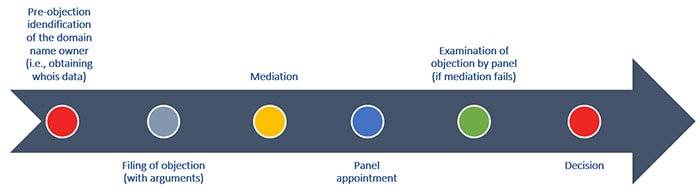
Under normal circumstances, the whole process may take around 2–3 months to be decided. An unsatisfied party that disagrees with the PPND decision may file a lawsuit with the court.

Possible Arguments

A claimant requesting a domain name take-down or transfer in accordance with the PPND policy must prove all of the following conditions:

  • The domain name is identical or confusingly similar to a trademark;
  • The registrant has no rights or legitimate interests in the domain name; and
  • The domain name has been registered and is being used in bad faith.

Of these three concurrent claims, the most challenging one to prove is the bad-faith intent. Nonetheless, it is essential. Even if a claimant can show valid trademark ownership and prove that the domain name in question was filed by an unauthorized entity, the PPND panels will refuse the claim if evidence of bad faith is lacking.

The strongest evidence of bad faith is any request (e.g. text message, email, etc.) by the registrant for compensation for transferring the domain name. Such evidence is straightforward proof that the registrant intended to sell, lease, or transfer the domain name for his or her financial benefit. However, of the 18 cases decided by the PPND since its inception, only seven were able to prove the registrant’s intent to sell the domain name for financial benefit.

There are other types of actions that are considered bad faith as well. For example, bad faith can be proven by showing that the registrant intends to prevent the trademark owner to use the contested domain name (i.e., parked domain), or by showing that the registrant intended to damage the trademark owner’s business activities. In addition, a domain name registrant intending to attract the internet user to another online location for illegal financial benefit would be another clear indication of bad faith.

Case Study

When the well-known video streaming service Netflix found that neflix.id had been registered by an unauthorized Indonesian citizen using their well-known trademark, they brought the matter before the PPND.

As the company had already registered their trademark in Indonesia, Netflix was able to prove that netflix.id was filed by an unauthorized party. However, no proof of intent to sell was forthcoming, so Netflix made the accusation that netflix.id was a parked domain, with the registrant trying to prevent Netflix from registering and using the domain name in Indonesia.

In his reply, the registrant pointed out that Netflix had not secured netflix.id before, and argued that in light of the “first to file” domain name registration principle, Netflix should have registered the domain name as soon as they were eligible to do so. The PPND, however, disagreed, deciding that the claim had in fact proved the three necessary conditions simultaneously. Hence, netflix.id was transferred to Netflix’s ownership.

Conclusion

Just as well-known brands are targeted by intellectual property infringers, these brands can also be targeted by parties wishing to benefit from their reputation or name recognition through a domain name. The process of acting against this in Indonesia is not simply a matter of trademark enforcement, but is a separate process governed by a different set of laws and regulations. Brand owners should be aware that having a trademark portfolio and strategy is often not enough; rather, they need a comprehensive and strategic awareness of how to manage all of their current and potential assets, including virtual properties such as domain names.

RELATED INSIGHTS​ 

July 24, 2026
As food innovation continues to accelerate, manufacturers are increasingly introducing ingredients derived from new sources, produced using novel technologies, or lacking a significant history of human consumption. While these innovations create new opportunities for the food industry, they also raise important questions regarding consumer safety. For this reason, many jurisdictions, including Thailand, the European Union, Australia and New Zealand, Canada, and Singapore, require a premarket safety assessment for novel food ingredients before they can be placed on the market. The objective of this assessment is to ensure that each ingredient is safe for its intended use and level of consumption, does not present toxicological, allergenic, microbiological, or nutritional concerns, and will not mislead consumers. Scientific authorities typically evaluate the ingredient’s identity, manufacturing process, composition, specifications, anticipated dietary exposure, toxicological information, nutritional impact, and history of use before determining whether it can be marketed. Against this background, the Thai Food and Drug Administration (FDA) recently took an important step toward improving regulatory transparency by publishing, for the first time, a consolidated public list of substances that have successfully completed the Thai FDA’s safety assessment process, including substances determined to be novel foods and those determined not to fall within the novel food category. The list identifies the approved substances, the corresponding manufacturers or importers, approval dates, and the approved conditions of use. Although the publication does not change the existing legal framework governing novel food approvals, it provides businesses with greater visibility into the Thai FDA’s regulatory precedents and the types of substances that have previously been accepted through the safety assessment process. The full announcement is available on the Thai FDA’s website. As the list is now publicly available, it also provides useful insight into the types of substances that have successfully completed the Thai FDA’s safety assessment process.
July 24, 2026
Indonesia has updated its fee framework for intellectual property (IP)-related government services, with implications for IP owners, licensees, lenders, digital platforms, and businesses operating in the country. Government Regulation No. 30 of 2026 on Types and Tariffs of Non-Tax State Revenue Applicable to the Ministry of Law (GR 30/2026) was promulgated on July 2, 2026, and will take effect on August 1, 2026. Key Takeaways GR 30/2026, which replaces the relevant IP service fees under Government Regulation No. 45 of 2024, reorganizes the fee schedule into separate categories for copyright, industrial designs, patents, layout designs of integrated circuits, trade secrets, trademarks, geographical indications, IP enforcement, and other categories. The most commercially relevant changes include a new copyright recordation tariff exemption for songs and music, higher fees for several trademark and geographical indication services, new IP enforcement service fees, and a new fee type for registration of fiduciary security over IP rights objects. In addition, this is the first major update for trademark fees in approximately 10 years. GR 30/2026 is significant not only as a fee update but also as a further indication of Indonesia’s increasing recognition of IP as a financeable commercial asset. By expressly assigning fees to the registration of fiduciary security over IP rights objects, the regulation places IP-backed collateral filings within the Ministry of Law’s administrative service framework. While GR 30/2026 does not create a new secured-transactions regime, this development is relevant for lenders, borrowers, and IP owners structuring financing arrangements secured by trademarks, patents, copyrights, industrial designs, or other registrable IP rights in Indonesia. Copyright: New Fee Exemption for Songs and Music Recordation For copyright, GR 30/2026 creates a fee-exempt category for recordation of works or related-rights products for songs or music, while maintaining a separate category for other works and related-rights products. It
July 21, 2026
Thailand’s Ministry of Digital Economy and Society (MDES) published a notification establishing an expedited court-ordered takedown mechanism for online content in cases of “urgent necessity.” The notification, which was issued on July 17, 2026, under the Computer Crime Act B.E. 2550 (2007), as amended, took effect the following day. It significantly expands the categories of content subject to rapid government-initiated removal. Content Categories Subject to Takedown The notification defines “urgent necessity” (section 20, paragraph 5, of the Computer Crime Act) as circumstances where any delay in suppressing computer data may impact national security, religion, the monarchy, good morals, social culture, or public order. In this regard, it establishes four broad categories of content: Computer Crime Act offenses. National security offenses. IP and other criminal offenses, where it is contrary to public order or good morals and a competent officer has requested its suppression. Content contrary to public order or good morals, a broad residual category encompassing 14 subcategories approved by the Computer Data Screening Committee. The fourth category is the most expansive. Its 14 subcategories include: Content defaming, mocking, satirizing, or devaluing the monarchy. Online gambling advertising or facilitation. Offering illegal firearms for sale. Offering baraku (hookah) products or e-cigarettes for sale. Offering cannabis inflorescences or processed cannabis products for sale. Advertising or soliciting prostitution. Content inciting violence, hatred, or social division. Unauthorized overseas employment advertising. Offering boiled kratom juice for sale. Online sale or advertising of alcoholic beverages. Content satirizing or degrading Buddhism. Money lending at interest rates exceeding legally prescribed limits. Advertising or disseminating information about surrogacy services. Forgery of documents, cards, or official documents. Enforcement Procedure In cases of urgent necessity, a competent official assigned by the MDES permanent secretary must file a petition with supporting evidence to the court with jurisdiction, requesting an order to
July 15, 2026
Ambush marketing refers to a strategy in which a business associates itself with an event, campaign, or brand without paying for official sponsorship rights. The tactic is most visible in sports, concerts, and festivals, where official sponsors have invested substantially for exclusivity. Ambush marketers may use suggestive wording, event-themed imagery, athlete endorsements, venue-adjacent promotions, or social media campaigns implying a commercial connection with the event. Common Forms of Ambush Marketing Ambush marketing typically takes one of the following forms: Direct ambushing: using event names, logos, or mascots suggesting authorization Coattail ambushing: sponsoring an athlete or broadcaster connected with the event Subtle ambushing: themed advertising, venue-adjacent campaigns, or similar visual cues The legal analysis in each case turns on whether the marketing crosses from permissible event-based advertising into infringement, passing off, deception, or wrongful exploitation of goodwill, and the risk assessment is necessarily fact-specific. Thailand has no dedicated ambush marketing statute, so legality depends on execution. A campaign that merely comments on a public event may be permissible, but one that uses protected marks, creates consumer confusion, misrepresents sponsorship status, or makes unsubstantiated claims may trigger liability under various Thai laws, as laid out below. Ambush Marketing and Thailand’s Trademark Act The Trademark Act B.E. 2534 (1991) is the primary tool for addressing campaigns that use registered trademarks, event names, logos, mascots, or confusingly similar signs. The law gives registered trademark owners the exclusive right to use their mark for registered goods, and infringement risk arises when a nonsponsor uses an event mark or a confusingly similar sign in advertising. Even referential or playful use may create liability if it causes public confusion as to sponsorship or commercial connection. The law also preserves passing-off claims for unregistered marks. This matters because event names, taglines, or mascots may not always be