
You are using an outdated browser and your browsing experience will not be optimal. Please update to the latest version of Microsoft Edge, Google Chrome or Mozilla Firefox. Install Microsoft Edge

March 2, 2021

Resolving Domain Name Disputes in Indonesia

Informed Counsel

Since 2014, Indonesia’s domain name registry (PANDI) has overseen the registration of .id domain names, following the earlier country code top-level domains (ccTLDs), such as .co.id, .or.id, and .go.id. PANDI has recently reported on the growth of .id domain names in 2019, which saw an increase in registrations of about 45%, reaching a total of 135,000 registrants.

An Indonesian Internet Providers Association (APJII) nationwide survey found that the number of internet users in Indonesia increased by 14.6 percent to 196 million people in the period between 2019 and Q2 2020, up from 171 million in 2018. The survey also revealed that Indonesia’s internet penetration rate has gone up to 73.7 percent. This means that the country is catching up with neighboring Brunei, Singapore, and Thailand, whose internet penetration rates exceeded 70 percent last year. Part of this increase seems to be related to the limitation of in-person activity in the wake of the COVID-19 outbreak.

This internet usage growth has also meant a higher incidence of cybercrimes and online disputes, including over domain names. According to the domain name dispute statistics from WIPO, there have been 274 generic top-level domain name disputes involving Indonesian respondents to date. Meanwhile, 18 cases have so far been decided by PANDI’s Domain Name Dispute Resolution (PPND) in fights against Indonesian ccTLD cybersquatters, third parties who attempt to register domain names using the trademarks of others. PPND, a non-litigation dispute settlement body for disputes over Indonesian internet domain names, handles domain name disputes related to trademarks, registered names or regarding matters of decency. The examination of such disputes is conducted by PPND panel(s).

PANDI’s Domain Name General Policy version 6.0, dated February 25, 2019, explains the five categories of.id domain names: normative, trademark-related, product- or service-related, distributorship-related, or institutional.

Ministry of Communication Regulation No. 23 of 2013 regarding Domain Name Management stipulates that a registered trademark holder is entitled to register, use, and benefit from Indonesian ccTLDs. Based on PANDI’s naming guidelines, a trademark registration or application is required if the applicant claims that the domain name is related to their trademark. However, in practice, the registrar typically only requires a copy of the registrant’s ID card to proceed with the .id domain name registration, because the registrar may choose another naming criterion that does not require a trademark or other IP ownership. This may lead to the registration of .id domains by cybersquatters.

Procedures

PPND welcomes any trademark holder to file a complaint regarding domain names violating their registered trademark, before filing litigation with the court.

The current PPND policy (version 7.0) requires that every claimant file a pre-objection as the first step. The pre-objection phase includes a request for the whois data, which reveals the owner of a domain. Obtaining the results takes around three days after the pre-objection documents are completed and accepted by PPND. Upon receiving the pre-objection result, the next step is filing an objection laying out pertinent arguments. PPND may then proceed to mediation, followed by examination of the objection.

The simplified timeline below shows the key steps in the process.
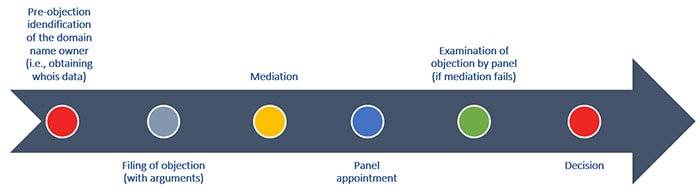
Under normal circumstances, the whole process may take around 2–3 months to be decided. An unsatisfied party that disagrees with the PPND decision may file a lawsuit with the court.

Possible Arguments

A claimant requesting a domain name take-down or transfer in accordance with the PPND policy must prove all of the following conditions:

  • The domain name is identical or confusingly similar to a trademark;
  • The registrant has no rights or legitimate interests in the domain name; and
  • The domain name has been registered and is being used in bad faith.

Of these three concurrent claims, the most challenging one to prove is the bad-faith intent. Nonetheless, it is essential. Even if a claimant can show valid trademark ownership and prove that the domain name in question was filed by an unauthorized entity, the PPND panels will refuse the claim if evidence of bad faith is lacking.

The strongest evidence of bad faith is any request (e.g. text message, email, etc.) by the registrant for compensation for transferring the domain name. Such evidence is straightforward proof that the registrant intended to sell, lease, or transfer the domain name for his or her financial benefit. However, of the 18 cases decided by the PPND since its inception, only seven were able to prove the registrant’s intent to sell the domain name for financial benefit.

There are other types of actions that are considered bad faith as well. For example, bad faith can be proven by showing that the registrant intends to prevent the trademark owner to use the contested domain name (i.e., parked domain), or by showing that the registrant intended to damage the trademark owner’s business activities. In addition, a domain name registrant intending to attract the internet user to another online location for illegal financial benefit would be another clear indication of bad faith.

Case Study

When the well-known video streaming service Netflix found that neflix.id had been registered by an unauthorized Indonesian citizen using their well-known trademark, they brought the matter before the PPND.

As the company had already registered their trademark in Indonesia, Netflix was able to prove that netflix.id was filed by an unauthorized party. However, no proof of intent to sell was forthcoming, so Netflix made the accusation that netflix.id was a parked domain, with the registrant trying to prevent Netflix from registering and using the domain name in Indonesia.

In his reply, the registrant pointed out that Netflix had not secured netflix.id before, and argued that in light of the “first to file” domain name registration principle, Netflix should have registered the domain name as soon as they were eligible to do so. The PPND, however, disagreed, deciding that the claim had in fact proved the three necessary conditions simultaneously. Hence, netflix.id was transferred to Netflix’s ownership.

Conclusion

Just as well-known brands are targeted by intellectual property infringers, these brands can also be targeted by parties wishing to benefit from their reputation or name recognition through a domain name. The process of acting against this in Indonesia is not simply a matter of trademark enforcement, but is a separate process governed by a different set of laws and regulations. Brand owners should be aware that having a trademark portfolio and strategy is often not enough; rather, they need a comprehensive and strategic awareness of how to manage all of their current and potential assets, including virtual properties such as domain names.

RELATED INSIGHTS​ 

June 24, 2026
Patent enablement requirements are provided under Article 102 of Vietnam’s Law on Intellectual Property (IP Law). In particular, a patent specification must “fully and clearly disclose the nature of the invention to such an extent that, based on the specification, a person having ordinary skill in the relevant art can implement the invention.” In pharmaceutical and biotechnology patents, this requirement is more complicated and subject to more rigorous assessment. The Patent Examination Guidelines (Guidelines) of the Intellectual Property Office of Vietnam (IP Office) were amended in March 2026 to introduce Annexes III and IV for the pharmaceutical and biotechnology sectors, in which Annex III provides detailed guidelines on the assessment of specification requirements. These amendments were made under a project for strengthening capacity in industrial property examination between the Japan International Cooperation Agency (JICA) and the IP Office. Annex III provides detailed instructions on how examiners assess enablement in a pharmaceutical or biotechnology application, and offers examples of acceptable and unacceptable descriptions with regard to the enablement aspect. Enablement Requirements in Pharma and Biotech Patents Article 12.7 of Circular 10/2026/TT-BKHCN (Circular 10) adds to the requirements of Article 102 of the IP Law that the description must demonstrate the novelty, inventive step, and industrial applicability of the technical solution. For pharmaceutical composition subject matters, Article 12.9 of Circular 10 sets out that the description must present the results of clinical trials and/or the pharmacological effects of the claimed pharmaceutical composition, and must include at least the following information: Substance/mixture used. Testing method (system) employed. Information on the test results. Correlation between the pharmacological effects obtained from the tests and the application of the pharmaceutical product in the prevention, diagnosis, and treatment of diseases. The Guidelines note that pharmacological study results should be presented in a quantified manner, and pharmacological
June 16, 2026
Since the implementation of the Trademark Law 2019 on April 1, 2023, Myanmar has operated under a modern first-to-file trademark system that brings its registration framework closer to international practice. As the new regime continues to develop in practice, applicants are increasingly required to navigate formal examination requirements, substantive objections, and procedural deadlines with greater precision. This article provides a high-level review of the trademark examination process in Myanmar, focusing on the principal stages from initial review to approval, the types of objections commonly raised by the Intellectual Property Department (IPD), and the key considerations for responding effectively. A clear understanding of these issues is essential for applicants seeking to secure registration efficiently and to mitigate avoidable delays or refusals. Examination Process: Key Stages Trademark applications filed with the IPD undergo two stages of review. Formality Examination The IPD first verifies compliance with procedural requirements, including: Correct Nice Classification Clear mark representation Accurate applicant details Clearly defined goods or services Representative details, if the application is filed by a representative Other formality requirements cover translation and transliteration of any non-English or non-Myanmar elements in the mark, color claim details, applicable disclaimers, and payment of official fees. Deficiencies result in an office action requiring correction within 30 days, which may be extended upon request. Registrability Examination The IPD also assesses registrability. A mark may be refused if it: Lacks distinctiveness Is descriptive or generic Misleads the public or violates public order/morality Contains prohibited state symbols Only compliant applications proceed to publication. Responding to Office Actions Applicants must respond within 30 days of notification from the IPD. Depending on the nature of the objection, strategies may include submitting legal arguments for distinctiveness, providing evidence of acquired distinctiveness, filing appropriate disclaimers, clarifying descriptions such as color claims, or amending the listed goods
June 15, 2026
The surge in AI development has led to a desperate demand for large, high-quality training data. However, real-world data can be expensive to collect, difficult to access, and often subject to strict privacy and regulatory constraints. Synthetic data, which consists of artificially generated records that replicate the statistical properties of real-world data without reproducing specific individuals’ information, provides an appealing solution by generating artificial datasets at scale without relying on identifiable personal information. It combines speed, cost efficiency, and regulatory compliance, making it a sensible alternative for organizations seeking to reduce risks while maintaining data utility. When properly anonymized, synthetic datasets may fall outside the scope of laws such as the EU’s General Data Protection Regulation (GDPR) or Thailand’s Personal Data Protection Act (PDPA), reducing compliance burdens while still supporting high-quality model training. However, relying on synthetic data without rigorous legal due diligence could be a strategic mistake. It replaces one set of known risks (scraping, direct privacy liability) with a new set of complex liabilities. The narrative that synthetic data is a “silver bullet” for privacy and IP compliance is dangerous and could be misleading. While synthetic data addresses data scarcity, it also introduces new legal uncertainties. Legal counsel should anticipate downstream risks arising from compromised data sources. Models trained on unlawfully obtained data may need to be decommissioned, even if their outputs appear lawful. What is synthetic data? Synthetic data refers to artificially generated information created using AI techniques such as deep learning and generative models. Instead of copying real records, it reproduces the statistical patterns and relationships found in the original dataset. Synthetic data generally falls into three categories: Fully synthetic data – Entirely new data points generated from learned patterns. The model studies the structure of the original data and produces records that resemble real-world
June 10, 2026
In March 2026, the Intellectual Property Office of Vietnam (IP Office) issued a decision refusing a trademark application after considering an opposition based primarily on copyright grounds. The outcome is noteworthy because the foreign brand owner had neither trademark registrations nor applications in Vietnam at the time the opposition was filed, and the IP Office has historically applied a stringent approach to oppositions relying on copyright. The Opposition Maurten is a well-known Swedish sports nutrition brand recognized globally for its innovative hydrogel technology, which is designed to help endurance athletes fuel more effectively without gastrointestinal discomfort. The brand’s distinctive logo is characterized by clean lines and a bold black-and-white color scheme, and has long been associated with the company’s performance products. The brand’s logo is displayed above. An identical mark was filed for registration by a Vietnamese trademark squatter. In 2023, a Vietnamese individual filed an application for registration of an identical mark (Application No. 4-2023-38668), a practice commonly observed in Vietnam as trademark squatting. The brand owner engaged Tilleke & Gibbins to assist with strategy and filing an opposition to the mark. At the time, Maurten had no trademark rights or meaningful use in Vietnam, and global marketing data showed only modest figures without any local presence. Thus, to convince the IP Office to refuse the squatter’s application, instead of relying on trademark rights or use evidence, the opposition strategy centered on the copyright protection of the logo itself, as copyright arises automatically in Vietnam upon creation of the work and does not require registration. (It is worth noting, however, that the IP Office has traditionally been cautious in accepting copyright as a basis for refusing trademark applications.) On September 24, 2024, an opposition was filed on three main grounds: confusing similarity, copyright infringement of the artistic work,