
You are using an outdated browser and your browsing experience will not be optimal. Please update to the latest version of Microsoft Edge, Google Chrome or Mozilla Firefox. Install Microsoft Edge

March 2, 2021

Resolving Domain Name Disputes in Indonesia

Informed Counsel

Since 2014, Indonesia’s domain name registry (PANDI) has overseen the registration of .id domain names, following the earlier country code top-level domains (ccTLDs), such as .co.id, .or.id, and .go.id. PANDI has recently reported on the growth of .id domain names in 2019, which saw an increase in registrations of about 45%, reaching a total of 135,000 registrants.

An Indonesian Internet Providers Association (APJII) nationwide survey found that the number of internet users in Indonesia increased by 14.6 percent to 196 million people in the period between 2019 and Q2 2020, up from 171 million in 2018. The survey also revealed that Indonesia’s internet penetration rate has gone up to 73.7 percent. This means that the country is catching up with neighboring Brunei, Singapore, and Thailand, whose internet penetration rates exceeded 70 percent last year. Part of this increase seems to be related to the limitation of in-person activity in the wake of the COVID-19 outbreak.

This internet usage growth has also meant a higher incidence of cybercrimes and online disputes, including over domain names. According to the domain name dispute statistics from WIPO, there have been 274 generic top-level domain name disputes involving Indonesian respondents to date. Meanwhile, 18 cases have so far been decided by PANDI’s Domain Name Dispute Resolution (PPND) in fights against Indonesian ccTLD cybersquatters, third parties who attempt to register domain names using the trademarks of others. PPND, a non-litigation dispute settlement body for disputes over Indonesian internet domain names, handles domain name disputes related to trademarks, registered names or regarding matters of decency. The examination of such disputes is conducted by PPND panel(s).

PANDI’s Domain Name General Policy version 6.0, dated February 25, 2019, explains the five categories of.id domain names: normative, trademark-related, product- or service-related, distributorship-related, or institutional.

Ministry of Communication Regulation No. 23 of 2013 regarding Domain Name Management stipulates that a registered trademark holder is entitled to register, use, and benefit from Indonesian ccTLDs. Based on PANDI’s naming guidelines, a trademark registration or application is required if the applicant claims that the domain name is related to their trademark. However, in practice, the registrar typically only requires a copy of the registrant’s ID card to proceed with the .id domain name registration, because the registrar may choose another naming criterion that does not require a trademark or other IP ownership. This may lead to the registration of .id domains by cybersquatters.

Procedures

PPND welcomes any trademark holder to file a complaint regarding domain names violating their registered trademark, before filing litigation with the court.

The current PPND policy (version 7.0) requires that every claimant file a pre-objection as the first step. The pre-objection phase includes a request for the whois data, which reveals the owner of a domain. Obtaining the results takes around three days after the pre-objection documents are completed and accepted by PPND. Upon receiving the pre-objection result, the next step is filing an objection laying out pertinent arguments. PPND may then proceed to mediation, followed by examination of the objection.

The simplified timeline below shows the key steps in the process.
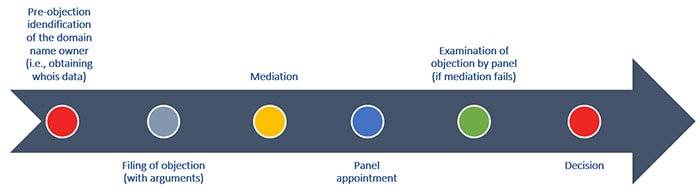
Under normal circumstances, the whole process may take around 2–3 months to be decided. An unsatisfied party that disagrees with the PPND decision may file a lawsuit with the court.

Possible Arguments

A claimant requesting a domain name take-down or transfer in accordance with the PPND policy must prove all of the following conditions:

  • The domain name is identical or confusingly similar to a trademark;
  • The registrant has no rights or legitimate interests in the domain name; and
  • The domain name has been registered and is being used in bad faith.

Of these three concurrent claims, the most challenging one to prove is the bad-faith intent. Nonetheless, it is essential. Even if a claimant can show valid trademark ownership and prove that the domain name in question was filed by an unauthorized entity, the PPND panels will refuse the claim if evidence of bad faith is lacking.

The strongest evidence of bad faith is any request (e.g. text message, email, etc.) by the registrant for compensation for transferring the domain name. Such evidence is straightforward proof that the registrant intended to sell, lease, or transfer the domain name for his or her financial benefit. However, of the 18 cases decided by the PPND since its inception, only seven were able to prove the registrant’s intent to sell the domain name for financial benefit.

There are other types of actions that are considered bad faith as well. For example, bad faith can be proven by showing that the registrant intends to prevent the trademark owner to use the contested domain name (i.e., parked domain), or by showing that the registrant intended to damage the trademark owner’s business activities. In addition, a domain name registrant intending to attract the internet user to another online location for illegal financial benefit would be another clear indication of bad faith.

Case Study

When the well-known video streaming service Netflix found that neflix.id had been registered by an unauthorized Indonesian citizen using their well-known trademark, they brought the matter before the PPND.

As the company had already registered their trademark in Indonesia, Netflix was able to prove that netflix.id was filed by an unauthorized party. However, no proof of intent to sell was forthcoming, so Netflix made the accusation that netflix.id was a parked domain, with the registrant trying to prevent Netflix from registering and using the domain name in Indonesia.

In his reply, the registrant pointed out that Netflix had not secured netflix.id before, and argued that in light of the “first to file” domain name registration principle, Netflix should have registered the domain name as soon as they were eligible to do so. The PPND, however, disagreed, deciding that the claim had in fact proved the three necessary conditions simultaneously. Hence, netflix.id was transferred to Netflix’s ownership.

Conclusion

Just as well-known brands are targeted by intellectual property infringers, these brands can also be targeted by parties wishing to benefit from their reputation or name recognition through a domain name. The process of acting against this in Indonesia is not simply a matter of trademark enforcement, but is a separate process governed by a different set of laws and regulations. Brand owners should be aware that having a trademark portfolio and strategy is often not enough; rather, they need a comprehensive and strategic awareness of how to manage all of their current and potential assets, including virtual properties such as domain names.

RELATED INSIGHTS​ 

September 4, 2023
With Vietnam’s entertainment industry booming, the demand for music to be used in films and video games has sharply increased. Sometimes a song featured in a movie’s soundtrack can become as popular as the movie itself. In order to use a song in a film, the producer of the film will typically need to enter into an agreement with the owner of a copyrighted work to have permission to use that work – with an agreed amount of royalty. Otherwise, their use could be considered a copyright infringement. However, what happens if the producer enters into an agreement with a song’s purported copyright owner, only to later find that such person does not really own the song entirely? A recent high-profile case in Vietnam brought this issue to light. The Dispute and Court Rulings The film “Face Off 4 – The Walking Guests,” financed and produced by Ly Hai Promotion Co., Ltd (“Ly Hai”) premiered in April 2019, and soon became a big success. In this film, Ly Hai used a song called “Ganh Me” on the basis of a March 2019 contract to use the song signed with the musician Quach Beem, who was recognized as the song owner in a copyright certificate issued on 24 April 2019 by the Copyright Office of Vietnam (COV). The dispute arose in November 2019 when an individual named Truong Minh Nhat discovered that the lyrics of “Ganh Me” were almost identical to a poem he had written and posted on his Facebook page in June 2014, well before the COV had issued the copyright certificate to Quach Beem. Mr. Nhat initiated a lawsuit against two defendants, Quach Beem and Ly Hai, for copyright infringement. In his petition, Mr. Nhat requested the court to, among other things, recognize him as the author
August 29, 2023
Cambodia recently tightened its trademark procedures by restricting the filing of separate single-class applications for a mark covering multiple classes, and tightening the deadline for filing affidavits of use or non-use. The latter requirement is especially consequential for existing registered trademark owners, as disregarding it could result in removal of the registered mark from Cambodia’s trademark registry. Multiple-Class Applications Cambodia’s Ministry of Commerce announced on August 1, 2023, that the Department of Intellectual Property Rights will now only accept a single application for a trademark covering more than one international class. This means that multiple-class applications are mandatory for applications covering more than one class. Previously, trademark applicants were allowed to file separate single-class applications for the same mark covering multiple classes. The new rule, which took effect immediately, aims to reduce unnecessary paperwork and facilitate the trademark registration process. Period for Filing Affidavits of Use or Non-Use On August 11, 2023, the Ministry of Commerce issued a notification stating that trademark registrants who miss the deadline for filing an affidavit of use or non-use will no longer be allowed to file an affidavit after the deadline or at the time of filing the trademark renewal, as had previously been allowed. This is in line with the Sub-Decree Concerning the Filing of an Affidavit of Use or Non-Use, which requires registered trademark owners to file an affidavit of use or non-use of the trademark within one year following the fifth anniversary of the mark’s registration or renewal. Importantly, the notification announces that registered trademarks will be removed from the registry if the trademark owner fails to file an affidavit of the mark’s use or non-use within the required time period. This announcement applies to both domestic registrations and international registrations made under the Madrid Protocol. Although the notification does
August 25, 2023
On August 23, 2023, the Vietnamese government issued Decree No. 65/2023/ND-CP detailing and guiding the implementation of some articles of the 2022 Intellectual Property Law with respect to the establishment and protection of industrial property rights (“Decree 65”). Decree 65 took immediate effect upon issuance, replacing Decree No. 103/2006/ND-CP and a part of Decree No. 105/2006/ND-CP, and provides long-awaited, necessary guidance for implementation of the IP Law, which took effect on January 1, 2023. Some of the most critical provisions of Decree 65 include the following:   Establishment of Industrial Property Rights Procedures for Establishment: The procedures for the establishment of industrial property rights are set out in Decree 65, rather than in a lower-level circular. These include the procedures related to PCT applications for inventions and Madrid applications for trademarks, and the (newly added) procedures related to Hague applications for industrial designs. Decree 65 also provides the details of the procedure for security control of inventions, including an annex listing the technical fields deemed to affect national security. The decree confirms that registration certificates can be issued in electronic form and in paper form. However, hard copy registration will only be issued under explicit request in the application. It also provides various new forms, including application forms for patents, designs, integrated circuits, and geographical indications, among others. Right Holder, Content, and Limitation of Rights: Further details are provided on the rights and responsibilities of organizations and individuals who use geographical indications. Decree 65 also details the procedure for compensation of patent owners due to the delay in granting marketing authorization of pharmaceutical products, stipulated in Article 131a of the IP Law. Secret Inventions: Decree 65 provides details for identifying and processing patent applications for secret inventions as well as procedures for decodifying inventions filed as secret inventions. Amendment:
August 23, 2023
Introduction The idea of the metaverse rose to prominence in the public discourse in 2021, most notably when Facebook renamed itself Meta and announced a new focus on launching a virtual, immersive world. The initial excitement around the metaverse has since faded, with worsening economic conditions having a particularly acute effect on companies in the technology sector. When Meta CEO Mark Zuckerberg announced in March 2023 that artificial intelligence (AI) was the company’s “single largest investment,” many took this as a sign of the company shifting focus away from the metaverse. However, there remains significant interest in the metaverse from both businesses and consumers. Zuckerberg himself reaffirmed Meta’s focus on the metaverse, highlighting how developments in AI will improve virtual reality (VR) and augmented reality (AR) technology. Meanwhile, Roblox, a metaverse gaming platform, announced that in Q1 2023, its number of daily active users had increased to 66 million. Most recently, the announcement by Apple of its new ‘Vision Pro’ AR headset is reported to have renewed interest in the metaverse among developers. A particular area of interest in the developing metaverse is digital fashion and retail. In its Metaverse Fashion Trends Report 2022, Roblox found that nearly three in four users aged 14 to 24 spend money on digital fashion items. Roblox itself has partnered with fashion brands Burberry, Gucci, Tommy Hilfiger, and others, to offer experiences and items for use on the platform. In March 2023, Decentraland, a metaverse platform with a decentralized governance structure, hosted the Metaverse Fashion Week, featuring brands such as Adidas, Coach, and DKNY. As businesses continue to invest and look for opportunities to expand into the metaverse, whether through traditional e-commerce or more innovative digital asset offerings, it is important that they consider the ways in which new and existing laws apply