
You are using an outdated browser and your browsing experience will not be optimal. Please update to the latest version of Microsoft Edge, Google Chrome or Mozilla Firefox. Install Microsoft Edge

March 2, 2021

Resolving Domain Name Disputes in Indonesia

Informed Counsel

Since 2014, Indonesia’s domain name registry (PANDI) has overseen the registration of .id domain names, following the earlier country code top-level domains (ccTLDs), such as .co.id, .or.id, and .go.id. PANDI has recently reported on the growth of .id domain names in 2019, which saw an increase in registrations of about 45%, reaching a total of 135,000 registrants.

An Indonesian Internet Providers Association (APJII) nationwide survey found that the number of internet users in Indonesia increased by 14.6 percent to 196 million people in the period between 2019 and Q2 2020, up from 171 million in 2018. The survey also revealed that Indonesia’s internet penetration rate has gone up to 73.7 percent. This means that the country is catching up with neighboring Brunei, Singapore, and Thailand, whose internet penetration rates exceeded 70 percent last year. Part of this increase seems to be related to the limitation of in-person activity in the wake of the COVID-19 outbreak.

This internet usage growth has also meant a higher incidence of cybercrimes and online disputes, including over domain names. According to the domain name dispute statistics from WIPO, there have been 274 generic top-level domain name disputes involving Indonesian respondents to date. Meanwhile, 18 cases have so far been decided by PANDI’s Domain Name Dispute Resolution (PPND) in fights against Indonesian ccTLD cybersquatters, third parties who attempt to register domain names using the trademarks of others. PPND, a non-litigation dispute settlement body for disputes over Indonesian internet domain names, handles domain name disputes related to trademarks, registered names or regarding matters of decency. The examination of such disputes is conducted by PPND panel(s).

PANDI’s Domain Name General Policy version 6.0, dated February 25, 2019, explains the five categories of.id domain names: normative, trademark-related, product- or service-related, distributorship-related, or institutional.

Ministry of Communication Regulation No. 23 of 2013 regarding Domain Name Management stipulates that a registered trademark holder is entitled to register, use, and benefit from Indonesian ccTLDs. Based on PANDI’s naming guidelines, a trademark registration or application is required if the applicant claims that the domain name is related to their trademark. However, in practice, the registrar typically only requires a copy of the registrant’s ID card to proceed with the .id domain name registration, because the registrar may choose another naming criterion that does not require a trademark or other IP ownership. This may lead to the registration of .id domains by cybersquatters.

Procedures

PPND welcomes any trademark holder to file a complaint regarding domain names violating their registered trademark, before filing litigation with the court.

The current PPND policy (version 7.0) requires that every claimant file a pre-objection as the first step. The pre-objection phase includes a request for the whois data, which reveals the owner of a domain. Obtaining the results takes around three days after the pre-objection documents are completed and accepted by PPND. Upon receiving the pre-objection result, the next step is filing an objection laying out pertinent arguments. PPND may then proceed to mediation, followed by examination of the objection.

The simplified timeline below shows the key steps in the process.
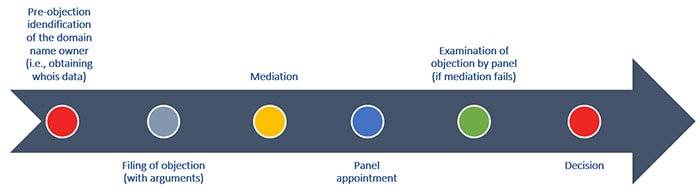
Under normal circumstances, the whole process may take around 2–3 months to be decided. An unsatisfied party that disagrees with the PPND decision may file a lawsuit with the court.

Possible Arguments

A claimant requesting a domain name take-down or transfer in accordance with the PPND policy must prove all of the following conditions:

  • The domain name is identical or confusingly similar to a trademark;
  • The registrant has no rights or legitimate interests in the domain name; and
  • The domain name has been registered and is being used in bad faith.

Of these three concurrent claims, the most challenging one to prove is the bad-faith intent. Nonetheless, it is essential. Even if a claimant can show valid trademark ownership and prove that the domain name in question was filed by an unauthorized entity, the PPND panels will refuse the claim if evidence of bad faith is lacking.

The strongest evidence of bad faith is any request (e.g. text message, email, etc.) by the registrant for compensation for transferring the domain name. Such evidence is straightforward proof that the registrant intended to sell, lease, or transfer the domain name for his or her financial benefit. However, of the 18 cases decided by the PPND since its inception, only seven were able to prove the registrant’s intent to sell the domain name for financial benefit.

There are other types of actions that are considered bad faith as well. For example, bad faith can be proven by showing that the registrant intends to prevent the trademark owner to use the contested domain name (i.e., parked domain), or by showing that the registrant intended to damage the trademark owner’s business activities. In addition, a domain name registrant intending to attract the internet user to another online location for illegal financial benefit would be another clear indication of bad faith.

Case Study

When the well-known video streaming service Netflix found that neflix.id had been registered by an unauthorized Indonesian citizen using their well-known trademark, they brought the matter before the PPND.

As the company had already registered their trademark in Indonesia, Netflix was able to prove that netflix.id was filed by an unauthorized party. However, no proof of intent to sell was forthcoming, so Netflix made the accusation that netflix.id was a parked domain, with the registrant trying to prevent Netflix from registering and using the domain name in Indonesia.

In his reply, the registrant pointed out that Netflix had not secured netflix.id before, and argued that in light of the “first to file” domain name registration principle, Netflix should have registered the domain name as soon as they were eligible to do so. The PPND, however, disagreed, deciding that the claim had in fact proved the three necessary conditions simultaneously. Hence, netflix.id was transferred to Netflix’s ownership.

Conclusion

Just as well-known brands are targeted by intellectual property infringers, these brands can also be targeted by parties wishing to benefit from their reputation or name recognition through a domain name. The process of acting against this in Indonesia is not simply a matter of trademark enforcement, but is a separate process governed by a different set of laws and regulations. Brand owners should be aware that having a trademark portfolio and strategy is often not enough; rather, they need a comprehensive and strategic awareness of how to manage all of their current and potential assets, including virtual properties such as domain names.

RELATED INSIGHTS​ 

October 30, 2023
A Resounding Victory The last days of October brought some excitement for one of the leading pharmaceutical companies in the world, Novartis, when its patent litigation case in Vietnam against a local generic manufacturer, which had stretched over more than eight years, finally came to an end. The background of this case is quite simple. Novartis was the owner of a patent protecting the active ingredient vildagliptin, which was commercialized through its Galvus® product, a medicine used to treat type 2 diabetes. In 2015, the company found that a drug manufacturer in Vietnam’s Binh Duong province on the outskirts of Ho Chi Minh City was producing a medicinal product containing the vildagliptin active ingredient—an infringement of its patent. Novartis first submitted a request to the Ministry of Science and Technology (MOST) to apply administrative sanctions on this infringer. Subsequently, the MOST Inspectorate concluded in July 2015 that the defendant had committed patent infringement and ordered them to stop producing the infringing drugs and recall them from the market. However, the defendant did not comply with the conclusion, and sought an appeal while it continued to produce the infringing medicine. Realizing that administrative sanctions were not strict enough to deter the defendant, Novartis continued to protect its legitimate rights and interests by initiating a lawsuit at the provincial court where the defendant was headquartered, Binh Duong. Novartis claimed that the defendant had infringed the patent and requesting the defendant to compensate for damages at the highest level allowed by law, pay attorney fees, and publicly apologize to Novartis in specialized newspapers. This began a long journey full of challenges that finally ended with the second appellate judgment declared by the High People’s Court of Ho Chi Minh City on October 17, 2023. The court accepted all claims raised by the
October 30, 2023
In its ongoing efforts to enhance Indonesia’s intellectual property e-filing system, the country’s Directorate General of Intellectual Property (DGIP) has consistently introduced improvements to the online system. In recent months, the DGIP has implemented several noteworthy changes that differ from previous versions of the system. These changes bear significant importance for applicants who intend to file IP applications, and include the changes highlighted below for designs, patents, and trademarks. Designs File format and view limitation. Under current rules, all design drawings must be submitted in JPG format, and only one view is permitted per page. No refund requests. Once the application payment has been made, refund requests are no longer an option. Figure limitation. Only one figure is allowed for each design view, with an exception made for reference and perspective views. Patents Title consistency. If an invention is already registered outside Indonesia through the Patent Cooperation Treaty (PCT), the title in the Indonesian registration application must match the title registered with the World Intellectual Property Organization (WIPO). Bibliographic data matching. In national phase applications, it is essential for all bibliographic data to mirror the information from the PCT international phase as listed on WIPO’s website. This conformity is crucial for a seamless application process. Excess claim fees. A new requirement stipulates that excess claim fees must be paid at the time of filing the patent application. Trademarks Goods and services selection. The DGIP requires applicants to choose their desired goods and services from a predefined list, and the provided list is not editable. The DGIP periodically updates this list, but there is no fixed schedule for these updates. Moreover, these updates can sometimes entail removal of items from the list, and requesting the addition of goods or services is often challenging, especially if a similar alternative already exists
October 25, 2023
Indonesia and South Korea have opened a patent prosecution highway (PPH) mechanism that allows applicants to seek patent protection in Indonesia by basing their application on a granted Korean patent. The PPH was opened following the conclusion of two memoranda of understanding (MOUs) between Indonesia’s Directorate General of Intellectual Property (DGIP) and the Korean Intellectual Property Office (KIPO) on September 8, 2023. One of the MOUs is about comprehensive cooperation in the field of intellectual property, while the other spells out the details of the PPH mechanism. When requested, the PPH will help applicants speed up the examination process for their patent applications in Indonesia using the substantive examination results issued by the KIPO. This can substantially shorten the amount of time required for the examination process period from approximately two years (from the substantive examination request) to less than one year (from the PPH request). Similar to a PPH request under Indonesia’s existing PPH agreement for Japanese patents, applicants can file a PPH request based on a granted Korean patent after the Indonesian patent application is published and before the issuance of the first office action. Requests must be accompanied by the official fee of IDR 5 million (approx. USD 315) for filing a PPH request. The scope of cooperation between the DGIP and KIPO, as described by the other MOU, includes increasing the countries’ capacity, framework, protection, inspection, and utilization of intellectual property, as well as other cooperative activities. The countries will also exchange information on how to increase public awareness about the importance of protecting intellectual property. For more information on this new bilateral cooperation, or on any aspect of patent protection in Indonesia, please contact Tilleke & Gibbins at [email protected] or +6221 2971 8088.
October 20, 2023
On October 18, 2023, Myanmar’s State Administration Council (SAC) issued notifications announcing the enforcement date of the Industrial Design Law and Copyright Law, which were both enacted in 2019. Notifications No. 217/2023 and No. 218/2023 set October 31, 2023, as the effective date for the Industrial Design Law and the Copyright Law, respectively. These notifications mark the beginning of the substantive protection framework for industrial designs and copyrights in the country. Myanmar’s Ministry of Commerce had already issued the Industrial Design Rules on September 29, 2023, laying out procedures and guidelines for registration of industrial designs under the Industrial Design Law. The next step will be the announcement of forms and official fees for conducting industrial design-related matters at Myanmar’s Intellectual Property Department (IPD)—a step that is imminent now that the effective date of the law has been announced. Rights owners should therefore begin assessing their portfolios and preparing the requirements for applying for registration to secure statutory rights for their industrial designs in Myanmar. The protection of copyrights arises automatically without a mandatory registration process. However, when the new Copyright Law takes effect, replacing the old Copyright Act of 1914, rights owners will be able to voluntarily record their copyrights under the framework established by the new law. These recordals can provide stronger evidence of ownership in the event of a dispute over the copyright work. For more information on these developments, or to check on the latest updates to Myanmar’s legal framework for protecting intellectual property, please contact Tilleke & Gibbins at [email protected].