
You are using an outdated browser and your browsing experience will not be optimal. Please update to the latest version of Microsoft Edge, Google Chrome or Mozilla Firefox. Install Microsoft Edge

March 2, 2021

Resolving Domain Name Disputes in Indonesia

Informed Counsel

Since 2014, Indonesia’s domain name registry (PANDI) has overseen the registration of .id domain names, following the earlier country code top-level domains (ccTLDs), such as .co.id, .or.id, and .go.id. PANDI has recently reported on the growth of .id domain names in 2019, which saw an increase in registrations of about 45%, reaching a total of 135,000 registrants.

An Indonesian Internet Providers Association (APJII) nationwide survey found that the number of internet users in Indonesia increased by 14.6 percent to 196 million people in the period between 2019 and Q2 2020, up from 171 million in 2018. The survey also revealed that Indonesia’s internet penetration rate has gone up to 73.7 percent. This means that the country is catching up with neighboring Brunei, Singapore, and Thailand, whose internet penetration rates exceeded 70 percent last year. Part of this increase seems to be related to the limitation of in-person activity in the wake of the COVID-19 outbreak.

This internet usage growth has also meant a higher incidence of cybercrimes and online disputes, including over domain names. According to the domain name dispute statistics from WIPO, there have been 274 generic top-level domain name disputes involving Indonesian respondents to date. Meanwhile, 18 cases have so far been decided by PANDI’s Domain Name Dispute Resolution (PPND) in fights against Indonesian ccTLD cybersquatters, third parties who attempt to register domain names using the trademarks of others. PPND, a non-litigation dispute settlement body for disputes over Indonesian internet domain names, handles domain name disputes related to trademarks, registered names or regarding matters of decency. The examination of such disputes is conducted by PPND panel(s).

PANDI’s Domain Name General Policy version 6.0, dated February 25, 2019, explains the five categories of.id domain names: normative, trademark-related, product- or service-related, distributorship-related, or institutional.

Ministry of Communication Regulation No. 23 of 2013 regarding Domain Name Management stipulates that a registered trademark holder is entitled to register, use, and benefit from Indonesian ccTLDs. Based on PANDI’s naming guidelines, a trademark registration or application is required if the applicant claims that the domain name is related to their trademark. However, in practice, the registrar typically only requires a copy of the registrant’s ID card to proceed with the .id domain name registration, because the registrar may choose another naming criterion that does not require a trademark or other IP ownership. This may lead to the registration of .id domains by cybersquatters.

Procedures

PPND welcomes any trademark holder to file a complaint regarding domain names violating their registered trademark, before filing litigation with the court.

The current PPND policy (version 7.0) requires that every claimant file a pre-objection as the first step. The pre-objection phase includes a request for the whois data, which reveals the owner of a domain. Obtaining the results takes around three days after the pre-objection documents are completed and accepted by PPND. Upon receiving the pre-objection result, the next step is filing an objection laying out pertinent arguments. PPND may then proceed to mediation, followed by examination of the objection.

The simplified timeline below shows the key steps in the process.
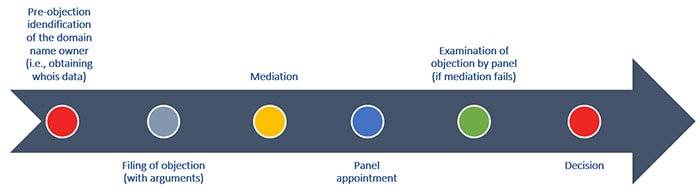
Under normal circumstances, the whole process may take around 2–3 months to be decided. An unsatisfied party that disagrees with the PPND decision may file a lawsuit with the court.

Possible Arguments

A claimant requesting a domain name take-down or transfer in accordance with the PPND policy must prove all of the following conditions:

  • The domain name is identical or confusingly similar to a trademark;
  • The registrant has no rights or legitimate interests in the domain name; and
  • The domain name has been registered and is being used in bad faith.

Of these three concurrent claims, the most challenging one to prove is the bad-faith intent. Nonetheless, it is essential. Even if a claimant can show valid trademark ownership and prove that the domain name in question was filed by an unauthorized entity, the PPND panels will refuse the claim if evidence of bad faith is lacking.

The strongest evidence of bad faith is any request (e.g. text message, email, etc.) by the registrant for compensation for transferring the domain name. Such evidence is straightforward proof that the registrant intended to sell, lease, or transfer the domain name for his or her financial benefit. However, of the 18 cases decided by the PPND since its inception, only seven were able to prove the registrant’s intent to sell the domain name for financial benefit.

There are other types of actions that are considered bad faith as well. For example, bad faith can be proven by showing that the registrant intends to prevent the trademark owner to use the contested domain name (i.e., parked domain), or by showing that the registrant intended to damage the trademark owner’s business activities. In addition, a domain name registrant intending to attract the internet user to another online location for illegal financial benefit would be another clear indication of bad faith.

Case Study

When the well-known video streaming service Netflix found that neflix.id had been registered by an unauthorized Indonesian citizen using their well-known trademark, they brought the matter before the PPND.

As the company had already registered their trademark in Indonesia, Netflix was able to prove that netflix.id was filed by an unauthorized party. However, no proof of intent to sell was forthcoming, so Netflix made the accusation that netflix.id was a parked domain, with the registrant trying to prevent Netflix from registering and using the domain name in Indonesia.

In his reply, the registrant pointed out that Netflix had not secured netflix.id before, and argued that in light of the “first to file” domain name registration principle, Netflix should have registered the domain name as soon as they were eligible to do so. The PPND, however, disagreed, deciding that the claim had in fact proved the three necessary conditions simultaneously. Hence, netflix.id was transferred to Netflix’s ownership.

Conclusion

Just as well-known brands are targeted by intellectual property infringers, these brands can also be targeted by parties wishing to benefit from their reputation or name recognition through a domain name. The process of acting against this in Indonesia is not simply a matter of trademark enforcement, but is a separate process governed by a different set of laws and regulations. Brand owners should be aware that having a trademark portfolio and strategy is often not enough; rather, they need a comprehensive and strategic awareness of how to manage all of their current and potential assets, including virtual properties such as domain names.

RELATED INSIGHTS​ 

August 7, 2024
A recent case at the Myanmar Competition Commission has set a significant precedent in the country’s approach to unfair competition practices. The case, involving a Thai manufacturer of cement grout and tile adhesive products and a local Myanmar producer, highlighted the Commission’s willingness to address issues of deceptive marketing and unfair competition. Background The case centered around a Thai manufacturer who has been distributing their cement grout and tile adhesive products in Myanmar for many years through local distribution agents. The company had established a well-known brand and a strong reputation for quality in the Myanmar market. In recent years, the Thai company discovered that a local individual in Myanmar was manufacturing and selling similar products with packaging nearly identical to their own. The local producer was using the same mark device, color, and packaging design themes, and the products contained deceptive information. Legal Proceedings After an initial cease-and-desist letter failed to resolve the issue, a complaint was submitted to the Myanmar Competition Commission. The case was notable because the Commission typically does not address issues of copying designs, marks, colors, or packaging themes. However, the complaint emphasized that the local individual was misleading customers and competing unfairly by using deceptive information and copying distinctive designs and themes. Lawyers from Tilleke & Gibbins, representing the Thai manufacturer, provided extensive documentation proving their client’s long-standing presence in the Myanmar market and the local individual’s deceptive practices. The Commission’s Investigation Committee conducted a thorough investigation, including market surveys and hearings involving both parties. Commission’s Decision After nearly a year of deliberation, on July 4, 2024, the Decision-Making Committee of the Myanmar Competition Commission ruled in favor of the Thai manufacturer. The decision required the local individual to: Immediately cease the production and distribution of cement grout and tile adhesive products bearing
July 31, 2024
On the afternoon of 19 April 2024, a cramped courtroom at the People’s Court of Hanoi was the setting for the first criminal trial of a case of copyright and related rights infringement in Vietnam, regarding the act of illegal streaming of English Premier League football matches on online platforms. This case is expected to open the door for the criminal prosecution of other cases of copyright and related rights infringement on the internet, an area that has faced numerous difficulties over the past two decades. First criminal case of illegal streaming Vietnamese criminal law has long had provisions in place for criminal handling of copyright infringement crimes, specifically in Article 131 of the 1999 Penal Code. However, more than 20 years after this law took effect, and even though Vietnam enacted the 2015 Penal Code with subsequent amendments, these regulations have remained mainly a law on paper only, and many significant and serious cases causing great frustration for rights holders and society have not been criminally prosecuted. The case in question was initiated by a denunciation of the BestBuyIPTV subscription service by the Football Association Premier League Limited (the “Premier League”) and the Alliance for Creativity and Entertainment (“ACE”), a coalition of global entertainment companies and film studios dedicated to combating digital piracy and copyright infringement. BestBuyIPTV had illegally streamed Premier League matches and other protected works without authorization of the rights holders. In 2023, after an extensive investigation, the Cybersecurity and High-Tech Crime Prevention Division (PA05) and the Police Department for Investigating Corruption, Smuggling, and Economic Crimes (PC03) of the Hanoi police brought a case for criminal copyright infringement, pursuant to Article 225 of the 2015 Penal Code, against the offender, an individual named Le Hai Nam, consolidating the dossiers for the People’s Procuracy to indict this
July 24, 2024
Experts from Tilleke & Gibbins’ intellectual property team have contributed an updated Intellectual Property Transactions in Vietnam to Thomson Reuters Practical Law, a high-level comparative overview of  laws and regulations across multiple jurisdictions. Intellectual Property Transactions focuses on business-related aspects of intellectual property, such as the value of intellectual assets in M&A transactions, and the licensing of IP portfolios. Key topics covered in the chapter include: IP assignment: Basis and formalities for assignments of patents, utility models, trademarks, copyright, design rights, trade secrets, confidential information, and domain names. IP licensing: Scope and formalities for licensing patents, utility models, trademarks, copyright, design rights, and trade secrets. Research and development collaborations. IP audits. IP aspects of M&A: Due diligence, warranties/indemnities, and transfer of IPRs. Employee and consultant agreements. Practical Law, a legal reference resource from Thomson Reuters, publishes a range of guides for hundreds of jurisdictions and practice areas. The Intellectual Property Transactions Global Guide is a valuable resource for legal practitioners, covering numerous jurisdictions worldwide. To view the latest version of the Intellectual Property Transactions in Vietnam overview, please visit the Practical Law website and enroll in the free Practical Law trial to gain full access.
July 24, 2024
Intellectual property specialists from Tilleke & Gibbins in Thailand have contributed an updated Intellectual Property Transactions in Thailand overview for Thomson Reuters Practical Law, an online publication that provides comprehensive legal guides for jurisdictions worldwide. The Thailand overview was authored by Darani Vachanavuttivong, managing partner of Tilleke & Gibbins and managing director of the firm’s regional IP practice; Titikaan Ungbhakorn, senior associate and patent agent; and San Chaithiraphant, senior associate. The chapter delivers a high-level examination of critical aspects of IP law, including IP assignment and licensing, research and development collaborations, IP in mergers and acquisitions (M&A), securing loans with intellectual property rights, settlement agreements, employee-related IP issues, competition law, taxation, and non-tariff trade barriers. Key topics covered in the chapter include: IP assignment: Basis and formalities for assignments of patents, utility models, trademarks, copyright, design rights, trade secrets, confidential information, and domain names. IP licensing: Scope and formalities for licensing patents, utility models, trademarks, copyright, design rights, and trade secrets. Research and development collaborations: Management of improvements, derivatives, and joint ownership of IP. IP aspects of M&A: Due diligence and critical considerations during mergers and acquisitions. Practical Law, a legal reference resource from Thomson Reuters, publishes a range of guides for hundreds of jurisdictions and practice areas. The Intellectual Property Transactions Global Guide is a valuable resource for legal practitioners, covering numerous jurisdictions worldwide. To view the latest version of the Intellectual Property Transactions in Thailand overview, please visit the Practical Law website and enroll in the free Practical Law trial to gain full access.