
You are using an outdated browser and your browsing experience will not be optimal. Please update to the latest version of Microsoft Edge, Google Chrome or Mozilla Firefox. Install Microsoft Edge

March 2, 2021

Resolving Domain Name Disputes in Indonesia

Informed Counsel

Since 2014, Indonesia’s domain name registry (PANDI) has overseen the registration of .id domain names, following the earlier country code top-level domains (ccTLDs), such as .co.id, .or.id, and .go.id. PANDI has recently reported on the growth of .id domain names in 2019, which saw an increase in registrations of about 45%, reaching a total of 135,000 registrants.

An Indonesian Internet Providers Association (APJII) nationwide survey found that the number of internet users in Indonesia increased by 14.6 percent to 196 million people in the period between 2019 and Q2 2020, up from 171 million in 2018. The survey also revealed that Indonesia’s internet penetration rate has gone up to 73.7 percent. This means that the country is catching up with neighboring Brunei, Singapore, and Thailand, whose internet penetration rates exceeded 70 percent last year. Part of this increase seems to be related to the limitation of in-person activity in the wake of the COVID-19 outbreak.

This internet usage growth has also meant a higher incidence of cybercrimes and online disputes, including over domain names. According to the domain name dispute statistics from WIPO, there have been 274 generic top-level domain name disputes involving Indonesian respondents to date. Meanwhile, 18 cases have so far been decided by PANDI’s Domain Name Dispute Resolution (PPND) in fights against Indonesian ccTLD cybersquatters, third parties who attempt to register domain names using the trademarks of others. PPND, a non-litigation dispute settlement body for disputes over Indonesian internet domain names, handles domain name disputes related to trademarks, registered names or regarding matters of decency. The examination of such disputes is conducted by PPND panel(s).

PANDI’s Domain Name General Policy version 6.0, dated February 25, 2019, explains the five categories of.id domain names: normative, trademark-related, product- or service-related, distributorship-related, or institutional.

Ministry of Communication Regulation No. 23 of 2013 regarding Domain Name Management stipulates that a registered trademark holder is entitled to register, use, and benefit from Indonesian ccTLDs. Based on PANDI’s naming guidelines, a trademark registration or application is required if the applicant claims that the domain name is related to their trademark. However, in practice, the registrar typically only requires a copy of the registrant’s ID card to proceed with the .id domain name registration, because the registrar may choose another naming criterion that does not require a trademark or other IP ownership. This may lead to the registration of .id domains by cybersquatters.

Procedures

PPND welcomes any trademark holder to file a complaint regarding domain names violating their registered trademark, before filing litigation with the court.

The current PPND policy (version 7.0) requires that every claimant file a pre-objection as the first step. The pre-objection phase includes a request for the whois data, which reveals the owner of a domain. Obtaining the results takes around three days after the pre-objection documents are completed and accepted by PPND. Upon receiving the pre-objection result, the next step is filing an objection laying out pertinent arguments. PPND may then proceed to mediation, followed by examination of the objection.

The simplified timeline below shows the key steps in the process.
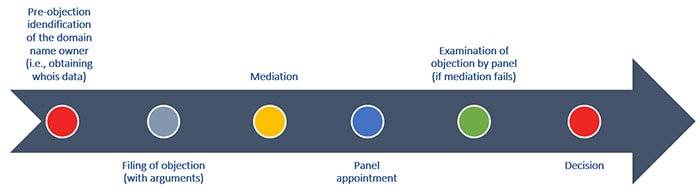
Under normal circumstances, the whole process may take around 2–3 months to be decided. An unsatisfied party that disagrees with the PPND decision may file a lawsuit with the court.

Possible Arguments

A claimant requesting a domain name take-down or transfer in accordance with the PPND policy must prove all of the following conditions:

  • The domain name is identical or confusingly similar to a trademark;
  • The registrant has no rights or legitimate interests in the domain name; and
  • The domain name has been registered and is being used in bad faith.

Of these three concurrent claims, the most challenging one to prove is the bad-faith intent. Nonetheless, it is essential. Even if a claimant can show valid trademark ownership and prove that the domain name in question was filed by an unauthorized entity, the PPND panels will refuse the claim if evidence of bad faith is lacking.

The strongest evidence of bad faith is any request (e.g. text message, email, etc.) by the registrant for compensation for transferring the domain name. Such evidence is straightforward proof that the registrant intended to sell, lease, or transfer the domain name for his or her financial benefit. However, of the 18 cases decided by the PPND since its inception, only seven were able to prove the registrant’s intent to sell the domain name for financial benefit.

There are other types of actions that are considered bad faith as well. For example, bad faith can be proven by showing that the registrant intends to prevent the trademark owner to use the contested domain name (i.e., parked domain), or by showing that the registrant intended to damage the trademark owner’s business activities. In addition, a domain name registrant intending to attract the internet user to another online location for illegal financial benefit would be another clear indication of bad faith.

Case Study

When the well-known video streaming service Netflix found that neflix.id had been registered by an unauthorized Indonesian citizen using their well-known trademark, they brought the matter before the PPND.

As the company had already registered their trademark in Indonesia, Netflix was able to prove that netflix.id was filed by an unauthorized party. However, no proof of intent to sell was forthcoming, so Netflix made the accusation that netflix.id was a parked domain, with the registrant trying to prevent Netflix from registering and using the domain name in Indonesia.

In his reply, the registrant pointed out that Netflix had not secured netflix.id before, and argued that in light of the “first to file” domain name registration principle, Netflix should have registered the domain name as soon as they were eligible to do so. The PPND, however, disagreed, deciding that the claim had in fact proved the three necessary conditions simultaneously. Hence, netflix.id was transferred to Netflix’s ownership.

Conclusion

Just as well-known brands are targeted by intellectual property infringers, these brands can also be targeted by parties wishing to benefit from their reputation or name recognition through a domain name. The process of acting against this in Indonesia is not simply a matter of trademark enforcement, but is a separate process governed by a different set of laws and regulations. Brand owners should be aware that having a trademark portfolio and strategy is often not enough; rather, they need a comprehensive and strategic awareness of how to manage all of their current and potential assets, including virtual properties such as domain names.

RELATED INSIGHTS​ 

March 6, 2025
Vietnam’s government is currently undergoing a significant restructuring, consolidating and eliminating various agencies with the aim of streamlining operations and increasing efficiency. The restructuring will bring notable changes to the country’s intellectual property (IP) landscape. We discuss below key developments that may influence IP protection and enforcement in Vietnam in the coming years. Mergers of Ministries One of the most notable changes in the restructuring is the merger of several ministries, including the Ministry of Information and Communications (MIC) and the Ministry of Science and Technology (MOST). Vietnam’s Intellectual Property Office is a unit under MOST; therefore, this merger is expected to impact various aspects of IP administration and enforcement. With the newly merged ministry—which is expected to retain the name of MOST—actively supporting the development of the digital economy, further advancements in digital tools for IP administration and prosecution are anticipated. This could include enhancements in e-filing, online procedures, and digital payment systems, contributing to greater accessibility and efficiency in IP-related services. Domain name disputes can also expect to see a more coordinated approach under the new ministry. Previously, jurisdiction over domain name disputes was divided between MIC and MOST, sometimes leading to procedural complexities. With both areas now under a single ministry, these matters are expected to be handled more seamlessly, potentially with a model aligned with the Uniform Domain Name Dispute Resolution Policy (UDRP). Structural Changes in Inspection Authorities The restructuring also affects inspection authorities responsible for IP enforcement, particularly those under MOST and the Ministry of Culture, Sports, and Tourism (MOCST). These changes may cause temporary delays in administrative enforcement actions: The MOST Inspectorate, which handles industrial property violations, may experience slower enforcement during the transition. The MOCST Inspectorate, responsible for copyright enforcement, may face similar disruptions. However, these delays are expected to be temporary,
February 3, 2025
Thailand’s aim of hosting entertainment complexes that include casinos is moving forward with the cabinet’s approval in principle of the draft Entertainment Complex Business Act on January 13, 2025. In fact, Thailand has studied the pros and cons of allowing the operation of entertainment complexes since March 2019. Though the initial surge of global interest died down during the COVID-19 pandemic, the country renewed its efforts with the recent draft law. This is part of the government’s aim of bringing parts of the informal economy (or shadow economy) and the underground economy—estimated to be more than 50% of Thailand’s GDP—into the revenue system. While many authors have provided analyses of the bill’s contents, this article explores how the enforcement of the Entertainment Complex Bill after its passage would relate to various aspects of intellectual property (IP) in the casino business in the context of Thai law. Below are some examples of the potential effects of the draft legislation on IP rights in Thailand. Public Order and Public Policy Under Thai law, contradiction of public order, good morality, or public policy is grounds for denying IP protection. With the eventual passage and enforcement of the Entertainment Complex Bill, IP rights related to gaming that used to be regarded as contrary to the public order and received no protection under the current law would become eligible for legal protection and considered registrable under the law. This is similar to what happened recently with cannabis in Thailand. Legalization of cannabis opened up pathways for trademark and patent protection in this industry. IP in the casino industry encompasses a wide range of assets, including patents, trademarks, copyrights, and trade secrets. These IP rights protect the unique features of casino games, gaming machines, software, and branding elements. For instance, in Thailand patents can cover
January 29, 2025
The fourth round of negotiations of the EU-Thailand Free Trade Agreement (FTA) wrapped up in Bangkok in November 2024. Now that the latest summary report is out, it is worth highlighting some of the intellectual property (IP)-related changes we might see once the chapter is complete. Copyright If Thailand were to agree to follow the EU proposal, we would see the term of protection for copyright extended. Currently under Thai law, protection is the life of the author plus fifty years. This is twenty years less than the EU proposal. It seems that copyright is one area the two sides have yet to agree on, and it is no wonder as agreeing to follow Thai law would deprive authors from the EU of an additional twenty years of protection post-death. On the other hand, Thailand agreeing to the EU proposal would likely result in legislative change in the country to align domestic law with the FTA. We may also see more robust and streamlined collective management organizations (CMOs) in Thailand. The current proposal calls for each party to promote cooperation between their CMOs, which would extend to transparency over their running, including revenue and representation agreements. Thailand does currently have CMOs within the territory, and the Department of Intellectual Property (DIP) has a voluntary CMO code. However, it is unclear whether existing practice will be sufficient for EU rightsholders. CMOs have been an area that is difficult to regulate as there has been a balancing act between tightening the examination of reporting and not wanting to limit the freedom of rightsholders and how they commercialize their IP. Trademarks There is a fair amount of overlap between the Trademark Act in Thailand and the EU proposals. However, it is unclear to what degree the existing laws would satisfy the requests
January 21, 2025
A proposal to establish a specialized Intellectual Property Court in Vietnam has been a topic of significant interest among IP practitioners for the past 20 years. It was thus a major breakthrough when the new Law on the Organization of People’s Courts was ratified in 2024, stipulating in Article 4.1(dd) that the Vietnamese court system would include a specialized first-instance IP Court. The new law took effect on January 1, 2025, replacing the Law on the Organization of People’s Courts of 2014, A groundbreaking law This breakthrough can be viewed from multiple perspectives. First of all, in terms of organization, this is the first time, after numerous considerations, that Vietnam has officially recognized the importance of the IP field and the need to establish a specialized adjudicative body due to the field’s unique nature. The establishment of a specialized first-instance IP Court is expected to lead to fundamental changes in the practice of developing and applying IP law. While the establishment of IP rights such as trademarks, patents, and plant varieties is managed by administrative agencies such as the Intellectual Property Office, the Copyright Office, and the Crop Production Department, which seem unlikely to change their functions and tasks, there could be significant changes in the enforcement of these rights, which has been a persistent issue in Vietnam’s IP law system. Thus far, in practice, the enforcement of IP rights in Vietnam has relied overwhelmingly on administrative measures over civil measures. Civil measures, typically involving court proceedings under which the matter will be submitted to a court for settlement, are not appealing to disputing parties, especially IP rights owners. The absence of a specialized court has led to many IP cases being handled by judges without any knowledge or experience in this specialized field, resulting in confusion, misconceptions about