
You are using an outdated browser and your browsing experience will not be optimal. Please update to the latest version of Microsoft Edge, Google Chrome or Mozilla Firefox. Install Microsoft Edge

May 19, 2020

Reinsurance Revolution in Myanmar

On May 12, 2020, Myanmar’s Insurance Business Regulatory Board (IBRB) issued Directive 4/2020—a game-changer for the insurance industry in Myanmar. Previously, reinsurance in Myanmar had only been available through the state-owned Myanma Insurance, without competition. However, when this directive comes into force on October 1, 2020, insurance companies (or cedants) will be able to obtain reinsurance from other insurers or reinsurers within Myanmar or abroad, with certain restrictions.

Reinsurance (and retrocession—the insurance or reinsurance of reinsurers) is a critical part of the insurance industry because it allows insurance companies to spread their risk and remain solvent in the event of large claims. It is expected that this new directive will result in Myanmar insurers—already undergoing tectonic shifts following the introduction of five foreign life insurer licenses and six foreign-Myanmar insurance joint ventures—seeking substantial reinsurance outside Myanmar. This greater spreading of insurance risk is a very positive development for the insurance market in Myanmar.

Reinsurance and Risk Retention

Under the directive, every insurer in Myanmar must retain risk up to the maximum amount commensurate with its financial strength, and must formulate a suitable retention policy for each insurance segment. In the case of life insurers and reinsurers transacting life insurance business, that must be a minimum of 20% of the sum at risk.

Every Myanmar insurer must also formulate a reinsurance program and retention policy and submit it to the IBRB at the beginning of each financial year.

Reinsurers and Licensing

Any reinsurer who wishes to operate within Myanmar must have a reinsurance license from the IBRB.

Foreign reinsurers or cross-border reinsurers who do not have a license to conduct insurance business in Myanmar will now also be permitted, subject to the following conditions:

  • They must have been licensed in their home country for at least the past three continuous years;
  • They must have a credit rating of at least BBB from S&P or equivalent for at least the past three continuous years;
  • They must have maintained a minimum solvency margin or capital adequacy as specified by their home country regulator for at least the past three continuous years;
  • Their past claims settlement must be satisfactory to the IBRB; and
  • They must comply with other requirements that may be stipulated by the IBRB.

Engaging a Reinsurer

Other than for life insurance, insurers must offer the best terms obtained to reinsurers in the following order:

  1. Myanma Insurance;
  2. Myanmar reinsurers or foreign reinsurers with representative offices in Myanmar; and
  3. Foreign reinsurers.

Insurers are obliged to follow this order of priority only if the terms offered are equaled (or bettered).

Again, other than life insurance, the IBRB has placed the following limits on cession to foreign reinsurers:
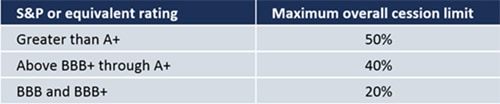
However, there is one catch that may prove frustrating. Section 20 of the directive provides that every Myanmar insurer, Myanmar reinsurer, and foreign reinsurer must cede a compulsory maximum of 10% of any insurance segment business to Myanma Insurance. Myanma Insurance is free to accept or reject the cession and will presumably be able to impose upon it such terms as it sees fit. Only if Myanma Insurance fails to offer such reinsurance is the insurer free to obtain cross border reinsurance from a foreign reinsurer for that original 10%. It seems probable that this provision will have a negative effect, because it will likely result in insurers being forced to comply with uncommercial terms from Myanma Insurance, despite better terms being available in Myanmar or abroad.

Insurance Pools

Insurance pools are another method by which smaller insurance companies can share risk. Insurance pools may now be formed in Myanmar, subject to a proposal being made to and approved by the IBRB.

Conclusion

Despite what some may see as the unwelcome involvement of Myanma Insurance, this directive is undoubtedly a giant step forward in the further liberalization and spreading of risk within the Myanmar insurance market, and is likely to herald large changes in reinsurance and retrocession both inside Myanmar and beyond.

For more information on this development, or on any aspect of doing business in Myanmar, please contact Tilleke & Gibbins’ Yangon office on [email protected]

RELATED INSIGHTS​ 

August 8, 2025
Thailand’s Office of Insurance Commission (OIC) has opened a public hearing period on its amendments of notifications concerning the timeframe for an insurance company to submit its annual financial statements and financial and operating reports (called “XML reports”). The amended notifications also require insurance companies to submit some data sets from the quarterly capital maintenance reports and XML reports to the OIC in advance, before the full reports are submitted. Key changes in these amended notifications are summarized below. Financial Statements Audited annual financial statements will need to be submitted to the OIC within two months from the last day of each calendar year (i.e., by the end of February of the following year), instead of within four months as currently required. Capital Maintenance Reports While the deadline for submitting quarterly capital maintenance reports is still 45 days from the last day of the quarter, the OIC will now require life and non-life insurance companies to submit a set of data from the report in advance, within 21 days from the last day of each quarter. This data set includes the following information from the capital maintenance report: Form 1 – Calculation of Capital Adequacy Ratio (CAR) Form 2 – Calculation of Total Capital Available (TCA) Form 4 – Calculation of Capital for Insurance Risk (Table 4.1, 4.2, 4.4, and 4.5 for life insurance companies; Table 4.1 and 4.2 for non-life insurance companies) Financial and Operating Reports (XML Reports) Similar to the audited annual financial statement, the annual XML report will need to be submitted to the OIC within two months from the last day of each calendar year, instead of within the current four-month timeframe. For quarterly XML reports, which must still be submitted within 45 days from the last day of each quarter, there is a new
June 24, 2025
Insurance specialists from Tilleke & Gibbins in Bangkok have contributed the Thailand chapter to the newly released 2025 edition of Thomson Reuters’ Practical Law guide to insurance and reinsurance. The Thailand chapter offers a comprehensive Q&A-style overview of the legal and regulatory framework governing insurance and reinsurance in the country. It provides key insights for businesses, insurers, reinsurers, and intermediaries operating in or entering the Thai market. Key topics covered include: Market structure and common types of insurance; Regulatory framework and oversight by the Office of Insurance Commission (OIC); Authorisation requirements for insurers, reinsurers, and intermediaries; Ownership restrictions and foreign investment rules; Corporate governance, capital requirements, and solvency obligations; Reinsurance arrangements, including fronting, risk transfer, and common contractual clauses; Policy content requirements, standard clauses, and consumer protections; Claims procedures, statutory time limits, and subrogation rights; Dispute resolution mechanisms, including OIC arbitration and court proceedings; Insolvency protections for policyholders; Tax treatment of insurance and reinsurance businesses in Thailand; Recent legal developments, including pending amendments to the Life and Non-Life Insurance Acts and updated OIC regulations on reinsurance and investment activities. The 2025 edition reflects Thailand’s evolving regulatory environment, including proposed legislative reforms to strengthen corporate governance, risk-based capital requirements, and financial stability in the insurance sector. It also highlights practical considerations for foreign insurers, reinsurers, and intermediaries seeking to participate in Thailand’s insurance market. Tilleke & Gibbins contributes regularly to the Practical Law series of guides for various jurisdictions in Southeast Asia, providing trusted legal insight for multinational companies. To access the latest Thailand chapter of the insurance and reinsurance guide, please visit the Practical Law website and enroll in the free Practical Law trial to gain full access.
May 28, 2025
Tilleke & Gibbins attorneys in Vietnam have contributed the 2025 edition of Doing Business in Vietnam, a comprehensive Q&A-style resource from Thomson Reuters Practical Law that provides essential insights for companies navigating business operations in Vietnam. The guide presents a detailed overview of the country’s legal framework and regulatory environment, reflecting recent updates in Vietnamese legislation and practice. This annually updated guide offers key information on the following areas: Legal system: Structure of the Vietnamese judiciary and the role of codified law. Foreign investment: Conditions for market access, licensing requirements, foreign ownership restrictions, and investment incentives. Business vehicles: Formation and operation of legal entities, including limited liability companies, joint-stock companies, and representative offices. Employment: Employment contracts, social insurance, labor rights, and procedures for hiring foreign nationals. Tax: Overview of corporate income tax, personal income tax, value-added tax, and other tax obligations. Intellectual property: Procedures for protecting and enforcing patents, trademarks, copyrights, and other IP rights. Data protection: Compliance requirements under Vietnam’s data privacy laws, including the Personal Data Protection Decree. Competition law: Antitrust rules and regulatory oversight under the Law on Competition. Anti-bribery and corruption: Legal framework and enforcement practices aimed at curbing corrupt activities. E-commerce and digital business: Regulations governing online platforms, digital content, and cross-border services. Marketing and advertising: Laws and guidelines on advertising standards and consumer protection. Product regulation and liability: Safety requirements, product liability issues, and roles of relevant authorities. Doing Business in Vietnam is part of Practical Law’s global series of legal guides designed to support international practitioners and businesses. To access the most recent edition of the Vietnam guide, visit the Practical Law website and sign up for a free trial.
May 2, 2025
Attorneys from Tilleke & Gibbins have updated the latest edition of Doing Business in Thailand, a Q&A-style guide from Thomson Reuters Practical Law that offers an overview of key legal considerations for companies operating in jurisdictions worldwide. The contribution outlines the country’s legal and regulatory framework for foreign investment and business operations and reflects the latest legislative developments. The chapter addresses the following core topics: Legal system: Structure of the courts and the codified nature of Thai law. Foreign investment: Business restrictions under the Foreign Business Act, sector-specific regulations, exchange control rules, and investment incentives. Business vehicles: Overview of partnerships, private and public limited companies, and other legal entities. Employment: Labor protections, employment contracts, foreign worker requirements, and termination procedures. Tax: Corporate and personal income tax, indirect taxes, and tax obligations for residents and non-residents. Intellectual property: Registration and enforcement of patents, trademarks, designs, and copyrights. Data protection: Key provisions of the Personal Data Protection Act and related compliance obligations. Competition law: Regulatory framework under the Trade Competition Act. Anti-bribery and corruption: Relevant legislation and enforcement mechanisms. E-commerce and digital business: Legal regime for online transactions and digital platforms. Marketing and advertising: Consumer protection laws and regulations affecting advertising and marketing practices. Product regulation and liability: Safety standards, liability regimes, and roles of enforcement authorities. Practical Law, a legal reference resource from Thomson Reuters, publishes a range of guides for hundreds of jurisdictions and practice areas. The insurance and reinsurance guide is a valuable resource for legal practitioners, covering numerous jurisdictions worldwide. To view the latest version of the guide, please visit the Practical Law website and enroll in the free Practical Law trial to gain full access.