
You are using an outdated browser and your browsing experience will not be optimal. Please update to the latest version of Microsoft Edge, Google Chrome or Mozilla Firefox. Install Microsoft Edge

May 19, 2020

Reinsurance Revolution in Myanmar

On May 12, 2020, Myanmar’s Insurance Business Regulatory Board (IBRB) issued Directive 4/2020—a game-changer for the insurance industry in Myanmar. Previously, reinsurance in Myanmar had only been available through the state-owned Myanma Insurance, without competition. However, when this directive comes into force on October 1, 2020, insurance companies (or cedants) will be able to obtain reinsurance from other insurers or reinsurers within Myanmar or abroad, with certain restrictions.

Reinsurance (and retrocession—the insurance or reinsurance of reinsurers) is a critical part of the insurance industry because it allows insurance companies to spread their risk and remain solvent in the event of large claims. It is expected that this new directive will result in Myanmar insurers—already undergoing tectonic shifts following the introduction of five foreign life insurer licenses and six foreign-Myanmar insurance joint ventures—seeking substantial reinsurance outside Myanmar. This greater spreading of insurance risk is a very positive development for the insurance market in Myanmar.

Reinsurance and Risk Retention

Under the directive, every insurer in Myanmar must retain risk up to the maximum amount commensurate with its financial strength, and must formulate a suitable retention policy for each insurance segment. In the case of life insurers and reinsurers transacting life insurance business, that must be a minimum of 20% of the sum at risk.

Every Myanmar insurer must also formulate a reinsurance program and retention policy and submit it to the IBRB at the beginning of each financial year.

Reinsurers and Licensing

Any reinsurer who wishes to operate within Myanmar must have a reinsurance license from the IBRB.

Foreign reinsurers or cross-border reinsurers who do not have a license to conduct insurance business in Myanmar will now also be permitted, subject to the following conditions:

  • They must have been licensed in their home country for at least the past three continuous years;
  • They must have a credit rating of at least BBB from S&P or equivalent for at least the past three continuous years;
  • They must have maintained a minimum solvency margin or capital adequacy as specified by their home country regulator for at least the past three continuous years;
  • Their past claims settlement must be satisfactory to the IBRB; and
  • They must comply with other requirements that may be stipulated by the IBRB.

Engaging a Reinsurer

Other than for life insurance, insurers must offer the best terms obtained to reinsurers in the following order:

  1. Myanma Insurance;
  2. Myanmar reinsurers or foreign reinsurers with representative offices in Myanmar; and
  3. Foreign reinsurers.

Insurers are obliged to follow this order of priority only if the terms offered are equaled (or bettered).

Again, other than life insurance, the IBRB has placed the following limits on cession to foreign reinsurers:
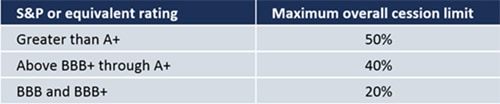
However, there is one catch that may prove frustrating. Section 20 of the directive provides that every Myanmar insurer, Myanmar reinsurer, and foreign reinsurer must cede a compulsory maximum of 10% of any insurance segment business to Myanma Insurance. Myanma Insurance is free to accept or reject the cession and will presumably be able to impose upon it such terms as it sees fit. Only if Myanma Insurance fails to offer such reinsurance is the insurer free to obtain cross border reinsurance from a foreign reinsurer for that original 10%. It seems probable that this provision will have a negative effect, because it will likely result in insurers being forced to comply with uncommercial terms from Myanma Insurance, despite better terms being available in Myanmar or abroad.

Insurance Pools

Insurance pools are another method by which smaller insurance companies can share risk. Insurance pools may now be formed in Myanmar, subject to a proposal being made to and approved by the IBRB.

Conclusion

Despite what some may see as the unwelcome involvement of Myanma Insurance, this directive is undoubtedly a giant step forward in the further liberalization and spreading of risk within the Myanmar insurance market, and is likely to herald large changes in reinsurance and retrocession both inside Myanmar and beyond.

For more information on this development, or on any aspect of doing business in Myanmar, please contact Tilleke & Gibbins’ Yangon office on [email protected]

RELATED INSIGHTS​ 

May 27, 2024
Thailand’s Office of Insurance Commission (OIC) has opened a public hearing period on a draft notification from the Ministry of Finance (MOF) that would relax foreign shareholding and board limits for life insurers. The hearing period runs until May 31, 2024. Key principles of the draft notification are outlined below. Life Insurer Qualifications Life insurers may apply for permission to exceed 49% foreign shareholding or have a majority of foreign directors if: They operate a business that may cause harm to insured parties or the public and either (1) the OIC has directed the company to improve its status or adjust its capital, or (2) the company’s actions may have a significant impact on the insurance industry, causing significant compensation burdens and affecting the company’s capital adequacy ratio (CAR); Their shareholders are unable to increase capital; and They are unable to attract Thai investors to increase the capital necessary to ensure stability and the long-term operation of the business. Foreign Shareholder Qualifications Eligible foreign shareholders must: Be an insurance company or participate in the insurance industry; Have at least 10 years of relevant experience; Demonstrate financial stability and possess a credit rating (or have a parent company with a credit rating) of at least “A” from a reliable credit rating agency; Present a clear business plan, financial resolution plan and strategy, and technological and expertise development plan to develop and promote the company’s efficiency and competitiveness in the industry; and Be capable of investing and increasing the capital to at least THB 2 billion to maintain stability and maintain a CAR of at least 250%. In addition, life insurers are required to present a clear restructuring plan and new organization chart to the OIC for further approval by the MOF. For more details on the MOF’s notification regarding criteria
May 21, 2024
Thailand’s Office of Insurance Commission (OIC) has released draft Notifications regarding Guidelines for Considering Qualifications and Suitability of Insurance Agents and Brokers to Manage Risks Related to Insurance Fraud for Life and Non-Life Insurance Companies for a public hearing period. The draft notifications set out criteria that life and non-life insurance companies should follow to assess the risk of brokers and agents committing insurance fraud. Risk Rating Under the OIC’s draft notifications, the risk of insurance agents and brokers committing insurance fraud is represented by four color-coded levels, according to the characteristics of the agent or broker. These levels are summarized in the table below. Insurance companies can verify the qualifications and suitability of agents and brokers by accessing information on insurance fraud in the OIC’s database. This access must comply with the Personal Data Protection Act, requiring the consent of the agent or broker whose information is being accessed. For more details on the OIC’s notification, or on any aspect of insurance regulations in Thailand, please contact Athistha (Nop) Chitranukroh at [email protected], Witchupong Chittchang at [email protected], Ajaree Trachukul at [email protected], Thammapas Chanpanich at [email protected], or Sireethorn Wijan at [email protected].
March 15, 2024
Thailand’s Office of Insurance Commission (OIC) has issued a notification announcing new and updated criteria for the approval of capital reductions for both life and non-life insurance companies. The notification was published in the Government Gazette on March 6, 2024. These updates aim to reduce the time required and relax and streamline the procedures for seeking OIC approval for capital reductions. Under the notification, general approval will be granted by the OIC upon submission of an application to the registrar if the capital reduction is to be implemented by way of: Removing registered shares that cannot be sold or that have not yet been issued for sale; or Reducing the share value or the number of shares to mitigate the accumulated loss. The reduction must not affect the share ratio of the shareholders in the financial statement and must comply with relevant laws, regulations, and accounting standards. After granting written approval, the registrar will notify the OIC to arrange for registration by the company. For more details on the OIC’s notification regarding capital reductions for life and non-life insurance companies, or for any issue concerning insurance regulations in Thailand, please contact Athistha (Nop) Chitranukroh at [email protected], Witchupong Chittchang at [email protected], Ajaree Trachukul at [email protected], Thammapas Chanpanich at [email protected], or Sireethorn Wijan at [email protected].
January 11, 2024
In December 2023, Thailand’s Office of Insurance Commission (OIC) presented draft amendments to the country’s laws for life and non-life insurance, pointing to significant modifications ahead for the laws governing insurers. These amendments primarily aim to: Elevate governance standards within the insurance industry. Support compliance with the Financial Sector Assessment Program (FSAP) of the International Monetary Fund and the World Bank. Address current regulatory enforcement issues. Harmonize governance standards for insurance businesses with those for financial institutions. The draft amendments involve changes to a wide range of regulatory areas; key changes include the following: Corporate Governance Expanding the definition of directors to include representatives of foreign insurers’ branches in Thailand. Imposing the same standards of care and obligations on “persons having the authority to manage the company” as on directors. Requiring OIC approval for appointment and reelection of directors. Expanding the list of prohibited connected transactions to include lease of property. Shareholding Requirements Requiring mandatory reporting to the OIC for individuals holding 5% or more of shares in an insurance company. Requiring regulatory approval for 10% shareholding and prohibiting exceeding the limit without OIC approval or compliance with subregulations. Dividend Payments Empowering the OIC to issue subregulations on dividend payments from both life and non-life insurance companies. Products and Distribution Permitting directors, staff, and employees to sell insurance products after obtaining relevant training from the OIC. Granting insurers discretion to set group insurance premium rates following regulations, methods, and conditions set out by the OIC without having to obtain OIC approval. Allowing insurers to underwrite foreign currency-based insurance. Allowing insurers to offer additional benefits beyond policy stipulations in compliance with the relevant OIC subregulations. Capital Fund and Finance Establishing minimum capital fund requirements of approximately THB 1 billion for non-life and THB 5 billion for life insurers. Imposing sanctions