You are using an outdated browser and your browsing experience will not be optimal. Please update to the latest version of Microsoft Edge, Google Chrome or Mozilla Firefox. Install Microsoft Edge

September 28, 2023

Registering Industrial Designs for Household Appliances in Vietnam, Indonesia, and Thailand

Protecting the aesthetic features of consumer items, such as household appliances, is essential for businesses looking to gain a competitive edge, particularly in the dynamic markets of Vietnam, Indonesia, and Thailand. Industrial design registrations (or design patents in Thailand) provide an effective means to protect the unique and ornamental designs of products, ensuring that their distinctive appearance is not imitated by competitors. This article provides a general overview of design systems in Vietnam, Indonesia, and Thailand, as well as some key considerations for businesses and rights holders.

All three of these countries use an examination system for assessing applications to protect designs. While all three jurisdictions are members of the Paris Convention, only Vietnam has fully completed the process of becoming a member of the Hague Agreement. The table below offers a general comparison of the three countries’ design systems, with additional details provided in the subsequent sections.
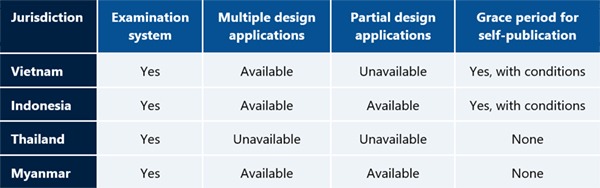
Vietnam

Owners of a household appliance design may seek design rights in Vietnam by filing a national design application at the Vietnam IP Office or by filing an international design application designating Vietnam either directly with the World Intellectual Property Organization (WIPO) or indirectly through the office of the applicant’s contracting party under the Hague Agreement.

Vietnam’s 2022 IP Law redefines “industrial design” as the external appearance of a product or part thereof to be assembled into a complex product, represented by shapes, lines, colors, or a combination thereof, and visible in the process of exploiting the utility of the product or complex product.

The two options for obtaining design rights in Vietnam are detailed below.

Vietnam National Design Application

As Vietnam is a signatory to the Paris Convention, applicants are entitled to a six-month convention priority period from the filing date of the corresponding application in another jurisdiction. Under Vietnam’s IP Law, an applied-for industrial design is deemed not to have lost its novelty if in the preceding six months it was published without permission from the person with the right to register it, was published by that person in a scientific presentation, or was displayed by that person at a national exhibition in Vietnam or at an official or officially recognized international exhibition.

Design applications must include clear and detailed drawings or photographs of the design, along with a description of the design. The title of the design must also identify the article under the industrial design application.

A valid design application can be published and then substantively examined in Vietnam. After being granted, a design certificate is valid for five years from the filing date, renewable for two consecutive five-year terms.

International Design Application Designating Vietnam

The Hague Agreement concerning the International Registration of Industrial Designs (Geneva Act of July 2, 1999) officially took effect in Vietnam on December 30, 2019. Hague System users can now designate Vietnam in an international design application.

Vietnam does not publish international design registrations in its own official gazette. However, an international design application can be substantively examined in Vietnam. If the IP Office finds any defects, it will issue a notification of refusal within six months of the international publication date. The applicant then has three months to file a response to the refusal, with the possibility of a single three-month extension.

The IP Office will issue a statement granting protection of the design if no defects are identified or if all identified defects have been remedied. The term of protection is 15 years from the registration date.

The international design application option for Vietnam contrasts with Thailand and Indonesia, which are currently not available as designated countries under the Hague System. Applications for these countries must be filed through their respective national pathways, as further explained below.

Indonesia

Industrial design applications in Indonesia are substantively examined for novelty. An industrial design is novel if on the filing date it is not the same as any previous disclosure—that is, any disclosure before the filing date or priority date of another application within or outside of Indonesia.

Indonesia does offer multiple-design applications covering a set of industrial designs that constitute a unified industrial design or that are within the same classification. Different embodiments of the same industrial design must be filed in separate applications.

Partial design applications are also available. The part of the design that is not claimed should be indicated with dashed lines.

There is a six-month grace period before the filing date of an industrial design, during which it is considered to still maintain its novelty. To benefit from this grace period, the industrial design must have been displayed in a national or international exhibition that is official or deemed to be official, or the industrial design may have been used by the designer in an experiment for education, research, or development purposes.

There is no annuity fee for industrial designs, and the protection period is 10 years from the filing date. There is no protection for unregistered industrial designs in Indonesia.

Thailand

Design patent applications in Thailand are subject to an examination system. The protection term for a design patent is 10 years from the filing date. A novelty requirement is an essential element of design patent applications. Thai examiners conduct a search and determine the novelty of a design, along with other requirements. An examiner who deems that a design lacks novelty may issue an examination report along with a rejection decision, potentially leading to an appeals process before the Board of Patents. To avoid this complication, applicants should safeguard the novelty of their design by retaining confidentiality and conducting a prior-art search for the design.

Unlike in Indonesia, neither multiple nor partial design applications are available in Thailand. The grace period mechanism, which allows inventors to disclose their work publicly for a limited time without forfeiting novelty, is limited to exhibitions that have been sponsored or authorized and held in Thailand by the Thai government. Therefore, the grace period cannot be applied to publication by inventors or applicants on any other channels. While there are proposed amendments to the Patent Act that would allow partial or related design applications and expand the grace period mechanism, these are still working their way through the legislative process.

In recent years, requisitions with regard to formality examinations for design patent applications have grown stricter. Examiners may issue an office action requesting that drawings be amended so the lines are sufficiently sharp and clear, with no blurriness or shaded areas. For designs related to appliances, there might also be requisitions concerning both the title of the design and the title indicated in the claims to ensure that the title is directed at an essential feature of the design. Applicants can mitigate these potential issues by researching generally accepted titles using an online database or consulting local counsel.

Why Register Designs?

In the rapidly evolving landscape of household appliance innovation, safeguarding the distinctiveness and uniqueness of designs is an important consideration. Vietnam, Indonesia, and Thailand, as regional drivers of industrial growth and technological advancement, present significant opportunities for manufacturers and designers to secure their creative assets through registration. Beyond legal protection, a registered industrial design can be a catalyst for market differentiation, bolstering brand identity and consumer loyalty. By investing in the protection of their industrial designs, companies secure a competitive edge. The future of the household appliance industry hinges not only on technological advancement but also on the foresight to protect the aesthetics that define it.


RELATED INSIGHTS​ 

November 12, 2025
Thailand’s Customs Department has announced the cancellation of the longstanding de minimis exemption, which waives import duties on goods valued at THB 1,500 or less, as of January 1, 2026. This policy shift will directly impact e-commerce, logistics, and retail sectors, and will have wide-ranging implications for any company involved in cross-border trade with Thailand. Background Under current regulations, imported goods with a customs value (cost, insurance, and freight, or “CIF”) of THB 1,500 or less are exempt from import duties. This has been a cornerstone of the cross-border e-commerce model, allowing for the duty-free import of millions of small parcels. Under the new policy effective January 1, 2026, all imported goods, regardless of value, will be subject to assessment for import duties upon entry into Thailand. The stated rationale for this change is to create fair competition for Thai small and medium-sized enterprises (SMEs), which must pay VAT and other costs on their goods, putting them at a price disadvantage against foreign sellers who utilize the de minimis loophole. Business Implications This policy change will create new costs, compliance burdens, and operational challenges. For foreign e-commerce sellers and platforms: The most direct impact will be the addition of import duties to low-value items. Assuming the costs are passed on to the consumer, the higher prices and potentially more complex or slower customs clearance processes could lead to increased cart abandonment and reduced consumer demand. Businesses should review their pricing models and develop a clear strategy for calculating, declaring, and paying these new duties. For logistics providers and customs brokers: The administrative burden will be considerable. Carriers that previously handled millions of nondutiable parcels will now be required to process them for duty assessment and collection. This may necessitate new IT systems and streamlined processes to avoid delays at
October 24, 2025
Thailand currently lacks a specific franchise act. Consequently, the legality of any franchise agreement is determined by its compliance with various existing laws, such as the Civil and Commercial Code, the Trademark Act B.E. 2534 (1991) (as amended), and the Unfair Contract Terms Act B.E. 2530 (1997). Thailand is a freedom-to-contract jurisdiction. This allows for a high degree of flexibility and autonomy in contractual arrangements, provided that the terms do not violate any laws or public policy and do not fall under the scope of unfair contract terms. Given this, the requirement for fairness in franchise agreement terms often leads to uncertainty, but decisions from the Trade Competition Commission of Thailand (TCCT) can provide guidance on whether specific contentious terms are in fact fair.  One issue worth examining in this light is the inclusion of terms on nonrefundable franchise fees and strict purchasing conditions. Franchise Fee: Unfair to Refuse Refund? Nonrefundable franchise fees represent a significant upfront investment for franchisees, often becoming a point of contention if the franchise relationship deteriorates or the franchisor ceases operations. Their fairness and enforceability are frequently scrutinized by regulatory bodies like the TCCT, highlighting the critical balance between contractual freedom and franchisee protection. Faced with one such case, the TCCT considered whether it was unfair for the franchisor to refuse to refund the franchise fee after the franchisor ceased operations.  The franchisee had entered into a service agreement on August 2, 2021, and begun operating on October 9, 2021. However, by November 21, 2023, the franchisee was notified that the system would be shut down for maintenance, and by December 26, 2023, the franchisor announced the cessation of operations due to financial losses. The franchisee then requested a refund of the franchise fee. Unfortunately for the franchisee, the TCCT found that the franchisor’s
October 3, 2025
On September 26, 2025, the Contract Committee under Thailand’s Consumer Protection Board issued a regulation that aims to standardize contracts and enhance consumer protection within the beauty and wellness industry. The Notification on Prescribing the Beauty Service Business as a Contract-Controlled Business B.E. 2568 (2025), which takes effect on January 24, 2026, requires business operators to use a prescribed standard contract in Thai and adhere to strict mandatory provisions and prohibitions. These regulations apply to operators across all in-person and online service channels, including via digital platforms. “Beauty services business” is defined as the provision of services under an agreement allowing consumers to receive a series of treatments, either over a set number of sessions or within a set period. This includes massage, spa, other methods for cleanliness, beauty, or care of facial or body skin, and weight control and body shaping—including services offered electronically. The law excludes surgery, liposuction, and medical treatments performed by licensed practitioners. The notification establishes the following key requirements: Mandatory contract and formatting. All contracts with consumers must use the standard contract form, in Thai, with clear, readable text (minimum font size of 2 millimeters, no more than 11 characters per inch), and include all essential terms from the annexed form. Contract execution. Contracts must be made in duplicate, with one copy given to the consumer at signing. For agreements concluded through electronic channels, the process must comply with the Electronic Transactions Act and use the same required terms. Digital platforms. Business operators who provide services facilitated through a digital platform as an intermediary are ultimately responsible for ensuring the consumer receives a compliant contract. Prohibited clauses. The law prohibits clauses that limit or exclude liability for damages to life, body, health, mind, or property resulting from breach of contract or a wrongful act;
September 16, 2025
Thailand has enacted amended alcohol control legislation that significantly tightens restrictions on marketing and advertising, strengthens enforcement, and creates mechanisms to support the country’s tourism objectives. The Alcoholic Beverage Control Act (No. 2) B.E. 2568 (2025), published in the Government Gazette on September 9, 2025, will take effect on November 8, 2025. Key aspects of the new law are outlined below. Continuation of Sales-Hour Restrictions Sales-hour restrictions remain in effect, though now under an updated regulatory pathway. Alcohol sales are permitted only between 11:00 a.m. and 2:00 p.m. and between 5:00 p.m. and midnight, with exceptions for airport terminals, entertainment venues under the Entertainment Place Act 1966, and hotels. Despite earlier discussions about relaxing these hours, no changes have been implemented under the new law. Enhanced Seller Responsibilities Sellers are now expressly permitted to check identification cards to verify purchaser age and may assess the condition of intoxicated customers. The assessment conditions will be announced in a forthcoming notification from the director of the Department of Disease Control. Sellers who willfully or negligently violate the law and cause damage to life, health, or property face possible penalties. Alcohol Vending Machines Permitted The law allows alcohol to be sold in vending machines that can verify buyer information and comply with rules, procedures, and conditions to be prescribed by the Alcoholic Beverage Control Committee. This means the industry must await the committee’s implementing regulations before deploying such machines. Expanded Marketing and Advertising Restrictions The amended law introduces a new suite of advertising restrictions, including more detailed and expansive definitions involving marketing and promotions. “Marketing communication” is broadly defined to include any direct or indirect act of publicizing, presenting, or disseminating information about alcoholic beverages through advertising, public relations, sales promotions, sponsorships, or any other means that may induce or encourage the