Protecting the aesthetic features of consumer items, such as household appliances, is essential for businesses looking to gain a competitive edge, particularly in the dynamic markets of Vietnam, Indonesia, and Thailand. Industrial design registrations (or design patents in Thailand) provide an effective means to protect the unique and ornamental designs of products, ensuring that their distinctive appearance is not imitated by competitors. This article provides a general overview of design systems in Vietnam, Indonesia, and Thailand, as well as some key considerations for businesses and rights holders.
All three of these countries use an examination system for assessing applications to protect designs. While all three jurisdictions are members of the Paris Convention, only Vietnam has fully completed the process of becoming a member of the Hague Agreement. The table below offers a general comparison of the three countries’ design systems, with additional details provided in the subsequent sections.
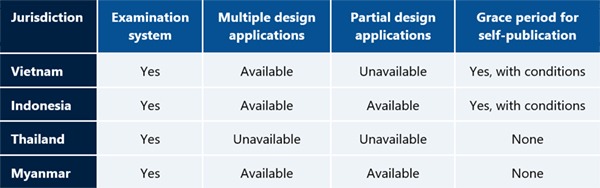
Vietnam
Owners of a household appliance design may seek design rights in Vietnam by filing a national design application at the Vietnam IP Office or by filing an international design application designating Vietnam either directly with the World Intellectual Property Organization (WIPO) or indirectly through the office of the applicant’s contracting party under the Hague Agreement.
Vietnam’s 2022 IP Law redefines “industrial design” as the external appearance of a product or part thereof to be assembled into a complex product, represented by shapes, lines, colors, or a combination thereof, and visible in the process of exploiting the utility of the product or complex product.
The two options for obtaining design rights in Vietnam are detailed below.
Vietnam National Design Application
As Vietnam is a signatory to the Paris Convention, applicants are entitled to a six-month convention priority period from the filing date of the corresponding application in another jurisdiction. Under Vietnam’s IP Law, an applied-for industrial design is deemed not to have lost its novelty if in the preceding six months it was published without permission from the person with the right to register it, was published by that person in a scientific presentation, or was displayed by that person at a national exhibition in Vietnam or at an official or officially recognized international exhibition.
Design applications must include clear and detailed drawings or photographs of the design, along with a description of the design. The title of the design must also identify the article under the industrial design application.
A valid design application can be published and then substantively examined in Vietnam. After being granted, a design certificate is valid for five years from the filing date, renewable for two consecutive five-year terms.
International Design Application Designating Vietnam
The Hague Agreement concerning the International Registration of Industrial Designs (Geneva Act of July 2, 1999) officially took effect in Vietnam on December 30, 2019. Hague System users can now designate Vietnam in an international design application.
Vietnam does not publish international design registrations in its own official gazette. However, an international design application can be substantively examined in Vietnam. If the IP Office finds any defects, it will issue a notification of refusal within six months of the international publication date. The applicant then has three months to file a response to the refusal, with the possibility of a single three-month extension.
The IP Office will issue a statement granting protection of the design if no defects are identified or if all identified defects have been remedied. The term of protection is 15 years from the registration date.
The international design application option for Vietnam contrasts with Thailand and Indonesia, which are currently not available as designated countries under the Hague System. Applications for these countries must be filed through their respective national pathways, as further explained below.
Indonesia
Industrial design applications in Indonesia are substantively examined for novelty. An industrial design is novel if on the filing date it is not the same as any previous disclosure—that is, any disclosure before the filing date or priority date of another application within or outside of Indonesia.
Indonesia does offer multiple-design applications covering a set of industrial designs that constitute a unified industrial design or that are within the same classification. Different embodiments of the same industrial design must be filed in separate applications.
Partial design applications are also available. The part of the design that is not claimed should be indicated with dashed lines.
There is a six-month grace period before the filing date of an industrial design, during which it is considered to still maintain its novelty. To benefit from this grace period, the industrial design must have been displayed in a national or international exhibition that is official or deemed to be official, or the industrial design may have been used by the designer in an experiment for education, research, or development purposes.
There is no annuity fee for industrial designs, and the protection period is 10 years from the filing date. There is no protection for unregistered industrial designs in Indonesia.
Thailand
Design patent applications in Thailand are subject to an examination system. The protection term for a design patent is 10 years from the filing date. A novelty requirement is an essential element of design patent applications. Thai examiners conduct a search and determine the novelty of a design, along with other requirements. An examiner who deems that a design lacks novelty may issue an examination report along with a rejection decision, potentially leading to an appeals process before the Board of Patents. To avoid this complication, applicants should safeguard the novelty of their design by retaining confidentiality and conducting a prior-art search for the design.
Unlike in Indonesia, neither multiple nor partial design applications are available in Thailand. The grace period mechanism, which allows inventors to disclose their work publicly for a limited time without forfeiting novelty, is limited to exhibitions that have been sponsored or authorized and held in Thailand by the Thai government. Therefore, the grace period cannot be applied to publication by inventors or applicants on any other channels. While there are proposed amendments to the Patent Act that would allow partial or related design applications and expand the grace period mechanism, these are still working their way through the legislative process.
In recent years, requisitions with regard to formality examinations for design patent applications have grown stricter. Examiners may issue an office action requesting that drawings be amended so the lines are sufficiently sharp and clear, with no blurriness or shaded areas. For designs related to appliances, there might also be requisitions concerning both the title of the design and the title indicated in the claims to ensure that the title is directed at an essential feature of the design. Applicants can mitigate these potential issues by researching generally accepted titles using an online database or consulting local counsel.
Why Register Designs?
In the rapidly evolving landscape of household appliance innovation, safeguarding the distinctiveness and uniqueness of designs is an important consideration. Vietnam, Indonesia, and Thailand, as regional drivers of industrial growth and technological advancement, present significant opportunities for manufacturers and designers to secure their creative assets through registration. Beyond legal protection, a registered industrial design can be a catalyst for market differentiation, bolstering brand identity and consumer loyalty. By investing in the protection of their industrial designs, companies secure a competitive edge. The future of the household appliance industry hinges not only on technological advancement but also on the foresight to protect the aesthetics that define it.