You are using an outdated browser and your browsing experience will not be optimal. Please update to the latest version of Microsoft Edge, Google Chrome or Mozilla Firefox. Install Microsoft Edge

September 28, 2023

Registering Industrial Designs for Household Appliances in Vietnam, Indonesia, and Thailand

Protecting the aesthetic features of consumer items, such as household appliances, is essential for businesses looking to gain a competitive edge, particularly in the dynamic markets of Vietnam, Indonesia, and Thailand. Industrial design registrations (or design patents in Thailand) provide an effective means to protect the unique and ornamental designs of products, ensuring that their distinctive appearance is not imitated by competitors. This article provides a general overview of design systems in Vietnam, Indonesia, and Thailand, as well as some key considerations for businesses and rights holders.

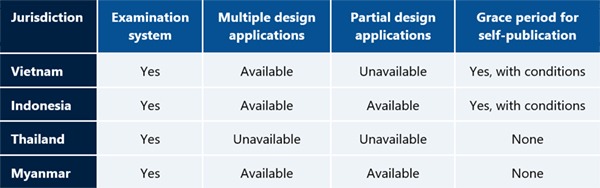
All three of these countries use an examination system for assessing applications to protect designs. While all three jurisdictions are members of the Paris Convention, only Vietnam has fully completed the process of becoming a member of the Hague Agreement. The table below offers a general comparison of the three countries’ design systems, with additional details provided in the subsequent sections.
Vietnam

Owners of a household appliance design may seek design rights in Vietnam by filing a national design application at the Vietnam IP Office or by filing an international design application designating Vietnam either directly with the World Intellectual Property Organization (WIPO) or indirectly through the office of the applicant’s contracting party under the Hague Agreement.

Vietnam’s 2022 IP Law redefines “industrial design” as the external appearance of a product or part thereof to be assembled into a complex product, represented by shapes, lines, colors, or a combination thereof, and visible in the process of exploiting the utility of the product or complex product.

The two options for obtaining design rights in Vietnam are detailed below.

Vietnam National Design Application

As Vietnam is a signatory to the Paris Convention, applicants are entitled to a six-month convention priority period from the filing date of the corresponding application in another jurisdiction. Under Vietnam’s IP Law, an applied-for industrial design is deemed not to have lost its novelty if in the preceding six months it was published without permission from the person with the right to register it, was published by that person in a scientific presentation, or was displayed by that person at a national exhibition in Vietnam or at an official or officially recognized international exhibition.

Design applications must include clear and detailed drawings or photographs of the design, along with a description of the design. The title of the design must also identify the article under the industrial design application.

A valid design application can be published and then substantively examined in Vietnam. After being granted, a design certificate is valid for five years from the filing date, renewable for two consecutive five-year terms.

International Design Application Designating Vietnam

The Hague Agreement concerning the International Registration of Industrial Designs (Geneva Act of July 2, 1999) officially took effect in Vietnam on December 30, 2019. Hague System users can now designate Vietnam in an international design application.

Vietnam does not publish international design registrations in its own official gazette. However, an international design application can be substantively examined in Vietnam. If the IP Office finds any defects, it will issue a notification of refusal within six months of the international publication date. The applicant then has three months to file a response to the refusal, with the possibility of a single three-month extension.

The IP Office will issue a statement granting protection of the design if no defects are identified or if all identified defects have been remedied. The term of protection is 15 years from the registration date.

The international design application option for Vietnam contrasts with Thailand and Indonesia, which are currently not available as designated countries under the Hague System. Applications for these countries must be filed through their respective national pathways, as further explained below.

Indonesia

Industrial design applications in Indonesia are substantively examined for novelty. An industrial design is novel if on the filing date it is not the same as any previous disclosure—that is, any disclosure before the filing date or priority date of another application within or outside of Indonesia.

Indonesia does offer multiple-design applications covering a set of industrial designs that constitute a unified industrial design or that are within the same classification. Different embodiments of the same industrial design must be filed in separate applications.

Partial design applications are also available. The part of the design that is not claimed should be indicated with dashed lines.

There is a six-month grace period before the filing date of an industrial design, during which it is considered to still maintain its novelty. To benefit from this grace period, the industrial design must have been displayed in a national or international exhibition that is official or deemed to be official, or the industrial design may have been used by the designer in an experiment for education, research, or development purposes.

There is no annuity fee for industrial designs, and the protection period is 10 years from the filing date. There is no protection for unregistered industrial designs in Indonesia.

Thailand

Design patent applications in Thailand are subject to an examination system. The protection term for a design patent is 10 years from the filing date. A novelty requirement is an essential element of design patent applications. Thai examiners conduct a search and determine the novelty of a design, along with other requirements. An examiner who deems that a design lacks novelty may issue an examination report along with a rejection decision, potentially leading to an appeals process before the Board of Patents. To avoid this complication, applicants should safeguard the novelty of their design by retaining confidentiality and conducting a prior-art search for the design.

Unlike in Indonesia, neither multiple nor partial design applications are available in Thailand. The grace period mechanism, which allows inventors to disclose their work publicly for a limited time without forfeiting novelty, is limited to exhibitions that have been sponsored or authorized and held in Thailand by the Thai government. Therefore, the grace period cannot be applied to publication by inventors or applicants on any other channels. While there are proposed amendments to the Patent Act that would allow partial or related design applications and expand the grace period mechanism, these are still working their way through the legislative process.

In recent years, requisitions with regard to formality examinations for design patent applications have grown stricter. Examiners may issue an office action requesting that drawings be amended so the lines are sufficiently sharp and clear, with no blurriness or shaded areas. For designs related to appliances, there might also be requisitions concerning both the title of the design and the title indicated in the claims to ensure that the title is directed at an essential feature of the design. Applicants can mitigate these potential issues by researching generally accepted titles using an online database or consulting local counsel.

Why Register Designs?

In the rapidly evolving landscape of household appliance innovation, safeguarding the distinctiveness and uniqueness of designs is an important consideration. Vietnam, Indonesia, and Thailand, as regional drivers of industrial growth and technological advancement, present significant opportunities for manufacturers and designers to secure their creative assets through registration. Beyond legal protection, a registered industrial design can be a catalyst for market differentiation, bolstering brand identity and consumer loyalty. By investing in the protection of their industrial designs, companies secure a competitive edge. The future of the household appliance industry hinges not only on technological advancement but also on the foresight to protect the aesthetics that define it.


RELATED INSIGHTS​ 

June 17, 2026
Thailand’s new labeling requirements for medical devices, which include for the first time a unique device identification (UDI) requirement for software as a medical device (SaMD), take effect on June 20, 2026. The Notification of the Ministry of Public Health regarding Criteria, Methods, and Conditions on Labeling and Instructions for Use for Medical Devices 2025, which replaces a similar notification from 2020, was published in the Government Gazette on December 22, 2025. To ensure clarity, modernity, and patient safety, the regulation requires domestic manufacturers and importers to provide labels and instructions for use (IFU) that are clearly legible, complete, and free of false or misleading claims. It also permits IFU to be provided in electronic format, such as via QR codes, websites, or other digital channels—directly relevant to SaMD, where physical labels are impractical and electronic presentation is the natural medium. The notification distinguishes two categories for labeling language. Home-use medical devices (for lay users outside healthcare facilities) must have labels and IFU in Thai. Professional-use medical devices may display labels and documentation in either Thai or English. This distinction is significant for SaMD developers: software intended for clinical professionals may use English-language interfaces and IFU, while consumer-facing health applications must provide Thai-language content. Labeling and UDI Requirements Labels and IFU must include, at a minimum: Product name and intended purpose Quantity or volume Name and address of domestic manufacturer or importer Thai FDA approval number Lot, version, or serial number Manufacturing date and expiry date For SaMD, the version number requirement is particularly relevant. The regulation also mandates display of a UDI code for SaMD in risk category 2 (moderate-risk), category 3 (moderate- to high-risk), and category 4 (high-risk), according to Thailand’s medical device risk classification system (which complies with the ASEAN Medical Device Directive and the EU
May 11, 2026
Thailand’s rise as a regional hub for luxury retail has influenced how market entry is structured and assessed across Southeast Asia. As brands consider establishing a presence in the market, regulatory and operational considerations form a key part of the overall entry assessment. Foreign Ownership Restrictions for Retailers Foreign investment in retail activities is subject to a relatively extensive regulatory framework, particularly in relation to foreign ownership and the approvals required under the Foreign Business Act B.E. 2542 (1999) (FBA). Under the FBA, a company is generally regarded as foreign if 50% or more of its shares are held by non-Thai nationals, in which case the business is required to obtain a foreign business license (FBL) issued by the director-general of the Department of Business Development, with the approval of the Foreign Business Committee. The committee will not grant an FBL unless it is convinced the proposed business demonstrates unique characteristics such as a distinctive business model, innovative processes, specialized services or products, or a clear competitive differentiation that will benefit Thailand; constitutes a highly specialized business or requires specialized technology or expertise; and will not compete with Thai business operators who engage in the same business. The committee makes its decisions on a case-by-case basis depending on the circumstances, which can make the licensing process less predictable in practice. However, there are also alternative pathways for consideration, including exemptions in specific circumstances. For example, foreign-owned businesses in Thailand with at least THB 100 million in registered capital are allowed to open five retail stores in the country. Some businesses may also be able to access preferential treatment under international agreements and treaties between Thailand and certain foreign states, subject to eligibility requirements. Structural and Business Model Challenges The determination of what constitutes a “retail store” may itself present
May 8, 2026
Thailand has liberalized its wine import regime, allowing, for the first time, multiple importers to bring in and distribute the same wine brands. On March 27, 2026, the Ministry of Finance issued the Ministerial Regulation on the Importation of Alcoholic Beverages (No. 3) 2026, which waives the requirement to appoint a sole authorized agent for alcoholic beverages to be specified in notifications from the Excise Department. The Excise Department has already issued its first such notification, expressly exempting wine and sparkling wine made from grapes from the sole agent requirement. For all other types of alcoholic beverages (e.g., beer, tequila, spirits) the sole agent requirement remains in force, and applicants for importer licenses must provide evidence of exclusive distributorship issued by the manufacturer or brand owner. The exemption may be extended to other alcoholic beverage categories through future Excise Department notifications. Implications for Competition and Tourism The reform allows multiple importers to bring in and distribute the same wine brand without routing through the brand owner’s designated exclusive importer, reducing monopolization and boosting competition. Excise Department Director-General Pornchai Thirawet noted that wine was chosen as the starting point because implementation is straightforward in this case and because domestic wine prices remain high—with increased competition expected to exert downward pressure on prices. More broadly, the reform is intended to lower market entry barriers, expand supply, and make wine more accessible to Thai consumers, while supporting Thailand’s position as a regional tourism hub. Product Quality Control and Loss of Sole Agent Accountability Under the previous framework, the designated importer bore full responsibility for the proper storage, handling, and distribution of wine and sparkling wine from importation to final sale. This arrangement helped ensure that products were maintained under appropriate conditions, including temperature control, light exposure, and humidity management, to preserve quality
April 22, 2026
A new decree in Vietnam brings significant implementation clarity to the country’s existing extended producer responsibility (EPR) legal framework. An EPR mechanism was first codified in Vietnam in the 2020 Law on Environmental Protection amid ongoing challenges surrounding the collection and treatment of product and packaging waste. The mechanism was progressively detailed through Decree No. 08/2022/ND‑CP and its successive amendments, but the regulatory framework remained insufficiently developed, notably in terms of support mechanisms for waste collection, recycling, and treatment. The newly launched regulations in Decree No. 110/2026/ND-CP (Decree 110), issued on April 1, 2026, and taking effect on May 25, 2026, stipulate fully and clearly the responsibility of manufacturers and importers to recycle products and packaging and to treat waste. Some key provisions of Decree 110 for manufacturers, importers, and related stakeholders are presented below. Subjects of EPR The Law on Environmental Protection assigns responsibility to manufacturers and importers for product and packaging recycling (under Article 54) or waste collection and treatment (under Article 55), depending on the type of products and packaging they produce or import. Decree 110 elaborates on these EPR provisions by specifying the responsible entities and listing out the types of products and packaging subject to recycling and waste treatment responsibilities. Decree 110 clarifies the responsible entities in special cases, such as when products under the same brand are made by multiple manufacturers, when there is a contract manufacturing or entrusted import relationship, and when the manufacturer or importer is part of a corporate group. Notably, exemptions may be applied in some scenarios, such as for manufacturers and importers of products and packaging exclusively for export, temporary import and re-export, or research and testing purposes, as well as for entities with annual revenue from related products not exceeding VND 30 billion. Recycling Responsibilities Decree 110