
You are using an outdated browser and your browsing experience will not be optimal. Please update to the latest version of Microsoft Edge, Google Chrome or Mozilla Firefox. Install Microsoft Edge

August 29, 2018

Panasonic Wins Passing Off Case for Packaging and Product Designs

Informed Counsel

Although the Thai Trademark Act provides protection for passing off, filing a lawsuit to defend an IP owner’s unregistered rights can still pose certain challenges. This is especially true where two registered trademarks are different, but the product packaging designs of both marks are confusingly similar. In these circumstances, the court occasionally decides upon a mere comparison of the two marks and may determine that the similarities of their packaging designs are not likely to cause confusion among public consumers due to their dissimilarity.

Recently, the Supreme Court rendered a remarkable and highly significant judgment on the grounds of passing off, which should serve as a landmark trademark infringement case in Thailand. Panasonic, the plaintiff, owns various trademark registrations worldwide. Among those registered marks, the most eye-catching mark is the PANASONIC mark itself. Panasonic registered this mark for use with manganese and alkaline batteries in Class 9 in Thailand in 1985. Panasonic exerted huge efforts and much research in designing the unique colors used with its batteries and the labeling on the packaging to let consumers recognize its products immediately as belonging to Panasonic.

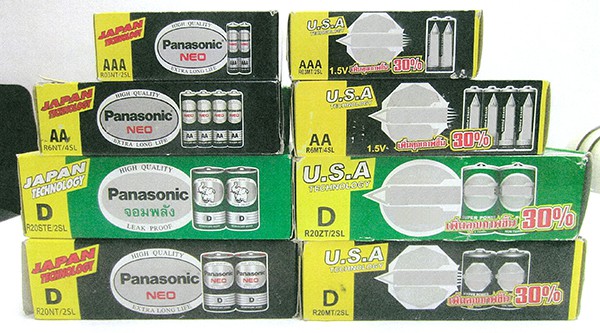
Approximately five years ago, a Thai manufacturing company (defendants) was discovered to be manufacturing different types of batteries that were found to be similar to those manufactured by Panasonic under its own trademark. The defendants’ batteries were closely similar to Panasonic’s battery colors and the text was positioned almost identically to Panasonic’s packaging.

After trying unsuccessfully to reach an amicable settlement, Panasonic decided to bring a civil lawsuit against the defendants on the grounds of trademark infringement and passing off.
IP&IT Court Decision   

At the Intellectual Property and International Trade (IP&IT) Court, Panasonic argued that the appearance of its packaging was immediately recognizable among Thai public consumers and distinguishable from the packaging of other battery manufacturers. To support its claim, Panasonic conducted a public survey opinion poll comparing the overall appearances of its packaging and that of other battery manufacturers’ packaging. The survey results revealed that the average consumer readily recognizes Panasonic’s packaging without seeing the PANASONIC mark, and that there is a likelihood of confusion when consumers see the defendant’s packaging. Unfortunately, these survey results were not convincing evidence to the court. Without considering the defendant’s bad faith in imitating the color, size, and word arrangement of its battery packaging, the court instead took into consideration the trademark itself, and therefore considered that the defendant’s batteries were distinguishable when considering pronunciation and overall appearance.    

Panasonic disagreed with the court’s opinion and decided to appeal the case to the Supreme Court, arguing that the IP&IT Court failed to elaborate on the legal point of the defendants’ bad faith, as it was using similar packaging, labeling, and colors to its own product designs and benefiting from Panasonic’s widespread reputation.

The Supreme Court Decision   

The Supreme Court confirmed the IP&IT Court decision with regard to the dissimilarity of the registered marks, when considering pronunciation and the shape of the Roman characters of the marks. However, the Supreme Court disagreed with most other aspects of the IP&IT Court’s reasoning, especially in its failure to determine whether the defendants, by using a similar packaging, label, and product design to that of Panasonic’s, acted in bad faith and thereby infringed Panasonic’s unregistered trademark rights.    

The Supreme Court emphasized the importance of the bad faith intention of the defendants by determining the manner in which the trademark is used on goods and packages. The court found that even though the registered mark in dispute was not confusingly similar to the PANASONIC trademark in either appearance or pronunciation, the court must compare the characteristics of the batteries and the packaging of the defendants with those aspects of Panasonic’s batteries to determine whether the two companies’ products are similar.    

With regard to the color scheme, the Supreme Court took an approach contrary to the IP&IT Court’s reasoning. Even though color is a common feature that anyone can freely use, a certain color combination (e.g., green and silver; black and silver; or red, white, black and yellow), together with the placement of the colors, text, and images, creates a visual design and pattern indicating that Panasonic’s goods are different from others’ goods.   

The Supreme Court further elaborated that the appearance of the defendants’ batteries and packaging, which appear to be closely similar to Panasonic’s, clearly reflect the bad-faith intention of the defendants to use their registered mark with batteries in order to deceive the relevant consumers into believing that the batteries belong to Panasonic. The court held that such tortious conduct can only have the result of causing injury to Panasonic and is thus unlawful.    

The Supreme Court ruled that the defendants must cease using their product designs and packaging designs of similar coloring and patterns to those of Panasonic, and must not pass off their products as those of Panasonic. Moreover, the court awarded Panasonic compensatory damages, together with its attorneys’ fees and court fees.

Conclusion   

The trademark owner’s victory in this case offers a valuable lesson in determining that trademark infringement should not only consider the mark itself but also the manner in which an alleged infringer uses its mark to imitate a brand owner’s unique product designs and packaging, which can now be considered to be unregistered trademarks. This Supreme Court judgment establishes an exemplary guideline for brand owners facing similar issues, whereby brand owners can protect themselves from others imitating their unique product designs and packaging.

RELATED INSIGHTS​ 

April 10, 2026
As digital commerce continues to reshape consumer behavior in Thailand, the Office of the Consumer Protection Board (OCPB) has been taking steps to review and update key regulations for online platforms. The OCPB has had a particular focus on addressing the risks posed by e-marketplace businesses—from misleading product information to fraudulent online transactions. Some of the regulator’s current legislative efforts related to Thailand’s labeling regulations as well as potential changes to the country’s law on direct sales and marketing. Proposed Changes to Consumer Protection Labeling Regulations On February 24, 2026, the OCPB convened a public hearing to review the Notification of the Committee on Labels re: Specification of Goods as Controlled Label Goods B.E. 2565 (2022) and its annex issued under the Consumer Protection Act. The closed-door session, which started the OPCD’s process of seeking feedback on the proposed changes, brought together representatives from government agencies, business operators, and consumer groups. The OCPB explained that its review of the labeling regulations aims to address regulatory gaps arising from evolving commercial practices, particularly the expansion of e-commerce and cross-border transactions. Authorities highlighted recurring issues involving product information that is unclear, incomplete, or potentially misleading in digital sales channels. The proposed revisions are intended to improve consumers’ access to accurate and complete product information, ensure that label disclosures remain relevant amid the growth of e-commerce, and strengthen protections against deceptive or misleading digital advertising. The review is being undertaken pursuant to the Consumer Protection Act B.E. 2522 (1979). As part of the initiative, the OCPB signaled a potential update to the categories of “controlled label products” as well as enhanced disclosure obligations for business operators, with the broader aim of promoting greater transparency, reinforcing operator accountability, and aligning Thailand’s labeling framework with current market conditions. The OCPB secretary general emphasized that
April 1, 2026
On March 30, 2026, Thailand’s Customs Department announced a strategy to raise import duties on a broad range of consumer goods—including plastic items and electronics accessories—to their maximum statutory ceilings, which often sit at 30% or 40%. Many of these goods currently benefit from promotional or incentive rates as low as 5%. For importers, e-commerce platforms, and logistics providers, this development demands immediate attention. While these increases generally require cabinet approval, they do not require full parliamentary amendment of the Customs Tariff Decree B.E. 2530, as the Customs director-general and the finance minister hold delegated authority to adjust rates within existing statutory bounds. Businesses should not assume that the legislative process will provide significant lead time before higher rates take effect. Death of the De Minimis: Abolishing the THB 1,500 Loophole This “ceiling-rate” policy, which is designed to equalize the landed cost of foreign goods with the domestic production costs of Thai manufacturers, builds on a sweeping set of customs reforms that have already begun to reshape Thailand’s trade environment. The foundation of this new regime was laid on January 1, 2026, when Thailand formally abolished the longstanding THB 1,500 duty exemption for small imported parcels under Customs Notification No. 219/2568. Every imported item is now subject to VAT and applicable import duties for its declared value, regardless of parcel size or transaction amount. By narrowing the scope of exemptions previously granted to low-value goods under the Customs Tariff Decree B.E. 2530, the government has made clear that the era of tax-free cross-border micro-imports is over. Three-Phased Strategy and Legal Modernization The March 30 announcement is the second phase of a three-part regulatory roadmap: Immediate enforcement: The removal of the THB 1,500 loophole and the imposition of VAT on all parcels, effective January 1, 2026. Tariff realignment: The current
March 31, 2026
Thailand’s Office of the Consumer Protection Board has opened a public hearing period on draft regulations governing the transfer of direct sales and direct marketing businesses. The draft Notification of the Direct Sales and Direct Marketing Committee: Criteria and Procedures for Business Transfer and Amendment of Registration for Direct Sales or Direct Marketing Businesses establishes a compliance-focused process with strict documentation requirements and timelines for transferring direct sales and direct marketing businesses. The proposed framework also defines the roles of transferors and transferees and establishes application procedures with the Office of the Consumer Protection Board. Applications may be submitted in person or electronically and will be examined to confirm they are complete, authentic, and compliant with legal requirements. This includes verification that: The transferee meets all required qualifications; No disqualifying factors apply; and The applicant is not subject to legal restrictions. The public hearing period is open until April 29, 2026. Direct sales and direct marketing business operators should prepare for these proposed requirements to ensure compliant implementation once the regulations are finalized.
March 20, 2026
Myanmar has introduced a comprehensive new regulatory framework for alcoholic beverages that will impose stricter controls on production, distribution, advertising, and sales. On March 7, 2026, the National Defence and Security Council issued a new Excise Law (NDSC Law No. 13/2026), repealing the Excise Act of 1917. The law, which has not yet entered into force, will take effect on a date to be specified in a separate notification—likely within this year. The new Excise Law establishes clearer definitions, introduces multiple categories of excise licenses and permits, and significantly expands prohibitions and compliance obligations for businesses operating in the alcohol sector. Many operational details will be clarified through implementing rules and notifications. Scope and Definitions The new law defines “excise” to cover alcoholic liquor and excisable articles. Alcoholic liquor is broadly defined as any liquid containing more than 0.5% ethyl alcohol, including beer, wine, toddy sap, fermented liquor, and any other liquid declared as alcohol by notification of the relevant ministry, excluding denatured alcohol. Alcoholic liquor is further categorized into country liquor, foreign liquor, and international‑standard domestically produced liquor. Excise Licensing The law also introduces a more detailed licensing regime. The following types of liquor excise licenses are available: Production Production of value-added products Bottling Distribution Sales Other excise‑related businesses designated by General Administrative Department (GAD) notification The GAD will prescribe the licensing fees, requirements, and conditions for each category through notifications issued with the approval of the Ministry of Home Affairs. The GAD may also, with the approval of the Ministry of Home Affairs, prescribe quantities and volumes of alcoholic beverages that may be possessed without a liquor license. No such prescribed quantities have yet been issued. Holders of excise licenses for manufacturing, production of value-added products, or bottling must obtain approval from the relevant government department or