
You are using an outdated browser and your browsing experience will not be optimal. Please update to the latest version of Microsoft Edge, Google Chrome or Mozilla Firefox. Install Microsoft Edge

August 29, 2018

Panasonic Wins Passing Off Case for Packaging and Product Designs

Informed Counsel

Although the Thai Trademark Act provides protection for passing off, filing a lawsuit to defend an IP owner’s unregistered rights can still pose certain challenges. This is especially true where two registered trademarks are different, but the product packaging designs of both marks are confusingly similar. In these circumstances, the court occasionally decides upon a mere comparison of the two marks and may determine that the similarities of their packaging designs are not likely to cause confusion among public consumers due to their dissimilarity.

Recently, the Supreme Court rendered a remarkable and highly significant judgment on the grounds of passing off, which should serve as a landmark trademark infringement case in Thailand. Panasonic, the plaintiff, owns various trademark registrations worldwide. Among those registered marks, the most eye-catching mark is the PANASONIC mark itself. Panasonic registered this mark for use with manganese and alkaline batteries in Class 9 in Thailand in 1985. Panasonic exerted huge efforts and much research in designing the unique colors used with its batteries and the labeling on the packaging to let consumers recognize its products immediately as belonging to Panasonic.

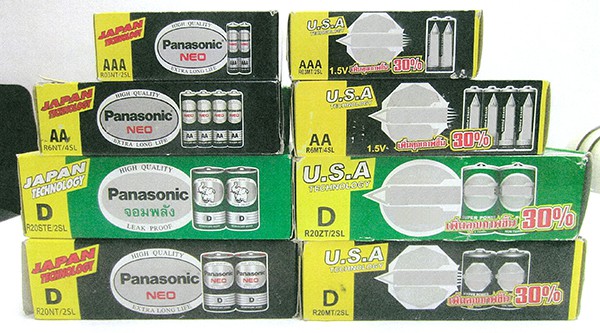
Approximately five years ago, a Thai manufacturing company (defendants) was discovered to be manufacturing different types of batteries that were found to be similar to those manufactured by Panasonic under its own trademark. The defendants’ batteries were closely similar to Panasonic’s battery colors and the text was positioned almost identically to Panasonic’s packaging.

After trying unsuccessfully to reach an amicable settlement, Panasonic decided to bring a civil lawsuit against the defendants on the grounds of trademark infringement and passing off.
IP&IT Court Decision   

At the Intellectual Property and International Trade (IP&IT) Court, Panasonic argued that the appearance of its packaging was immediately recognizable among Thai public consumers and distinguishable from the packaging of other battery manufacturers. To support its claim, Panasonic conducted a public survey opinion poll comparing the overall appearances of its packaging and that of other battery manufacturers’ packaging. The survey results revealed that the average consumer readily recognizes Panasonic’s packaging without seeing the PANASONIC mark, and that there is a likelihood of confusion when consumers see the defendant’s packaging. Unfortunately, these survey results were not convincing evidence to the court. Without considering the defendant’s bad faith in imitating the color, size, and word arrangement of its battery packaging, the court instead took into consideration the trademark itself, and therefore considered that the defendant’s batteries were distinguishable when considering pronunciation and overall appearance.    

Panasonic disagreed with the court’s opinion and decided to appeal the case to the Supreme Court, arguing that the IP&IT Court failed to elaborate on the legal point of the defendants’ bad faith, as it was using similar packaging, labeling, and colors to its own product designs and benefiting from Panasonic’s widespread reputation.

The Supreme Court Decision   

The Supreme Court confirmed the IP&IT Court decision with regard to the dissimilarity of the registered marks, when considering pronunciation and the shape of the Roman characters of the marks. However, the Supreme Court disagreed with most other aspects of the IP&IT Court’s reasoning, especially in its failure to determine whether the defendants, by using a similar packaging, label, and product design to that of Panasonic’s, acted in bad faith and thereby infringed Panasonic’s unregistered trademark rights.    

The Supreme Court emphasized the importance of the bad faith intention of the defendants by determining the manner in which the trademark is used on goods and packages. The court found that even though the registered mark in dispute was not confusingly similar to the PANASONIC trademark in either appearance or pronunciation, the court must compare the characteristics of the batteries and the packaging of the defendants with those aspects of Panasonic’s batteries to determine whether the two companies’ products are similar.    

With regard to the color scheme, the Supreme Court took an approach contrary to the IP&IT Court’s reasoning. Even though color is a common feature that anyone can freely use, a certain color combination (e.g., green and silver; black and silver; or red, white, black and yellow), together with the placement of the colors, text, and images, creates a visual design and pattern indicating that Panasonic’s goods are different from others’ goods.   

The Supreme Court further elaborated that the appearance of the defendants’ batteries and packaging, which appear to be closely similar to Panasonic’s, clearly reflect the bad-faith intention of the defendants to use their registered mark with batteries in order to deceive the relevant consumers into believing that the batteries belong to Panasonic. The court held that such tortious conduct can only have the result of causing injury to Panasonic and is thus unlawful.    

The Supreme Court ruled that the defendants must cease using their product designs and packaging designs of similar coloring and patterns to those of Panasonic, and must not pass off their products as those of Panasonic. Moreover, the court awarded Panasonic compensatory damages, together with its attorneys’ fees and court fees.

Conclusion   

The trademark owner’s victory in this case offers a valuable lesson in determining that trademark infringement should not only consider the mark itself but also the manner in which an alleged infringer uses its mark to imitate a brand owner’s unique product designs and packaging, which can now be considered to be unregistered trademarks. This Supreme Court judgment establishes an exemplary guideline for brand owners facing similar issues, whereby brand owners can protect themselves from others imitating their unique product designs and packaging.

RELATED INSIGHTS​ 

February 23, 2021
As many are already aware, following the change of government in Myanmar on February 1, 2021, a draft Cyber Security Law was proposed which attracted widespread criticism. However, less attention has been paid to significant amendments to two existing laws, some of which have a similar effect to parts of the draft Cyber Security Law. In other words, while the draft Cyber Security Law has not progressed further and is under public scrutiny, significant elements of it have found their way into law in Myanmar by other routes. Because these amendments are already law, it is very important that individuals and businesses in Myanmar understand their implications. Amendments to the Law Protecting the Privacy and Security of Citizens The Law Protecting the Privacy and Security of Citizens (2017), or the “Privacy Law,” was amended on February 13, 2021, less than two weeks after the military government came into power. These amendments chiefly address the power of the government to conduct searches, seizures, and arrests; to extend detention without judicial oversight; and to carry out broad surveillance and investigation activities that could intrude on individual privacy. The amendments accomplish this by suspending various sections of the Privacy Law for as long as the State Administration Council (the military body now governing Myanmar) is in power. The suspended sections include the following: Section 5: Search, seizure, and arrest without civilian observation The relevant part of Section 5 of the Privacy Law states, “The responsible authorities shall … when acting in accordance with existing law, not enter into a person’s residence or a room used as a residence, or a building, compound or building in a compound, for the purpose of search, seizure, or arrest, unless accompanied by minimum of two witnesses who should comprise Ward or Village Tract Administrators…”. The suspension
February 22, 2021
Following the recent imposition of sanctions on Myanmar individuals and companies by the US, the UK and Canada have now imposed new sanctions. As with the US sanctions, these new measures impact UK and Canadian citizens and companies, and non-UK and non-Canadian companies and citizens with interests in those jurisdictions. The EU has indicated that it is planning to issue similar sanctions in the near future. New UK Sanctions In addition to the 16 individuals already sanctioned by the UK government, on February 18, 2021, the UK government announced that three individuals have been sanctioned for serious human rights violations and are now subject to asset freezes and travel bans. The full list of Myanmar individuals and companies sanctioned by the UK is available on the website of the Office of Financial Sanctions Implementation. Breaches of UK financial sanctions are criminal offences punishable in the UK by up to 7 years imprisonment and heavy fines. New Canadian Sanctions Also on February 18, timed to coincide with the UK sanctions, new Canadian sanctions were imposed on nine individuals. As with the UK, Canada already had a number of individuals in the Myanmar military on its sanctions list, and the new additions bring the total number of individuals sanctioned by Canada to 54. All assets of these individuals in Canada are now frozen, and they are banned from travelling to Canada. Canadian businesses or entities may not do business with any of the 54 individuals. Full details of the impact of the sanctions are available on the Government of Canada’s website, as is a database of the Myanmar individuals and companies subject to them. Breach of Canadian sanctions carries with it up to 5 years’ imprisonment in Canada and/or a large fine. Other Countries The EU is reportedly drawing up sanctions
February 18, 2021
As you will no doubt know, on February 1, 2021, the Myanmar military declared a state of emergency in Myanmar for a period of one year. State Counsellor Daw Aung Sang Su Kyi was detained, as were the president and various significant political and civil leaders. Min Aung Hlaing, commander-in-chief of the Tatmadaw (Myanmar armed forces) has installed himself as chairman of the State Administration Council, the current administration. New sanctions The reaction of the Biden administration has been swift. On February 10, 2021, President Biden issued Executive Order 14014, which provides bases to impose sanctions on individuals and companies deemed by the US to, among other things: operate in the defense sector of Myanmar; be responsible for policies that undermine democratic processes in Myanmar; have taken actions to undermine democratic processes or institutions, or prohibit, limit, or penalize the exercise of free speech, in Myanmar; or be a spouse or child of the foregoing. On the next day, February 11, the US Office of Foreign Assets Control (OFAC), imposed sanctions under the new executive order on ten individuals—including General Min Aung Hlaing—and three companies, including Cancri Gems & Jewelry Co, Myanmar Imperial Jade Co, and Myanmar Ruby Enterprise.  All such individuals and companies have now been designated on the US list of specially designated nationals (SDNs). Effect of sanctions As a result of such sanctions, the property of these individuals or companies that is located in the US or is under the possession or control of US companies and citizens is frozen, and US companies and citizens are generally prohibited from dealing deal with any such property.  Reportedly, roughly USD 1 billion of funds belonging to the individuals and companies blocked on February 11 are located in the US and thus now frozen. The SDN list As many
January 13, 2021
The Thai Industrial Standards Institute (TISI) has postponed a requirement to display QR codes next to the Thailand Industrial Standards (TIS) logo on certain product labels, linking to each product’s licensing information. Originally scheduled to take effect on January 21, 2021, TISI has agreed to extend this implementation date by a further six months owing to complexities involving product labeling and the COVID-19 pandemic. Manufacturers and importers therefore have an extra six months to prepare for compliance with the new regulations, which will now come into force on July 20, 2021. Thailand’s Ministry of Industry (MOI) requires various manufactured goods, such as gas water heaters, fans, light bulbs, rice cookers, fuel oils, toys, and so on, to meet Thailand’s industrial standards before they are imported or manufactured domestically. The standards, governing product qualities such as design, shape, manufacturing process, durability, safety, and packaging, are laid out in the Industrial Product Standards Act (No. 6) B.E. 2548 (2005) and overseen by the TISI (which operates as part of the MOI). As the MOI prescribes these compulsory standards, via TISI, to ensure product safety and prevent harm to consumers and the public, once a product becomes subject to them it cannot be manufactured or imported without an appropriate license from TISI. Such products must display the TIS logo on their labels. However, many products have been found to display the TIS logo dishonestly—that is, without having been evaluated or licensed by TISI. To deal with this dishonest use of the TIS logo, MOI Regulation Re: Format and Methods to Label and Use Markings on Industrial Products B.E. 2563 (2020) was issued in July 2020, mandating that various household appliances and other approved goods display a QR code linking to the TISI license information. With the postponement of this regulation, all affected