
The tragic increase in COVID-19 cases worldwide has changed how we live and work the world over, and Cambodia has not escaped the severe business impact being seen elsewhere. As a result of these changes, many businesses in Cambodia are seeking to understand what options they have for managing their employees during this time, and the consequences of various courses of actions. The purpose of this article is to address these issues.
Suspension
Overview
Cambodia’s Labor Law allows an employer to suspend both fixed duration and undetermined duration employment contracts in certain circumstances. While the employment contract is suspended, the employer is not required to pay wages and the employee is not required to work unless there are provisions to the contrary in an employee’s employment contract. At the end of the suspension period, the employment relationship typically returns to normal.
The Labor Law allows an employer or an employee to suspend an employment contract in the following situations:
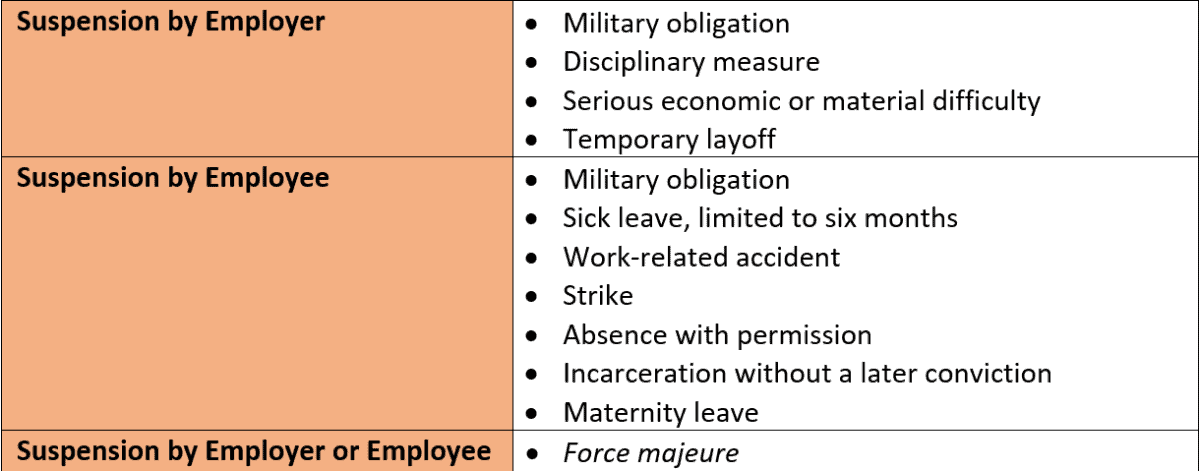
In light of COVID-19, an employer may be able to suspend employees on the basis of serious economic or material difficultly, or force majeure. Likewise, if an employee were sick because of COVID-19, an employee could seek to suspend the employment contract on the basis of being sick.
Notwithstanding the suspension of an employment contract, employers must continue providing accommodation to employees (if this benefit is already being provided). Employees, on the other hand, are still required to keep the company’s information confidential.
Lastly, the suspension of an employment contract will not affect the determination of length of continuous service of the employee for the purposes of calculating seniority (unless the employment contract or collective bargaining agreement states otherwise) and annual leave for the employee.
Grounds for Suspension
Serious Economic or Material Difficulty
An employer can only suspend an employee’s contract on the grounds of serious economic or material difficulty if the below criteria are satisfied:
- the employer can prove that it has encountered a difficult situation, such as serious economic and material difficulty, that requires the employer to suspend work; and
- the suspension will not exceed two months.
From a procedural standpoint, the employer must obtain approval from the Ministry of Labor and Vocational Training (MLVT)’s labor inspector before suspending any employees. To obtain approval, the employer must submit a request for suspension detailing the reasons for the suspension to the labor inspector. The labor inspector will grant the company permission to suspend employment contracts if it determines the reasons to be valid.
If an employer fails to follow the correct procedure when suspending an employment contract, then the employer will still likely have an obligation to pay wages to the employees even if the employees are not working. Such an approach has been adopted by the Arbitration Council in a recent decision (please refer to Award No.011/20 issued on 12 March 2020).
Force Majeure
An employer can also suspend a contract on the basis of force majeure for a maximum of three months under Article 71(10) of the Labor Law. However, neither the Labor Law nor Cambodia’s Civil Code defines what constitutes a force majeure event under Cambodian law.
As force majeure is typically defined as an unforeseeable and unavoidable event that prevents a party to a contract from performing its contractual obligations, we recommend that any employers seeking to suspend employees on the basis of force majeure document how COVID-19 is impacting their businesses. Such evidence of force majeure will be necessary in the event that employees later challenge the basis for the suspension.
Provisions Relating to Certain Employees That Were Enacted in Response to COVID-19
In February, the MLVT issued a regulations entitled Instruction on the Suspension of Employment Contracts, Soft Skills Enrollment, Suspension of Payment to NSSF for Textile, Garment, and Footwear Sectors Affected by Lack of Raw Materials due to COVID-19. This instruction required employers in the textile, garment, and footwear sectors to pay 40% of the wages of suspended employees, while the government would provide another 20% of the USD 190 minimum wage.
However, on April 7, 2020, the government made an unofficial announcement that changes the above instruction for suspended employees in the textile, garment, and footwear sectors, and extends certain benefits to employees in the tourism sector as well. Under the announcement, the following benefits should be provided to suspended employees in the textile, garment, footwear, and tourism sectors:
- Suspended employees in the textile, garment, and footwear sectors will no longer receive 60% of the minimum wage, but will instead receive a flat benefit of USD 70, of which the government would pay USD 40 and employers would pay USD 30.
- Suspended employees in the tourism sector will receive a flat benefit of USD 40 from the government. Employers have the discretion to pay an amount of wages to employees on a voluntary basis and based on the employers’ actual financial position.
Employees are only eligible for the above payments if the employer satisfies the following conditions:
- the employment suspension was approved by the MLVT;
- the employees have been legally registered with MLVT; and
- the employees are already registered with the National Social Security Fund.
Termination
Overview
Cambodia’s Labor Law also allows employers to terminate employment contracts. The procedures for terminating an employment contract, and the consequences of doing so, will depend on whether the employment contract is structured as a fixed duration contract (FDC) or an undetermined duration contract (UDC). In general, an FDC must be in writing and must have clear starting and expiration dates that do not exceed an initial term of two years. After the first expiration of an FDC, it can be renewed one or more times so long as the total renewal duration, excluding the first period, does not exceed another two years. If a contract fails to meet these requirements, it would be deemed a UDC.
Fixed Duration Contracts
Basis for Termination of the Contract
The Labor Law recognizes three grounds for terminating an FDC before the end date and without the payment of severance:
- by mutual agreement between employer and employee, in which case the termination must be in writing and signed in the presence of a Labor Inspector;
- serious misconduct by either party; and
- force majeure.
Notice Periods
Absent one of the grounds discussed above, an FDC cannot be unilaterally terminated by the employer without the need to pay severance (as discussed below). The below notice periods relate to the amount of notice that must be granted to an employee if the employer wants to let the contract to expire.

Failure to give an employee due notice will result in the contract being renewed for a duration equal to the original contract. If the renewal periods exceed two years in total, the contract will be deemed to a UDC.
Amount of Payments
An employee with an FDC would be entitled to the following compensation upon the expiration of the employee’s contract.
- A severance payment equal to at least 5% of the wages paid to the employee during the length of the contract (Article 73 of the Labor Law);
- Unused and unpaid annual leave through to the termination date (Article 167 of Labor Law);
- Any other benefits agreed to between the employer and the employee in an employment contract, internal work rules, employee manual/HR handbook or collective bargaining agreement, if any.
If the employee is terminated before the expiration date of the employee’s contract, the employee is also entitled to the following payment:
- Damages for being laid off before the expiration date of the FDC, which equals the wages the employee would have received had he or she completed the original contracted term of employment (Article 73 of Labor Law).
Undetermined Duration Contracts
Basis for Termination of the Contract
The Labor Law recognizes two grounds for terminating a UDC without notice and without payment of severance:
- serious misconduct by either party; and
- force majeure.
Otherwise, a UDC can be terminated by either party provided:
- due notice of the termination is given in writing; and
- in the case of an employer giving notice, the employer has a valid reason for terminating the contract, such as deficiencies in the employee’s aptitude or behavior, or business operation requirements of the employer.
Notice Periods
Minimum notice requirements under the Labor Law for terminating an UDC are based on the employee’s length of service as follows:

During the notice period, an employee is entitled to receive full wages and benefits, and is entitled to two days’ paid leave per week to look for new employment.
Amounts of Payments
An employee under a UDC would be entitled to the following compensation upon termination:
- seniority back payments that remain unpaid for employment periods before 2019 at a rate of 15 days of wages and benefits for each year of service before 2019 (subject to a payment cap equivalent to six months of the employee’s actual wages);
- final seniority payment of seven days of wages and benefits if the employee has worked for at least one month since the last seniority payment;
- compensation in lieu of notice required;
- unused and unpaid annual leave through to the termination date;
- damages for being laid off in an amount equal to the seniority payment received during the employment contract; and
- any other benefits agreed to between the employer and the employee in an employment contract, internal work rules, employee manual, HR handbook, or collective bargaining agreement, if any.
Damages
Regarding damages, Article 91 of the Labor Law provides that termination of an employment contract without a “proper reason or cause” entitles the employee to damages.
In order to avoid this liability, the employer must have a proper reason or cause for the termination, and generally comply with the procedures for terminating an employee under the Labor Law. The Labor Law does not to define “proper reason or cause,” so employers have a certain amount of discretion to argue that they have a proper reason or cause. However, it may be inferred from Article 74 (2) of the Labor Law that a “proper reason or cause” refers to the employee’s ability or behavior based on the employer’s business operation requirements.
Mass Layoff
The Labor Law allows a mass layoff resulting from a reduction in an establishment’s activity or an internal reorganization that is foreseen by the employer. An employer seeking to carry out a mass layoff of employees must:
- establish the order of the layoffs in light of professional qualifications, seniority within the establishment, and family burdens of the workers;
- inform the workers’ representatives in writing in order to solicit their suggestions, primarily, on the measures for a prior announcement of the reduction in staff and the measures taken to minimize the effects of the reduction on the affected workers; and
- layoff first employees with the least professional ability, followed by employees with the least seniority. Seniority must be increased by one year for a married employee and by an additional year for each dependent child.
Dismissed employees have priority to be re-hired for the same position for two years. Employees who have priority for re-hire are required to inform their employer of any change in address during this layoff period. If there is a vacancy, the employer must inform the concerned employee by sending a registered letter to his last address. The employee must appear at the establishment within one week after receiving the letter.
While employers have a number of options to manage their workforce during these difficult times, employers should ensure that they are aware of and compliant with all relevant procedures for these options in order to minimize their liabilities.