
You are using an outdated browser and your browsing experience will not be optimal. Please update to the latest version of Microsoft Edge, Google Chrome or Mozilla Firefox. Install Microsoft Edge

August 29, 2018

A Novel Approach to Evaluating the Similarity of Trademarks in Thailand

Informed Counsel

The Court of Appeal for Specialized Cases (Specialized Appeal Court) was established in October 2016 to review all appeals against the judgments of the five specialized first instance courts in Thailand, including the Central Intellectual Property and International Trade Court (IP&IT Court). Most, if not all, judges of the Specialized Appeal Court, who are responsible for reviewing IP-related appeals, have had experience working as judges at the IP&IT Court and can be expected to be well versed in IP law and practices. They are capable of providing fair, practical, and sometimes novel judgments, as illustrated in a recent case involving how similarity of trademarks should be evaluated.

Opposition of Similar Trademarks

In June 2009, a Thai company filed an application for registration of the trademark MOBIL-AG & Device, Application No. 734360, for use with goods in Class 1, namely chemical fertilizers. This application was subsequently published in a trade gazette in September 2012. As the applicant’s mark is closely similar to the well-known registered trademarks of Exxon Mobil Corporation (“ExxonMobil”), ExxonMobil filed an opposition petition against this application with the Trademark Office in December 2012 under Section 13 of the Trademark Act, among others. The opposition was based on several prior registered trademarks of ExxonMobil, particularly:

  1. Trademark Registration No. Kor. 63198, registered for use with goods in Class 4, including lubricant oil, kerosene, gasoline, diesel; and
  2. Trademark Registration No. Kor. 99756, registered for use with goods in Class 5, including antiseptics in plants and pesticides.

The marks are shown in the table below.
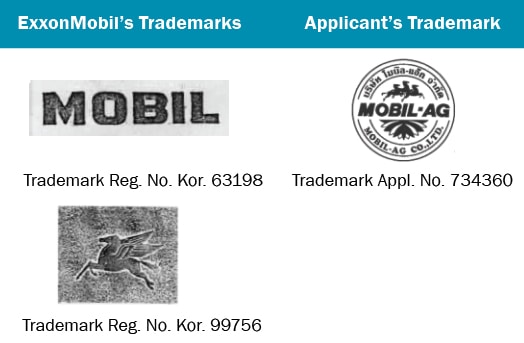
Even though the Trademark Office Registrar found that the applicant’s trademark and ExxonMobil’s trademark MOBIL, Reg. No. Kor. 63198, are similar, the registrar unfortunately dismissed the opposition because it found that both marks are for use with goods in different classes and that the lists of goods were not of the same character.     

ExxonMobil then appealed the decision to the Board of Trademarks, which dismissed the appeal based on the same reasons. ExxonMobil therefore further appealed the decision by filing a lawsuit with the IP&IT Court.

IP&IT Court’s Judgment

In January 2017, after reviewing the evidence and statements of witnesses produced by both parties, the IP&IT Court rendered judgment dismissing the lawsuit. The IP&IT Court found that (1) the appearances and pronunciations of both parties’ marks were different; (2) the classifications of the goods of both parties’ marks were different; and (3) the lists of goods of both parties’ marks were not related. The court therefore ruled that the applicant’s mark was not prohibited from registration under Section 13 of the Trademark Act. Disappointed with the judgment, ExxonMobil instructed Tilleke & Gibbins to appeal the IP&IT Court judgment to the Specialized Appeal Court.

Specialized Appeal Court’s Judgment   

On October 11, 2017, the Specialized Appeal Court rendered judgment finding that the applicant’s Trademark Application No. 734360 is similar enough to ExxonMobil’s Trademark Registration Nos. Kor. 99756 and Kor. 63198 so as to cause confusion among the public.

Even though both parties’ marks are for use with goods of different classes, the lists of goods were found to have the same character. Accordingly, the applicant’s Trademark Application No. 734360 is not registrable under Section 13 of the Trademark Act. The Specialized Appeal Court therefore reversed the judgment of the IP&IT Court and ordered that the prior decisions of the Trademark Registrar and the Board of Trademarks be withdrawn.

It is interesting to note that the Specialized Appeal Court not only addressed the similarity of both parties’ marks, element by element, but also discussed the origin of the word “MOBIL.” Particularly, it stated that this word is not Thai, but foreign. If this foreign word has not been used until it has a comparative meaning in Thai, there would be limitations for general consumers to recognize and remember it. Most importantly, “MOBIL” does not have a meaning in the dictionary and ExxonMobil’s witness confirmed that the word has been used as a trademark since 1906 and has been registered worldwide. It can therefore be concluded that the applicant used the same word as that of ExxonMobil as a part of its trademark.

Moreover, in the appeal, in addition to the similarity issue, ExxonMobil argued that its registered trademarks are well known, and the applicant, who was well aware of ExxonMobil’s well-known mark, applied for registration of a similar mark in bad faith. Even though the Specialized Appeal Court did not discuss or rule on the well-known and bad faith issues, it is obvious that these arguments were taken into consideration when evaluating the similarity between both parties’ marks. 

The ruling has positive implications for future similar cases in Thailand as it implies that, in deciding whether an applicant’s trademark is prohibited from registration under Section 13 of the Trademark Act, the Specialized Appeal Court will take into consideration the fame of the prior registered trademark and the bad faith of the applicant. This approach should help in deterring any bad faith applicant from imitating other parties’ well-known trademarks or applying for registration of such imitation trademarks.

RELATED INSIGHTS​ 

December 5, 2025
One morning, a California-based company mapping its Southeast Asia rollout opened an unexpected cease-and-desist letter from a Vietnamese IP firm. To the company’s surprise, the letter asserted that a local client already owned the company’s brand in Vietnam and threatened legal action. This is not an isolated incident. In another recent matter in the sports industry, a squatter demanded at least USD 48,000 from our client to “resolve” a similar conflict. For brands entering Vietnam or expanding distribution there, these tactics can create acute risk at precisely the point at which market momentum is building. Vietnam’s rapid economic growth and deepening integration into global trade have made it an increasingly attractive destination for multinational brands. Those same dynamics have intensified a longstanding issue: trademark squatting. Vietnam has modernized its IP framework over the past decade, but its strict first-to-file trademark system continues to incentivize opportunistic filings by parties with no legitimate interest in a mark. As more foreign brands build their reputation abroad before turning to Vietnam, squatters remain alert to timing gaps and enforcement frictions. The First-to-File System: Advantages and Vulnerabilities Vietnam adheres closely to the first-to-file principle under its Law on Intellectual Property. In practice, exclusive trademark rights belong to whoever submits the earliest valid application to the Vietnam Intellectual Property Office, regardless of prior use in Vietnam. This approach offers administrative clarity and reduces evidentiary burdens compared to use-based jurisdictions. Yet it also creates fertile conditions for squatting. Bad-faith actors regularly monitor foreign markets, identify brands gaining traction, and move quickly to register those marks domestically, often long before the genuine owner enters the market or prioritizes local filings. By the time the true brand seeks protection, the squatter’s application (or registration) stands as a legal obstacle, pushing businesses toward costly oppositions, cancellations, or uncomfortable negotiations
December 3, 2025
Attorneys from Tilleke & Gibbins’ Bangkok office have contributed the Thailand chapter to Litigation 2026, published by Chambers and Partners. Litigation 2026 provides an overview of litigation procedures and practices across numerous jurisdictions. The guide is a key reference for businesses, in-house counsel, and legal professionals seeking to understand and compare litigation frameworks around the world. The Thailand chapter delivers analysis of 14 core areas of litigation, including: General characteristics of the legal system and court structure Litigation funding options and requirements Procedures for initiating lawsuits and pre-trial steps Discovery processes and injunctive relief Trial procedures and rules on evidence Settlement mechanisms and enforcement Damages and judgment considerations Appeal processes and cost issues Alternative dispute resolution and arbitration Developments and future outlook for dispute resolution in Thailand Each section offers practical guidance on navigating Thailand’s litigation landscape, providing useful context for international businesses and legal practitioners involved in dispute resolution matters. Chambers and Partners’ Global Practice Guides deliver expert commentary on key practice areas across jurisdictions, allowing readers to compare legislation, procedures, and practical considerations relevant to business operations. The Thailand chapter can be downloaded through the button below, and the full Litigation 2026 guide is available free of charge on the Chambers and Partners website.
December 3, 2025
Thailand’s Civil Court has issued a regulation targeting the use of artificial intelligence (AI) in the preparation of pleadings and other documents submitted to the court. Effective November 17, 2025, the regulation aligns with September 2025 guidance from the president of the Supreme Court, and aims to safeguard accuracy, transparency, and public confidence in civil adjudication. The regulation applies to all parties submitting pleadings or any documents to the Civil Court that are prepared using AI tools or contain AI-generated content. It subjects AI used for these purposes to strict requirements on verification, disclosure, and accountability. Core Obligations The regulation imposes four principal obligations: Lawyers who use AI remain subject to duties of honesty, responsibility to the court, professional standards, and legal ethics, including the duty to assess the appropriateness of the AI tool for the work. Parties and lawyers must verify the accuracy and completeness of all facts, legal provisions, and citations in AI-generated content before submission. Parties and lawyers must disclose to the court any AI-generated content by clearly marking the beginning and end of the AI-generated portion with prescribed statements (see below). Additionally, a certification confirming the use of AI must be provided at the end of the pleading or document, stating that AI was used for certain portions and that the party has reviewed and certifies the accuracy of factual and legal content. Parties and lawyers bear the same full legal and ethical responsibility for AI-generated content as they do for personally authored documents; they cannot evade responsibility or avoid liability by citing AI-related errors. Likewise, parties must ensure that any AI-generated content is truthful, accurate, and unbiased. Prescribed Disclosure Language Each instance of AI-generated content must be preceded by the statement “[The following content was prepared using artificial intelligence]” and must end with “[End
November 26, 2025
On November 21, 2025, Myanmar’s Ministry of Commerce (MOC) issued Notification No. 103/2025 promulgating the Geographical Indication Rules (GI Rules), establishing a comprehensive framework for the registration and administration of geographical indications (GI), which are primarily governed by the Trademark Law of 2019. On the same day, the MOC released Notification No. 104/2025 specifying the required forms for GI-related matters. The GI Rules establish a comprehensive set of procedures for the entire GI application process, including filing applications, oppositions, cancellations, and invalidations, and appointing a local representative for GI-related matters. Under the Trademark Law and the GI Rules, domestic and foreign legal entities (organizations) that formally represent a defined group of stakeholders (such as producers or manufacturers of natural products or resources, agricultural products, handicrafts, or industrial products) and other competent authorities from government departments are eligible to apply for GI registration with the Intellectual Property Department (IPD) in Myanmar. Application A GI application can be submitted in either English or Myanmar language electronically, in person, or via post. Foreign applicants seeking to register a GI in Myanmar are required to submit a copy of the registration certificate from their country of origin with the GI application. This certificate must explicitly state the GI name of the protected product. Notably, foreign applicants are mandated to appoint a local representative in Myanmar to act on their behalf for GI-related matters with the IPD and appeal-related matters with the IP Agency. The form for appointing the local representative must be duly notarized in the applicant’s home country to ensure its legal validity and acceptance in accordance with the GI Rules. Application for Use of GI Logo Pursuant to the GI Rules, any interested individual, local or foreign, may submit an application to the IPD for authorization to use the GI logo,