
You are using an outdated browser and your browsing experience will not be optimal. Please update to the latest version of Microsoft Edge, Google Chrome or Mozilla Firefox. Install Microsoft Edge

August 29, 2018

A Novel Approach to Evaluating the Similarity of Trademarks in Thailand

Informed Counsel

The Court of Appeal for Specialized Cases (Specialized Appeal Court) was established in October 2016 to review all appeals against the judgments of the five specialized first instance courts in Thailand, including the Central Intellectual Property and International Trade Court (IP&IT Court). Most, if not all, judges of the Specialized Appeal Court, who are responsible for reviewing IP-related appeals, have had experience working as judges at the IP&IT Court and can be expected to be well versed in IP law and practices. They are capable of providing fair, practical, and sometimes novel judgments, as illustrated in a recent case involving how similarity of trademarks should be evaluated.

Opposition of Similar Trademarks

In June 2009, a Thai company filed an application for registration of the trademark MOBIL-AG & Device, Application No. 734360, for use with goods in Class 1, namely chemical fertilizers. This application was subsequently published in a trade gazette in September 2012. As the applicant’s mark is closely similar to the well-known registered trademarks of Exxon Mobil Corporation (“ExxonMobil”), ExxonMobil filed an opposition petition against this application with the Trademark Office in December 2012 under Section 13 of the Trademark Act, among others. The opposition was based on several prior registered trademarks of ExxonMobil, particularly:

  1. Trademark Registration No. Kor. 63198, registered for use with goods in Class 4, including lubricant oil, kerosene, gasoline, diesel; and
  2. Trademark Registration No. Kor. 99756, registered for use with goods in Class 5, including antiseptics in plants and pesticides.

The marks are shown in the table below.
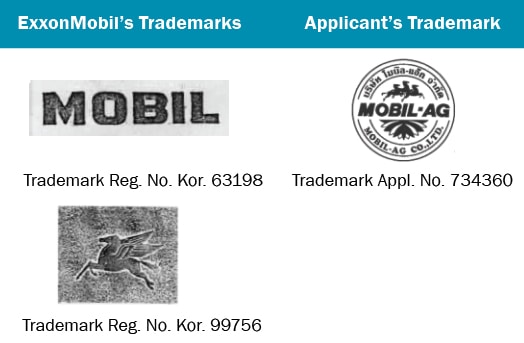
Even though the Trademark Office Registrar found that the applicant’s trademark and ExxonMobil’s trademark MOBIL, Reg. No. Kor. 63198, are similar, the registrar unfortunately dismissed the opposition because it found that both marks are for use with goods in different classes and that the lists of goods were not of the same character.     

ExxonMobil then appealed the decision to the Board of Trademarks, which dismissed the appeal based on the same reasons. ExxonMobil therefore further appealed the decision by filing a lawsuit with the IP&IT Court.

IP&IT Court’s Judgment

In January 2017, after reviewing the evidence and statements of witnesses produced by both parties, the IP&IT Court rendered judgment dismissing the lawsuit. The IP&IT Court found that (1) the appearances and pronunciations of both parties’ marks were different; (2) the classifications of the goods of both parties’ marks were different; and (3) the lists of goods of both parties’ marks were not related. The court therefore ruled that the applicant’s mark was not prohibited from registration under Section 13 of the Trademark Act. Disappointed with the judgment, ExxonMobil instructed Tilleke & Gibbins to appeal the IP&IT Court judgment to the Specialized Appeal Court.

Specialized Appeal Court’s Judgment   

On October 11, 2017, the Specialized Appeal Court rendered judgment finding that the applicant’s Trademark Application No. 734360 is similar enough to ExxonMobil’s Trademark Registration Nos. Kor. 99756 and Kor. 63198 so as to cause confusion among the public.

Even though both parties’ marks are for use with goods of different classes, the lists of goods were found to have the same character. Accordingly, the applicant’s Trademark Application No. 734360 is not registrable under Section 13 of the Trademark Act. The Specialized Appeal Court therefore reversed the judgment of the IP&IT Court and ordered that the prior decisions of the Trademark Registrar and the Board of Trademarks be withdrawn.

It is interesting to note that the Specialized Appeal Court not only addressed the similarity of both parties’ marks, element by element, but also discussed the origin of the word “MOBIL.” Particularly, it stated that this word is not Thai, but foreign. If this foreign word has not been used until it has a comparative meaning in Thai, there would be limitations for general consumers to recognize and remember it. Most importantly, “MOBIL” does not have a meaning in the dictionary and ExxonMobil’s witness confirmed that the word has been used as a trademark since 1906 and has been registered worldwide. It can therefore be concluded that the applicant used the same word as that of ExxonMobil as a part of its trademark.

Moreover, in the appeal, in addition to the similarity issue, ExxonMobil argued that its registered trademarks are well known, and the applicant, who was well aware of ExxonMobil’s well-known mark, applied for registration of a similar mark in bad faith. Even though the Specialized Appeal Court did not discuss or rule on the well-known and bad faith issues, it is obvious that these arguments were taken into consideration when evaluating the similarity between both parties’ marks. 

The ruling has positive implications for future similar cases in Thailand as it implies that, in deciding whether an applicant’s trademark is prohibited from registration under Section 13 of the Trademark Act, the Specialized Appeal Court will take into consideration the fame of the prior registered trademark and the bad faith of the applicant. This approach should help in deterring any bad faith applicant from imitating other parties’ well-known trademarks or applying for registration of such imitation trademarks.

RELATED INSIGHTS​ 

August 11, 2026
Cambodia’s Ministry of Justice has launched a new platform on its official website to publish notices of forced sales issued by each municipal and provincial court of first instance. The platform’s stated purpose is to inform the public and facilitate greater participation in forced-sale auctions conducted in connection with court-ordered enforcement proceedings. How the Platform Works The platform publishes forced-sale notices from courts of first instance across Cambodia’s municipalities and provinces and includes a link where the public can view properties currently subject to forced sale. To participate in a forced-sale auction, individuals can download Khmer-language bidding application forms through links provided on the platform. The form typically requires the applicant’s name, sex, year of birth, identity card number and issue date, and address, together with details identifying the immovable property (including its ownership certificate number), the relevant enforcement case number and date, and the reference to the public auction or tender announcement issued by the court. Completed application forms must be submitted directly to the specific municipal or provincial court that issued the forced sale. For further inquiries about a particular forced sale, interested parties should likewise contact the relevant municipal or provincial court. Forced Sale of Immovable Property in Cambodia The publication of these notices relates to the forced sale procedure for immovable property under Cambodia’s Code of Civil Procedure (CPC). Unlike property seizure by a court, a forced sale is a compulsory execution proceeding—a subsequent enforcement step that arises only after an underlying dispute has been adjudicated and a debtor fails to pay the debt or outstanding amount due under a final and binding judgment or other enforceable title of execution. For the purposes of this procedure, the term “immovable property” under the CPC refers to land, registered buildings, jointly held shares of such property, registered
August 10, 2026
Thailand has finalized its social media KYC (“know your customer”) rules under Notification of the Electronic Transactions Commission on Measures to Prevent Technological Crimes for Social Media Service Providers (No. 2), which was published in the Government Gazette on May 5, 2026, and will take effect on November 1, 2026. While an early draft of the notification proposed requiring social media platforms to arrange identification of every user account, the final notification is significantly more targeted, focusing on paid online advertising and advertiser identity verification. Though the regulatory initiative primarily aims to combat online fraud and technology-related crimes, it also has important consequences for intellectual property enforcement, because the verified platform records that will be generated under the new requirements can help IP rights holders to identify anonymous online infringers. Key Regulatory Mandates The notification requires social media service providers to verify the identity of advertisers before their paid advertisements are published and disseminated in Thailand through social media, regardless of whether the advertising fees come from the advertisers or third parties. Verification of an advertiser is valid for one year, after which verification would have to be performed again before the platform could publish additional paid advertisements from the advertiser. Permitted verification methods are specified under the notification. A platform may verify an advertiser by checking identity evidence and confirming the connection between the advertiser and that identity evidence, with the notification giving facial comparison against certain government-issued identity documents as an example. Alternatively, platforms may verify advertisers through a digital identity verification and authentication system with an identity-proofing assurance level not lower than the level prescribed by Thailand’s Electronic Transactions Commission. The notification further requires platforms to retain only the advertiser’s information necessary to identify the advertiser, beginning from the start of the advertising activity and for
August 6, 2026
Introduction: A Trademark Paradox in Sustainable Packaging Walk into any Thai supermarket, and the label-free water bottle is no longer a novelty. Thailand’s packaging market, valued at approximately USD 15.68 billion in 2025, is shifting toward minimalist, plastic-light designs as ESG pressures reshape how brands present their products. The country generated roughly 5.68 million tons of plastic waste in 2021, with a recycling rate of only 19 percent, and regulators are now considering rules that would allow label-free bottled water relying on embossing, laser printing, or QR codes instead of wrap-around labels. As packaging itself becomes the brand identifier, a paradox emerges: designs built to say the least often struggle hardest for protection under Thai intellectual property law. The Trademark Barrier: When Shape Is Not Enough Section 7, paragraph 2(10) of the Thai Trademark Act deems a shape distinctive only if it is not the natural form of the goods, is not necessary to achieve a technical result, and does not add value to the goods. The Department of Intellectual Property’s 2022 examination guidelines apply this test conservatively, as the following examples illustrate. A plain water bottle relying on subtle contours to signal its brand is typically read as just another bottle, not a source identifier. Acquired distinctiveness offers a theoretical escape route, but it demands extensive evidence of sales, advertising, and consumer recognition—an especially heavy burden for new entrants whose minimalist packaging has not yet achieved market prominence. The result is a structural bias against precisely the design innovation that sustainability goals are meant to encourage. Design Patents: A Partial, Imperfect Substitute Design patent protection, covering a product’s shape, configuration, or ornamentation, appears to offer an alternative route. In practice, it is constrained by the same forces driving the minimalist trend. Because many brands converge on similar solutions—clear
August 6, 2026
Every month, VAT-registered businesses in Thailand calculate their output and input VAT and file a return to pay the net amount due or claim a refund. Yet a common and costly dispute arises when a business that has paid input VAT to its supplier—and done everything asked of it—later finds that input VAT rejected on the grounds that the tax invoice was issued by “a person not entitled to issue tax invoices.” In these cases, a buyer may have confirmed the supplier’s VAT registration on the Revenue Department’s website, paid through the banking system, received a complete tax invoice, and kept full payment and inventory records. Even so, if the Revenue Department later determines that the supplier did not genuinely make the sale or collected the VAT without remitting it, the department can disallow the input VAT and assess additional tax, surcharge, and penalty—often more than a year after the transaction. A new article from tax and dispute resolution specialists at Tilleke & Gibbins in Bangkok examines how the Revenue Department and the courts approach these disputes, including two recent Supreme Court (Tax Division) decisions confirming that the taxpayer bears the burden of proving a supplier genuinely sold and delivered the goods and received payment. It considers why the VAT registration system offers no legal safe harbor, why the evidentiary burden falls hardest on online and cross-border transactions where buyers and sellers never meet, and how the Revenue Department’s own digital infrastructure could detect non-remitting suppliers at the source rather than shifting the loss to good-faith buyers. The article also sets out practical guidance: how to build a comprehensive “know-your-supplier” file at the time of a transaction, the procedural steps and strict deadlines for challenging a VAT assessment, and why dispute readiness belongs alongside tax planning at the center