
You are using an outdated browser and your browsing experience will not be optimal. Please update to the latest version of Microsoft Edge, Google Chrome or Mozilla Firefox. Install Microsoft Edge

August 30, 2022

New Minimum Wages in Thailand

On August 26, 2022, Thailand’s National Wage Committee voted to raise the minimum wage to THB 328–354 per day (USD 9.01–9.72)—an increase of approximately 5% from the previous range of THB 313–336. The decision to boost minimum wages, which were last increased in January 2020, came after a 14-year-high headline inflation rate of 7.61% in July 2022.

The new minimum wages have been submitted to the cabinet for final approval and are expected to take effect on October 1, 2022, following publication in the Government Gazette. The exact minimum wage depends on the province in which the workplace is located, as shown in the table below.
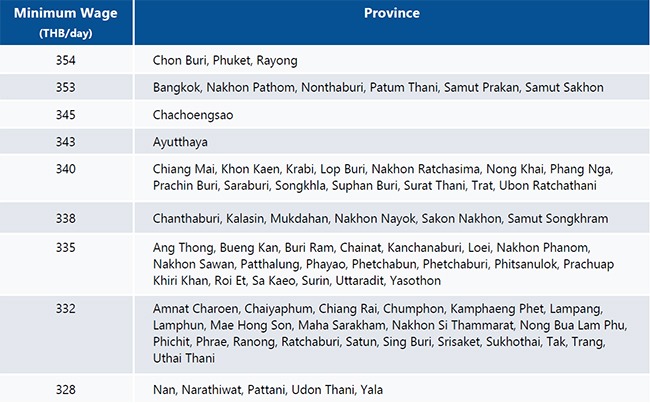
These minimum rates are for one working day, which consists of eight hours for normal work, or seven hours for work that may be harmful to the health and safety of the employee.

Legal Requirements

After the new minimum wages are announced in the Government Gazette, employers may not pay employees wages below the prescribed rates. Violations are punishable by imprisonment for up to six months, a fine of up to THB 100,000, or both.

Regarding the question of whether employers can reduce the working hours in order to pay less than minimum wages (e.g., a prorated amount), based on past practice, the National Wage Committee’s announcement is expected to provide that a “day” refers to an employee’s normal working day, regardless of whether it is shorter than the “normal working hours” set by the employer under the Labor Protection Act.

For example, an employee in Bangkok who earns the current minimum wage of THB 331 per day for normal working hours of eight hours a day would still be entitled to the full new rate of THB 353 per day in October 2022, even if the employer reduces the working hours.

For further information on Thailand’s minimum wage regulations, or on any aspect of employment law in Thailand, please contact Tilleke & Gibbins at [email protected] or +66 2056 5555.

RELATED INSIGHTS​ 

April 27, 2020
Thailand’s Ministry of Interior has proposed a second round of automatic visa extensions for non-Thai citizens in Thailand whose visas will expire on or after April 30, 2020, along with a temporary exemption from the 90-day report duty, due to the continued travel restrictions in light of the COVID-19 pandemic.On April 21, the Cabinet approved the second automatic visa extension. All types of visas will therefore be automatically extended to July 31, 2020. A temporary suspension of the 90-day report requirement has also been granted until July 31, 2020.
April 24, 2020
The Government Office of Vietnam recently announced the conclusions of Prime Minister Nguyen Xuan Phuc regarding the combat of the COVID-19 pandemic following government meetings on April 20 and 22, 2020. Accordingly, the country has now moved into long-term epidemic combat, and thus needs to practice appropriate social distancing while facilitating the supply of goods and business development. As such, the strict social distancing guidelines under Directive No. 16/CT-TTg issued on March 31, 2020, have been lifted for most localities.
April 23, 2020
On April 21, 2020, following the Prime Minister’s extension of the lockdown measures in Laos to May 3, the National Taskforce Committee for COVID-19 Prevention and Control (the Taskforce) issued guidance on what companies must do to be allowed to operate during the lockdown, entitled Instructions on the Conditions and Measures for Eligible Private Companies to Operate during the COVID-19 Outbreak. 
April 23, 2020
The tragic increase in COVID-19 cases worldwide has changed how we live and work the world over, and Cambodia has not escaped the severe business impact being seen elsewhere. As a result of these changes, many businesses in Cambodia are seeking to understand what options they have for managing their employees during this time, and the consequences of various courses of actions. The purpose of this article is to address these issues.SuspensionOverview