
You are using an outdated browser and your browsing experience will not be optimal. Please update to the latest version of Microsoft Edge, Google Chrome or Mozilla Firefox. Install Microsoft Edge

August 30, 2022

New Minimum Wages in Thailand

On August 26, 2022, Thailand’s National Wage Committee voted to raise the minimum wage to THB 328–354 per day (USD 9.01–9.72)—an increase of approximately 5% from the previous range of THB 313–336. The decision to boost minimum wages, which were last increased in January 2020, came after a 14-year-high headline inflation rate of 7.61% in July 2022.

The new minimum wages have been submitted to the cabinet for final approval and are expected to take effect on October 1, 2022, following publication in the Government Gazette. The exact minimum wage depends on the province in which the workplace is located, as shown in the table below.
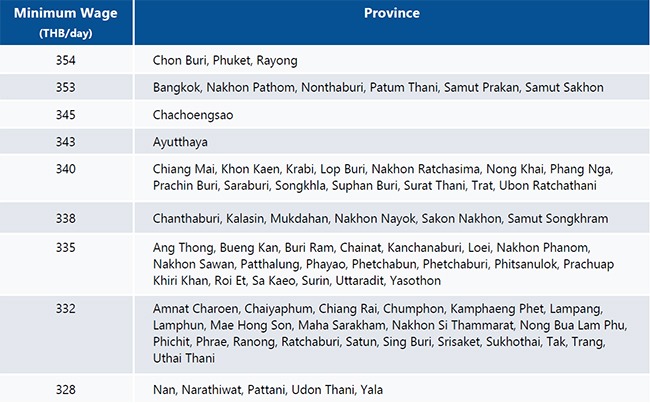
These minimum rates are for one working day, which consists of eight hours for normal work, or seven hours for work that may be harmful to the health and safety of the employee.

Legal Requirements

After the new minimum wages are announced in the Government Gazette, employers may not pay employees wages below the prescribed rates. Violations are punishable by imprisonment for up to six months, a fine of up to THB 100,000, or both.

Regarding the question of whether employers can reduce the working hours in order to pay less than minimum wages (e.g., a prorated amount), based on past practice, the National Wage Committee’s announcement is expected to provide that a “day” refers to an employee’s normal working day, regardless of whether it is shorter than the “normal working hours” set by the employer under the Labor Protection Act.

For example, an employee in Bangkok who earns the current minimum wage of THB 331 per day for normal working hours of eight hours a day would still be entitled to the full new rate of THB 353 per day in October 2022, even if the employer reduces the working hours.

For further information on Thailand’s minimum wage regulations, or on any aspect of employment law in Thailand, please contact Tilleke & Gibbins at [email protected] or +66 2056 5555.

RELATED INSIGHTS​ 

April 28, 2023
Instead of the typical dystopian scene of flames, wastelands of shattered buildings, and robotic overlords policing the remaining humans, our actual dystopian future may be a workplace filled only with men named Jared who once played lacrosse in high school. This may sound far-fetched, but one resume-screening tool was found to be using an algorithm that concluded two factors were most determinative of job performance: the name Jared and a history of playing lacrosse in high school. The frailties of artificial intelligence (AI) systems in recruitment and hiring could transform our workforces in unpredictable ways. If employers blindly follow AI outcomes without a deeper examination of how the algorithmic decision is reached, hiring outcomes may be not only ridiculous but also discriminatory. Risks of AI-Reliant Hiring Some employers have enthusiastically embraced AI as a way to reduce costs and replace human bias in the recruitment process. Human recruiters do not have a great track record; for example, in France, discrimination in recruitment has posed such a serious problem that the government submits false work biographies with ethnic names to identify and punish employers that unreasonably reject qualified ethnic applicants. Unfortunately, AI is modeled on human thinking, so it may amplify our own prejudices and errant conclusions while giving the appearance of providing a fair and clean process. AI typically learns inductively by training on examples and historical data. Factors such as exclusion of certain groups from educational or career opportunities has often shaped this data, so AI’s decisions may amplify this past prejudice. For instance, Amazon experimented with mechanized recruitment in 2014, but abandoned these efforts prior to implementation after the AI tool selected a predominantly male workforce. The AI learned by analyzing patterns in resumes submitted to the company over the last 10 years. Since over this period
April 3, 2023
Most employers know that terminating employees for poor job performance is not easy. But it is actually legally possible—if employers have the right approach and take specific precautionary measures. However, failing to take these precautions can mean that an employer is either stuck with an incompetent employee or on the losing end of a lawsuit for unfair termination. This article will lay out some essential considerations for employers in Thailand regarding termination of employment for poor performance. First, understand that “poor work performance” is a lack of performance or ability, or an inability to work with other employees. It does not constitute a violation of work rules or regulations. In some cases, however, an employee’s failure to act in accordance with lawful instructions or commands of the employer, resulting in poor work performance, could also be considered a violation of work rules or regulations. This may be the case if the work rules or regulations clearly state that an employee must strictly comply with the employer’s instructions or commands. Second, an employer can, in fact, terminate an employee due to poor work performance. For example, this may be possible in the following scenarios: Records show that an employee’s work performance has fallen below the employer’s required standards, and the employee has not tried to improve his or her work performance for three consecutive years. In addition, it does not appear that the employer was biased when giving ratings or scores for the employee’s work performance. The job description of the employee includes coordination with employees in other departments, but the employee has not been able to do so. Therefore, the employee was reassigned to a new job function, but the employee still did not improve. This suggests that the employee has a lack of interpersonal skills and is not
March 23, 2023
On March 19, 2023, Thailand’s new work-from-home (WFH) legislation amending the Labour Protection Act (No. 8) B.E. 2566 (2023) was published in the Government Gazette. It will come into effect on April 18, 2023. The amendment aims to enhance employee protections to accord with current global standards, provide alternative working arrangements for employers and employees, increase workforce efficiency, and strengthen employees’ job security and a better quality of life. As we detailed previously, the new WFH legislation allows employers and employees to reach agreements that permit employees to work remotely. Since there are no accompanying criminal punishments relating to this new provision, and the legislation incorporates the term “may agree,” it appears that this WFH provision is not mandatory but is primarily intended to facilitate and encourage remote working agreements between employers and employees. For more details on the WFH legislation, or on any aspect of employment law in Thailand, please contact Tilleke & Gibbins at [email protected].
February 24, 2023
Many companies have moved to Southeast Asia to benefit from the advantages of this vibrant and diverse market. The region is already a manufacturing hub for a multitude of industries—computer and automotive products in Thailand, textiles in Cambodia, and footwear and electrical goods in Vietnam, to name a few—and an increasing number of companies worldwide are reconfiguring their supply chains to include regional suppliers. A key challenge is keeping up to date with employment law trends in these jurisdictions to ensure compliance with local regulations—and avoid costly, time-consuming business interruption. Here we outline trends and recent regulatory developments in Cambodia, Thailand, and Vietnam, and consider what they mean for employers. Cambodia The Ministry of Labour and Vocational Training (MLVT) is likely to pursue a more proactive enforcement strategy in 2023. Last May, the MLVT announced companies would be required to submit a twice yearly self-declaration on labour compliance through a new online system. The self-declaration form requires companies to confirm and upload evidence of compliance, and the MLVT online system—through which the ministry can easily determine if a company is compliant –generates a report that lists all fines. Companies should comply with the self-declaration requirement and carefully review the form to understand what fines will apply for non-compliance. On 1 October 2022, regulations relating to the National Social Security Fund (NSSF) pension system came into effect, and employers and employees began making NSSF pension contributions. Over the next five years, total compulsory pension contributions will amount to 4% of an employee’s wage, half of which is paid by the employer and half deducted from the employee’s salary. The contribution wage is capped at KHR 1.2m (USD 300). Employers are currently required to pay a relatively small amount (KHR 24,000, or around USD 6). This will increase to 10.75% over