
You are using an outdated browser and your browsing experience will not be optimal. Please update to the latest version of Microsoft Edge, Google Chrome or Mozilla Firefox. Install Microsoft Edge

August 30, 2022

New Minimum Wages in Thailand

On August 26, 2022, Thailand’s National Wage Committee voted to raise the minimum wage to THB 328–354 per day (USD 9.01–9.72)—an increase of approximately 5% from the previous range of THB 313–336. The decision to boost minimum wages, which were last increased in January 2020, came after a 14-year-high headline inflation rate of 7.61% in July 2022.

The new minimum wages have been submitted to the cabinet for final approval and are expected to take effect on October 1, 2022, following publication in the Government Gazette. The exact minimum wage depends on the province in which the workplace is located, as shown in the table below.
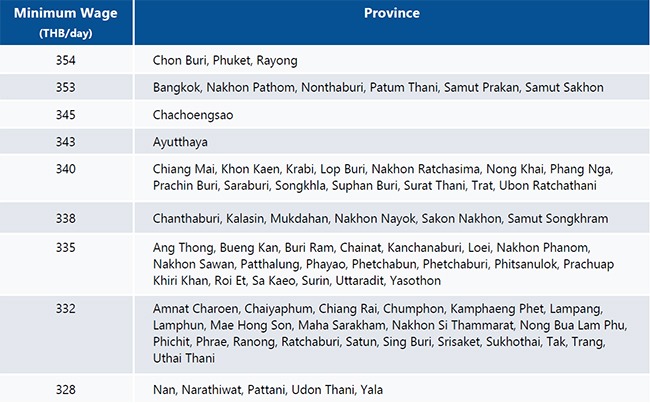
These minimum rates are for one working day, which consists of eight hours for normal work, or seven hours for work that may be harmful to the health and safety of the employee.

Legal Requirements

After the new minimum wages are announced in the Government Gazette, employers may not pay employees wages below the prescribed rates. Violations are punishable by imprisonment for up to six months, a fine of up to THB 100,000, or both.

Regarding the question of whether employers can reduce the working hours in order to pay less than minimum wages (e.g., a prorated amount), based on past practice, the National Wage Committee’s announcement is expected to provide that a “day” refers to an employee’s normal working day, regardless of whether it is shorter than the “normal working hours” set by the employer under the Labor Protection Act.

For example, an employee in Bangkok who earns the current minimum wage of THB 331 per day for normal working hours of eight hours a day would still be entitled to the full new rate of THB 353 per day in October 2022, even if the employer reduces the working hours.

For further information on Thailand’s minimum wage regulations, or on any aspect of employment law in Thailand, please contact Tilleke & Gibbins at [email protected] or +66 2056 5555.

RELATED INSIGHTS​ 

May 2, 2025
Attorneys from Tilleke & Gibbins have updated the latest edition of Doing Business in Thailand, a Q&A-style guide from Thomson Reuters Practical Law that offers an overview of key legal considerations for companies operating in jurisdictions worldwide. The contribution outlines the country’s legal and regulatory framework for foreign investment and business operations and reflects the latest legislative developments. The chapter addresses the following core topics: Legal system: Structure of the courts and the codified nature of Thai law. Foreign investment: Business restrictions under the Foreign Business Act, sector-specific regulations, exchange control rules, and investment incentives. Business vehicles: Overview of partnerships, private and public limited companies, and other legal entities. Employment: Labor protections, employment contracts, foreign worker requirements, and termination procedures. Tax: Corporate and personal income tax, indirect taxes, and tax obligations for residents and non-residents. Intellectual property: Registration and enforcement of patents, trademarks, designs, and copyrights. Data protection: Key provisions of the Personal Data Protection Act and related compliance obligations. Competition law: Regulatory framework under the Trade Competition Act. Anti-bribery and corruption: Relevant legislation and enforcement mechanisms. E-commerce and digital business: Legal regime for online transactions and digital platforms. Marketing and advertising: Consumer protection laws and regulations affecting advertising and marketing practices. Product regulation and liability: Safety standards, liability regimes, and roles of enforcement authorities. Practical Law, a legal reference resource from Thomson Reuters, publishes a range of guides for hundreds of jurisdictions and practice areas. The insurance and reinsurance guide is a valuable resource for legal practitioners, covering numerous jurisdictions worldwide. To view the latest version of the guide, please visit the Practical Law website and enroll in the free Practical Law trial to gain full access.
April 22, 2025
Thailand’s Immigration Bureau has announced the launch of the Thailand Digital Arrival Card (TDAC) as part of ongoing efforts to improve entry procedures and streamline immigration processing. Effective May 1, 2025, all foreign nationals with any type of visa entering Thailand by any means will be required to complete the TDAC online prior to arrival. This requirement does not apply to individuals transiting or transferring through Thailand without passing through immigration control, or to those entering with a border pass. Foreign nationals planning to enter Thailand must complete and submit their TDAC within the three days prior to their arrival date. The form, which collects passport information, personal details, travel information (e.g., flight number), Thai accommodation information, and a health declaration—can be filled out in English online at https://tdac.immigration.go.th. Once the form is submitted, an acknowledgment will be sent to the email address entered on the form. This acknowledgment must be presented at the immigration checkpoint in Thailand along with travel documents for verification. The Thai government strongly encourages all foreign passport holders to complete the TDAC ahead of their departure to prevent any entry delays or issues at the checkpoint.
April 18, 2025
On March 31, 2025, Cambodia’s Ministry of Labour and Vocational Training (MLVT) issued Notification 009/25, which grants an extension for the renewal of foreign workers’ work permits and employment books in 2025. This extension is to ensure that those who have not yet applied for the renewal of their work permits are provided with sufficient time to complete the application process, as there have been delays in the submission of work permit extension requests. The new deadline for the submission of renewal applications for work permits and employment books is April 30, 2025. Applications and renewals must be processed via the MLVT’s online Foreign Workforce Centralized Management System before the specified deadline. Failure to extend the validity of work permits and employment books for foreign workers before the deadline may result in significant monetary penalties for both employers and foreign nationals. All foreign workers should renew their work permits and employment books within the extended deadline to ensure continued validity for working in Cambodia.
March 13, 2025
The recent freeze on US foreign aid has led to the suspension of billions of dollars in foreign assistance as well as widespread layoffs at contracting organizations around the world. Under this situation, USAID-funded offices in all jurisdictions, including Cambodia, may face the challenge of determining whether they need to lay off their employees. Employers in Cambodia may take different steps in response to this and other instances of sudden financial stress in order to manage their workforce in accordance with Cambodian laws and regulations. Suspension Cambodia’s Labor Law allows employers to suspend employment contracts due to a major economic or material issue or any unexpected difficulty that results in the suspension of operations. To impose this employment contract suspension, the employer must initially submit a suspension request to the Ministry of Labor and Vocational Training (MLVT), detailing the reasons for the requested suspension. If the reasons are deemed valid and the request is approved, the suspension period cannot exceed two months. During the suspension period, the employer must continue providing accommodation for employees if this benefit is already being provided. In some circumstances, the suspension period can be extended if necessary (as happened during the COVID-19 pandemic). However, financial difficulties alone may not be a valid reason for extension. The decision is at the discretion of the MLVT labor inspectors on a case-by-case basis. Therefore, given the uncertain timeline of financial difficulties that may significantly impact the employer’s budget, suspending employment contracts might be ineffective. Mass Layoffs Under Cambodia’s Labor Law, mass layoffs due to a significant reduction in an establishment’s operation or an internal reorganization foreseen by the employer are permissible. The layoff order must be based on professional qualifications, seniority period, and family burdens of the employees. The first employees to be laid off must be