
You are using an outdated browser and your browsing experience will not be optimal. Please update to the latest version of Microsoft Edge, Google Chrome or Mozilla Firefox. Install Microsoft Edge

August 30, 2022

New Minimum Wages in Thailand

On August 26, 2022, Thailand’s National Wage Committee voted to raise the minimum wage to THB 328–354 per day (USD 9.01–9.72)—an increase of approximately 5% from the previous range of THB 313–336. The decision to boost minimum wages, which were last increased in January 2020, came after a 14-year-high headline inflation rate of 7.61% in July 2022.

The new minimum wages have been submitted to the cabinet for final approval and are expected to take effect on October 1, 2022, following publication in the Government Gazette. The exact minimum wage depends on the province in which the workplace is located, as shown in the table below.
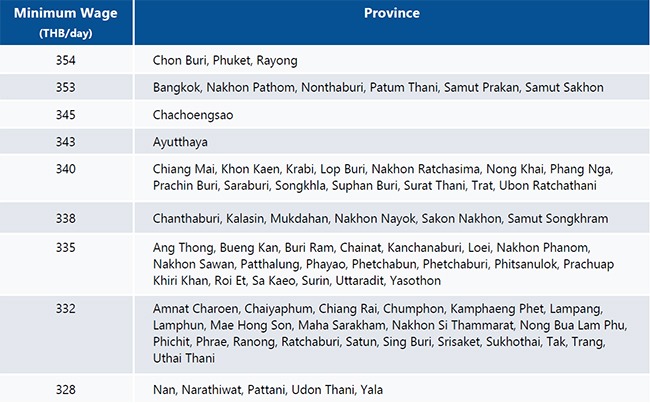
These minimum rates are for one working day, which consists of eight hours for normal work, or seven hours for work that may be harmful to the health and safety of the employee.

Legal Requirements

After the new minimum wages are announced in the Government Gazette, employers may not pay employees wages below the prescribed rates. Violations are punishable by imprisonment for up to six months, a fine of up to THB 100,000, or both.

Regarding the question of whether employers can reduce the working hours in order to pay less than minimum wages (e.g., a prorated amount), based on past practice, the National Wage Committee’s announcement is expected to provide that a “day” refers to an employee’s normal working day, regardless of whether it is shorter than the “normal working hours” set by the employer under the Labor Protection Act.

For example, an employee in Bangkok who earns the current minimum wage of THB 331 per day for normal working hours of eight hours a day would still be entitled to the full new rate of THB 353 per day in October 2022, even if the employer reduces the working hours.

For further information on Thailand’s minimum wage regulations, or on any aspect of employment law in Thailand, please contact Tilleke & Gibbins at [email protected] or +66 2056 5555.

RELATED INSIGHTS​ 

March 31, 2020
On March 31, 2020, the Prime Minister of Vietnam issued Directive No. 16/CT-TTg, which sets out Vietnam’s strongest measures yet for preventing and controlling the COVID-19 virus.Notably, Directive 16 mandates strict social distancing throughout the country for 15 days, from April 1 through April 15. In the wording of the directive, “families should be distanced from families, villages should be distanced from villages … provinces should be distanced from provinces.”Practical Implications
March 31, 2020
Delay in Social Security ContributionsOn March 20, 2020, Myanmar’s Social Security Board announced that it will allow employers to make social security payments quarterly, instead of monthly, due to the hardship businesses are facing due to the COVID-19 pandemic. This will provide a degree of relief for employers, although the measures do not yet go as far as reducing the required social security contributions.Workplace Requirements
March 31, 2020
Due to the complicated and unpredictable developments of the COVID-19 pandemic, the Vietnamese government has taken various measures, which have grown more stringent over time, to combat the spread of the disease. Due in part to these timely measures, as of Monday, March 30, Vietnam had reported just over 200 confirmed COVID-19 cases, and no fatalities—encouraging numbers for a country of its size.
March 30, 2020
As the COVID-19 situation escalates, governments worldwide are imposing travel restrictions, mandatory quarantine procedures, and curfews and lockdowns in an attempt to slow the transmission of the virus. The Thai government has announced many measures to deal with the COVID-19 outbreaks, including ordering the postponement of the Songkran holidays and the temporary shutdown of portions of the public and private sectors.