
You are using an outdated browser and your browsing experience will not be optimal. Please update to the latest version of Microsoft Edge, Google Chrome or Mozilla Firefox. Install Microsoft Edge

March 15, 2019

New Land and Building Tax Act in Thailand

Thailand’s new Land and Building Tax Act B.E. 2562 (2019) (the “Act”) came into effect on March 13, 2019. Payment of land and building tax under the new Act will be required from January 1, 2020, onwards.

The new Act revokes and replaces various pieces of formerly applicable legislation, including the House and Land Tax B.E. 2475 (1932) and its amendments; the Land Development Tax B.E. 2508 (1965) and its amendments; the Notification of the National Executive Council No. 156 dated June 4, B.E. 2515 (1972); and the Royal Decree Designating the Medium Price of Land for Land Development Tax Assessment B.E. 2529 (1986).

Under the Act, both individual and juristic persons who have ownership, possessory, or usage rights over land or buildings (including condominium units), as of January 1 of each year, will be required to pay land and building tax to the local administrative authorities. Payment will be due in April of each year.  

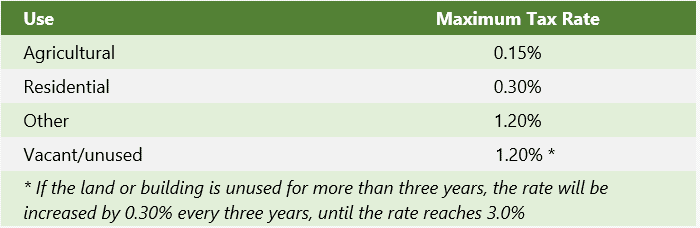
The official assessed price of the land, building, or condominium unit, as determined by the government authority for the purpose of collecting registration fees under the current Land Code, will be used as the basis for calculation of the land and building tax. The actual land and building tax rate that authorities will collect will be announced by royal decree in due course, subject to the fixed maximum rates, exemptions, and transition period rates outlined below. 

Fixed Maximum Rates for Land and Building Tax 
Exemptions

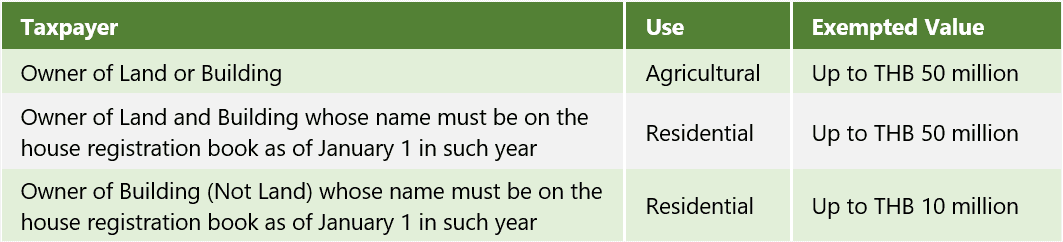
The Act provides limited exemptions to owners that meet the following criteria:  
Transition Period Rates

For the first two years of tax collection under the Act commencing from January 1, 2020, the land and building tax rates will be reduced for the following land and/or building owners: 
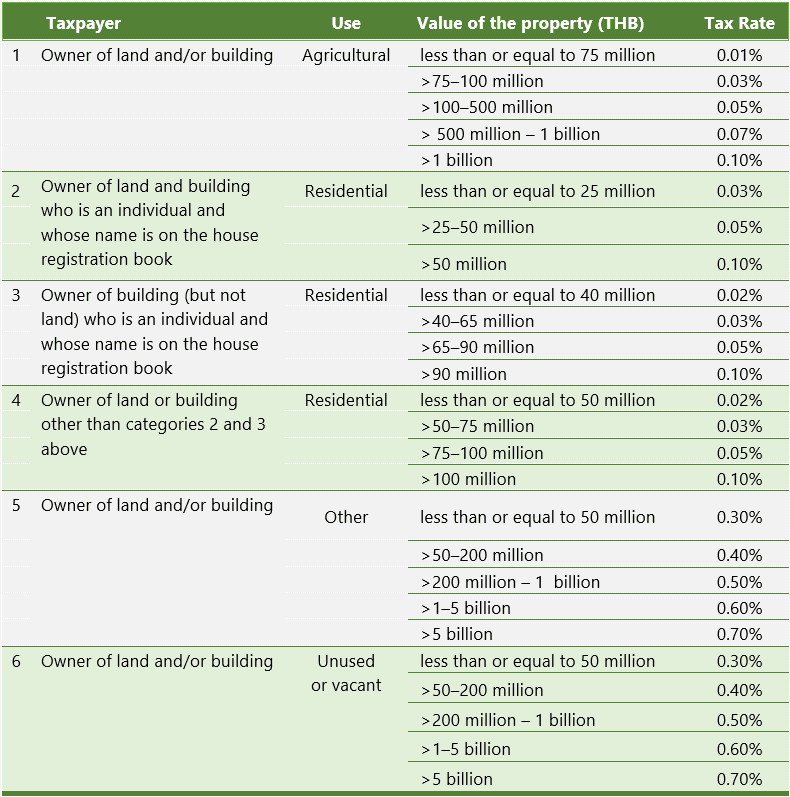
In addition, individual owners who use the land, or building, for agricultural purposes will be exempt for the first three years of tax collection under the Act.

For more information on the Act, or for any other enquiries, please contact our Bangkok office on [email protected] or on +66 2056 5555.

RELATED INSIGHTS​ 

December 15, 2025
On December 10, 2025, the National Assembly of Vietnam officially passed the amended Law on Construction, marking the culmination of a multiyear reform process aimed at modernizing Vietnam’s construction legal framework, streamlining administrative procedures, and aligning with digital transformation and sustainability goals. The amended law, which replaces the current Law on Construction No. 50/2014/QH13, will take effect on July 1, 2026. The Ministry of Construction (MOC) is also preparing several guiding decrees covering project classification, digital submissions and database management, and technical standards for design documentation. Key Changes in the Amended Law While the executed version of the amended Law on Construction has yet to be released to the public, reports have confirmed that it includes the following key changes introduced under the latest draft submitted by the MOC in September: Project classification: The amended Law on Construction classifies construction projects by investment form (public, PPP, business investment, and others), which aligns with the Law on Public Investment, the Law on Investment, and the Law on PPP Investment. This reduces regulatory overlap and clarifies responsibilities. Project preparation and appraisal: The requirement for prefeasibility reports for business investment projects is abolished, as this requirement is now governed by the Law on Investment and the Law on Public Investment. This change shortens the preparation timeline and reduces duplication of procedures. In addition, the authority’s appraisal is streamlined to a single feasibility stage. Also eliminated is the appraisal process conducted following basic design approval, shifting more responsibility to investors and consultants, with targeted post-audit mechanisms for high-risk projects. Construction permits: One of the most significant new changes of the amended Law on Construction is the expansion of exemptions from construction permit requirements to the following eight distinct groups of construction works: State-secret works, emergency or urgent constructions, works under special public investment
December 12, 2025
Similar to other types of corporate disputes, tax-related conflicts often begin with an earnest attempt to resolve matters outside the courtroom. The prospect of engaging in tax litigation can be daunting, given the potential strain on commercial relationships, the legal expenses, and the uncertainty surrounding its resolution. However, there are instances when tax litigation becomes the sole avenue for seeking redress. For individuals and entities contemplating the pursuit of tax-related legal remedies, the Thai legal system offers an accessible, impartial, and equitable platform for dispute resolution. Tilleke & Gibbins’ latest update to Tax Litigation in Thailand provides an outline for navigating tax-related disputes within the Thai legal framework. It aims to equip readers with a fundamental understanding of procedures and practices within the Thai tax litigation landscape. The full guide is available through the button below.
November 28, 2025
On November 26, 2025, the government of Vietnam issued Resolution No. 8/2025/NQ-CP to extend and expand the pilot program allowing Vietnamese citizens who meet certain conditions to gamble at three integrated casino resorts in Vietnam: Corona Resorts & Casino Phu Quoc (An Giang Province) – Effective immediately, and continuing an ongoing pilot program that started in 2019. The Grand Casino Ho Tram (Ho Chi Minh City) – New pilot program for five years starting November 26, 2025. Van Don Integrated Casino & Tourism Complex (Quang Ninh Province) – New pilot program for five years from the date the casino receives its license. The pilot program was originally established under Decree No. 03/2017/ND-CP on casino business, which also sets out the specific eligibility conditions for Vietnamese citizens. After the pilot period, these projects must stop allowing Vietnamese players until the government issues further decisions. This expansion of the pilot program comes after Vietnam’s Ministry of Finance (MOF) released a draft decree earlier this year proposing significant changes to the regulatory framework governing casino operations. These revisions, which focus on increasing fiscal contributions from local players and strengthening compliance obligations for casino operators nationwide, are detailed below. Proposed Increase in Casino Entry Fees for Vietnamese Players The draft decree increases the entry fees applicable to Vietnamese citizens permitted to play at casinos. Under the current regulations, Vietnamese players are required to pay an entry fee of VND 1 million (approx. USD 38) for 24 consecutive hours or VND 25 million (approx. USD 950) per month. The draft decree proposes increasing these fees to VND 2.5 million (approx. USD 95) for 24 consecutive hours and VND 50 million (approx. USD 1,900) per month, effectively doubling the existing amounts and marking the first major fee revision since the pilot program allowing Vietnamese players
November 21, 2025
On November 17, 2025, Thailand’s Ministry of Interior introduced significant regulatory changes to make rooftop solar adoption easier and more cost-effective for property owners. Ministerial Regulation No. 72 B.E. 2568 (2025), issued under the Building Control Act B.E. 2522 (1979), was published in the Government Gazette on November 19, 2025, with immediate effect. Background Under the Building Control Act (BCA), any alteration made to a building requires either notification of the relevant authority or application for a building alteration permit—unless the alteration falls under a separate list of exceptions specified in the ministerial regulations issued under the BCA. In 2015, installation of solar rooftops on any residential building under 160 square meters was added to this list of exceptions, subject to inspection and notification requirements. The newly enacted regulation now eliminates many of these requirements and introduces a broader and more permissive framework to promote solar adoption nationwide. Key Changes Specifically, the regulation introduces three major changes: Expanded exemption from the definition of “building alteration”: The installation of solar panels on any building roof—regardless of the type of building or the total area of the installation—is no longer considered a building alteration under the BCA, provided that the total weight of the installation does not exceed 20 kg/m2. Removal of structural integrity certification requirement: The new regulation eliminates the obligation to obtain a structural stability certificate from a licensed civil engineer. Removal of notification requirement: Property owners or possessors are no longer required to notify the local authority before installation of a solar rooftop. Impact This significant streamlining of requirements for solar rooftop installation is expected to accelerate the adoption of renewable energy in the country, particularly for residential and commercial properties—similar to the way Thailand’s December 2024 removal of licensing requirements for factory solar rooftop installations encouraged such