
You are using an outdated browser and your browsing experience will not be optimal. Please update to the latest version of Microsoft Edge, Google Chrome or Mozilla Firefox. Install Microsoft Edge

March 15, 2019

New Land and Building Tax Act in Thailand

Thailand’s new Land and Building Tax Act B.E. 2562 (2019) (the “Act”) came into effect on March 13, 2019. Payment of land and building tax under the new Act will be required from January 1, 2020, onwards.

The new Act revokes and replaces various pieces of formerly applicable legislation, including the House and Land Tax B.E. 2475 (1932) and its amendments; the Land Development Tax B.E. 2508 (1965) and its amendments; the Notification of the National Executive Council No. 156 dated June 4, B.E. 2515 (1972); and the Royal Decree Designating the Medium Price of Land for Land Development Tax Assessment B.E. 2529 (1986).

Under the Act, both individual and juristic persons who have ownership, possessory, or usage rights over land or buildings (including condominium units), as of January 1 of each year, will be required to pay land and building tax to the local administrative authorities. Payment will be due in April of each year.  

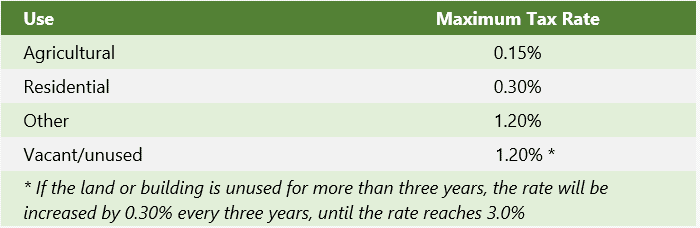
The official assessed price of the land, building, or condominium unit, as determined by the government authority for the purpose of collecting registration fees under the current Land Code, will be used as the basis for calculation of the land and building tax. The actual land and building tax rate that authorities will collect will be announced by royal decree in due course, subject to the fixed maximum rates, exemptions, and transition period rates outlined below. 

Fixed Maximum Rates for Land and Building Tax 
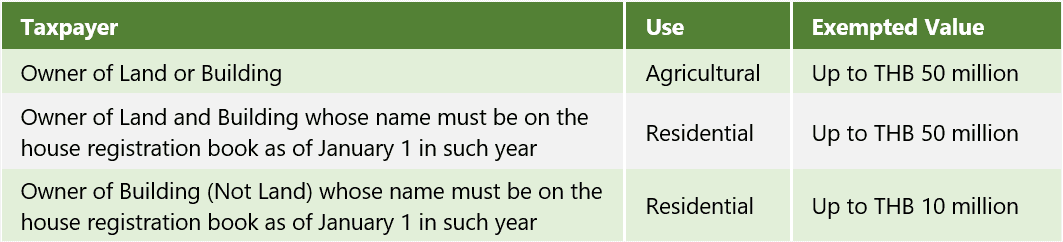
Exemptions

The Act provides limited exemptions to owners that meet the following criteria:  
Transition Period Rates

For the first two years of tax collection under the Act commencing from January 1, 2020, the land and building tax rates will be reduced for the following land and/or building owners: 
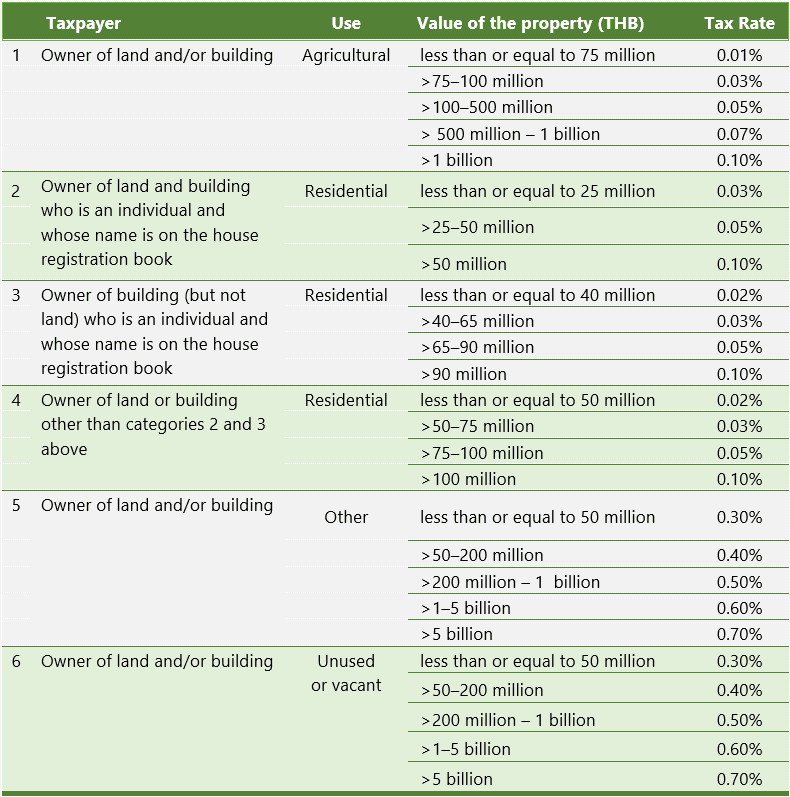
In addition, individual owners who use the land, or building, for agricultural purposes will be exempt for the first three years of tax collection under the Act.

For more information on the Act, or for any other enquiries, please contact our Bangkok office on [email protected] or on +66 2056 5555.

RELATED INSIGHTS​ 

July 14, 2025
Tilleke & Gibbins in Bangkok has contributed an updated Thailand entry to Multilaw’s Real Estate Guide, a concise online resource designed to give investors insight into some fundamental issues they may face in managing real estate transactions and ownership. The guide now features contributions from Multilaw member firms in 68 jurisdictions worldwide. It outlines key legal requirements in each jurisdiction, focusing especially on the restrictions and taxes applicable in each country, and the legal methods available for registering and identifying real estate and property ownership. Tilleke & Gibbins is a proud member of Multilaw, a leading network of carefully selected, independent law firms in more than 150 commercial centers, able to provide expert legal advice in complex environments around the globe. The Thailand entry in the Real Estate Guide is available on the Multilaw website.
July 14, 2025
Attorneys at Tilleke & Gibbins in Yangon have contributed an updated Myanmar entry to Multilaw’s Real Estate Guide, a concise online resource designed to give investors insight into some fundamental issues they may face in managing real estate transactions and ownership. The guide now features contributions from Multilaw member firms in 68 jurisdictions worldwide. It outlines key legal requirements in each jurisdiction, focusing especially on the restrictions and taxes applicable in each country, and the legal methods available for registering and identifying real estate and property ownership. Tilleke & Gibbins is a proud member of Multilaw, a leading network of carefully selected, independent law firms in more than 150 commercial centers, able to provide expert legal advice in complex environments around the globe. The Myanmar entry in the Real Estate Guide is available on the Multilaw website.
July 14, 2025
Specialists from Tilleke & Gibbins in Vientiane have contributed an updated Laos entry to Multilaw’s Real Estate Guide, a concise online resource designed to give investors insight into some fundamental issues they may face in managing real estate transactions and ownership. The guide now features contributions from Multilaw member firms in 68 jurisdictions worldwide. It outlines key legal requirements in each jurisdiction, focusing especially on the restrictions and taxes applicable in each country, and the legal methods available for registering and identifying real estate and property ownership. Tilleke & Gibbins is a proud member of Multilaw, a leading network of carefully selected, independent law firms in more than 150 commercial centers, able to provide expert legal advice in complex environments around the globe. The Laos entry in the Real Estate Guide is available on the Multilaw website.
July 7, 2025
On June 20, 2025, Cambodia’s Ministry of Economy and Finance issued Instruction No. 19116 to clarify when board members and company directors must receive salaries and pay payroll taxes. Board members and company directors who are not considered employees are subject to a withholding tax. This category consists of people who complete services for a nonresident individual and people who perform independent work for a company in Cambodia. Board members and company directors who are considered employees, including those appointed by a foreign head office to temporarily manage a company in Cambodia, must pay payroll taxes on any salary they receive, regardless of whether they are paid by a local or foreign branch of the company. The above obligations apply regardless of whether the person has a work permit. Board members and company directors are exempt from paying payroll tax if they: Are not present and not performing a regular management role at the company despite being registered on the company’s statutes or patent tax card; Participate only in board meetings and occasional shareholder meetings; and Do not receive a salary from a company in Cambodia. Overall, this instruction provides an important clarification regarding the tax obligations of board members and company directors. Companies should pay attention to the classification of their board members and directors and be mindful of the exemption.   This article was written with the assistance of Tilleke & Gibbins interns Amelia Gemma Erickson and Amrin Keat.