
You are using an outdated browser and your browsing experience will not be optimal. Please update to the latest version of Microsoft Edge, Google Chrome or Mozilla Firefox. Install Microsoft Edge

December 28, 2017

New Decree on Minimum Wage Increases in Vietnam

On December 7, 2017, the government issued Decree No. 141/2017/ND-CP stipulating new minimum wage requirements for employees working under labor contracts (Decree 141). Under the provisions of Decree 141, which will apply from January 1, 2018, the monthly minimum wage will be increased by VND 180,000 to 230,000 (USD 7.92 to 10.13), depending on the region.

Levels of Increase  

Decree 141 determines four minimum wage rates in Vietnam for four different regions (cumulatively covering the whole country). Each region is evaluated according to its socio-economic development, costs of living, and location. The specific level of minimum wage increase applied in each region is summarized in the table below:
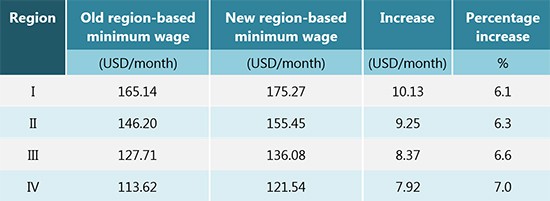
As such, by January 1, 2018, the average minimum wage will increase by about 6.5 percent.
 

Adjusted Regions

As mentioned above, the minimum wages vary across four geographical regions. The number of regions remains unchanged in the new decree, but there are slight adjustments to the list of cities/provinces which each region covers.

Under Decree 141, Region I spans the urban areas of Hanoi and Ho Chi Minh City. Region II covers the rural areas of Hanoi and Ho Chi Minh City, in addition to the urban localities of Can Tho City, Da Nang City, and Hai Phong City. Region III comprises the provincial cities of Bac Ninh Province, Bac Giang Province, Hai Duong Province, and Vinh Phuc Province, while Region IV covers the remaining localities. Some cities/provinces are moved up from Region II to Region I, from Region III to Region II, and from Region IV to Region III, while some others are moved down a level.

Reasons and Impacts

According to the Ministry of Labor, Invalids and Social Affairs, the level of minimum wage increase was calculated based on the necessary compensation for daily living expenses in 2017 to ensure that employees meet their minimum needs. Once Decree 141 comes into effect, the new minimum wages should help meet about 92-96% of the minimum living demands of employees and their families, depending on the region.

The above-mentioned adjustment plan was given taking into account the impacts of minimum wage increase on various matters such as jobs, unemployment, difficulties in manufacturing and trading, conditions of enterprises, minimum living requirements of employees and their dependents, etc. In particular, the adjustment plan was also affected by the new provisions which expand the range of employees who are subject to the statutory social insurance contribution (according to which employees with a labor contract of one month or more must participate in the social insurance scheme, as opposed to those with a contract of three months and more as presently), and the new salary will be used as the basis for payment of statutory insurance contributions.

As a result, the raise will meet basic living costs and certainly improve the living standards of employees and their families. However, on the other hand, the expenditures of enterprises will increase, as they must not only adjust the monthly salary of their workers, but must also increase their statutory insurance contributions.

RELATED INSIGHTS​ 

August 23, 2021
Since July 13, 2021, the Thai government has issued a series of resolutions offering relief measures for persons insured under sections 33 (regular employees), 39 (former employees still paying contributions to the SSO) and 40 (freelancers) of the Social Security Act B.E. 2533 (1990) (the SSA) who have been affected by the COVID-19 prevention measures under the Emergency Decree on Public Administration in Emergency Situations B.E. 2548 (2005), including the business closures required in some provinces. The latest cabinet resolution extends relief measures to SSA-insured persons in 29 provinces designated as maximum control areas (or “dark red” provinces). The provinces are grouped into three categories based on when they received that designation (which, in turn, impacts the duration of the relief which they receive): Two types of relief measures have been announced—one for parties under section 33 of the SSA, and one for parties under sections 39 and 40.   Section 33 (Regular Employees) Monetary assistance is available for Thai nationals insured under section 33 of the SSA (and their employers) engaged in the following business activities: Administrative and support activities Arts, entertainment, and recreation Automotive repair Construction Food and accommodation Information and communication activities Professional activities in science and academia Services Transportation and storage Wholesale/retail Employers must submit an application to the Social Security Office (SSO) through the online portal (www.sso.go.th/eservices) in order for them and their employees to receive the assistance payments. Each qualifying employee receives THB 2,500 per month if they are registered with the SSO within the deadline, while registered employers receive THB 3,000 per qualifying employee, up to a maximum of 200 employees (i.e., THB 600,000), as summarized in the table below.   Section 39 (Former Employees Still Paying SSO Contributions) and Section 40 (Freelancers) THB 5,000 assistance payments are available for Thai employees insured
August 23, 2021
Ho Chi Minh City has been locked down for months in an effort to fight the challenging fourth wave of the Covid-19 pandemic. We explore the various options available to employers to cut labor costs, as well as government relief measures to support both workers and employers.
August 5, 2021
With the latest wave of COVID-19 continuing to have a serious impact on Thailand, many businesses have been looking for ways to survive. Some have temporarily reduced employees’ wages, while others have resorted to a complete or partial halt to operations. In these unprecedented circumstances, it is vital that business owners understand the legal criteria and steps for implementing a temporary cessation of operations in Thailand, as outlined in this article. Any business can apply for a temporary cessation of operations under section 75 of the Labor Protection Act (LPA) if there is a necessity and a significant cause, such as the business being unable to operate as usual, and if the necessity is not considered force majeure under Thai law. (If it is deemed force majeure, an employer may be able to withhold all wages—more on this below.) If these criteria are met, the employer can choose whether to seek temporary cessation of operations on a whole or partial basis, depending on the actual situation and necessity. The employer then has to inform a labor inspection officer and the employees at least three business days in advance of the intended cessation of operations. Once this is done, operations may be halted, but the employer must pay employees at least 75 percent of their wages, calculated based on the rate on their latest working day, and these payments must continue throughout the entire cessation period. “Necessity” and force majeure Though the LPA does not indicate what qualifies as a “necessity” allowing an employer to call for a temporary cessation, past rulings from the Supreme Court provide some guidance on this issue. For instance, reduced purchase orders from customers and financial difficulties faced by the employer can amount to a situation of “necessity.” Additionally, the situation has to be significant
July 28, 2021
Lawyers from Tilleke & Gibbins’ labor and employment team including Kien Trung Trinh, Sarah Galeski, and Nam Ngoc Trinh have written the Vietnam chapter of Practical Law’s Employment and Employee Benefits Global Guide. The 2021 edition of the handbook provides a high-level comparative overview of employment laws and regulations across 32 jurisdictions around the world. Tilleke & Gibbins also contributed the Myanmar chapter of the guide. The Vietnam chapter covers a wide range of typical employment matters, such as limitations on working hours, paid leave requirements, minimum wage, and health and safety obligations. In addition, the guide provides insight on a number of topics of special interest to foreign investors doing business in Vietnam, including the following: Mandatory contents of a labor contract; Visas and permits required for expatriate employees; Employers’ obligations for protecting employees’ privacy and personal data; Procedural requirements for the dismissal of an employee; Employer and parent company liability. The 2021 edition also includes a special section on Covid-19 related provisions of labor law. To read the Vietnam chapter, click on the link below.