
You are using an outdated browser and your browsing experience will not be optimal. Please update to the latest version of Microsoft Edge, Google Chrome or Mozilla Firefox. Install Microsoft Edge

December 28, 2017

New Decree on Minimum Wage Increases in Vietnam

On December 7, 2017, the government issued Decree No. 141/2017/ND-CP stipulating new minimum wage requirements for employees working under labor contracts (Decree 141). Under the provisions of Decree 141, which will apply from January 1, 2018, the monthly minimum wage will be increased by VND 180,000 to 230,000 (USD 7.92 to 10.13), depending on the region.

Levels of Increase  

Decree 141 determines four minimum wage rates in Vietnam for four different regions (cumulatively covering the whole country). Each region is evaluated according to its socio-economic development, costs of living, and location. The specific level of minimum wage increase applied in each region is summarized in the table below:
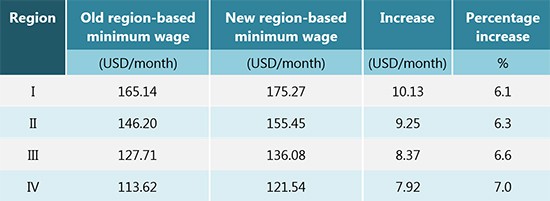
As such, by January 1, 2018, the average minimum wage will increase by about 6.5 percent.
 

Adjusted Regions

As mentioned above, the minimum wages vary across four geographical regions. The number of regions remains unchanged in the new decree, but there are slight adjustments to the list of cities/provinces which each region covers.

Under Decree 141, Region I spans the urban areas of Hanoi and Ho Chi Minh City. Region II covers the rural areas of Hanoi and Ho Chi Minh City, in addition to the urban localities of Can Tho City, Da Nang City, and Hai Phong City. Region III comprises the provincial cities of Bac Ninh Province, Bac Giang Province, Hai Duong Province, and Vinh Phuc Province, while Region IV covers the remaining localities. Some cities/provinces are moved up from Region II to Region I, from Region III to Region II, and from Region IV to Region III, while some others are moved down a level.

Reasons and Impacts

According to the Ministry of Labor, Invalids and Social Affairs, the level of minimum wage increase was calculated based on the necessary compensation for daily living expenses in 2017 to ensure that employees meet their minimum needs. Once Decree 141 comes into effect, the new minimum wages should help meet about 92-96% of the minimum living demands of employees and their families, depending on the region.

The above-mentioned adjustment plan was given taking into account the impacts of minimum wage increase on various matters such as jobs, unemployment, difficulties in manufacturing and trading, conditions of enterprises, minimum living requirements of employees and their dependents, etc. In particular, the adjustment plan was also affected by the new provisions which expand the range of employees who are subject to the statutory social insurance contribution (according to which employees with a labor contract of one month or more must participate in the social insurance scheme, as opposed to those with a contract of three months and more as presently), and the new salary will be used as the basis for payment of statutory insurance contributions.

As a result, the raise will meet basic living costs and certainly improve the living standards of employees and their families. However, on the other hand, the expenditures of enterprises will increase, as they must not only adjust the monthly salary of their workers, but must also increase their statutory insurance contributions.

RELATED INSIGHTS​ 

November 24, 2021
Attorneys from Tilleke & Gibbins have provided the latest update to the Thailand contribution to Doing Business in…, a Q&A-style guide published by Thomson Reuters Practical Law that presents an overview of the legal framework for doing business in 63 jurisdictions worldwide. The Thailand chapter of the guide outlines Thailand’s legal system and key laws applicable to foreign companies doing business in the country. The chapter specifically covers the following main topics: Legal system: Thailand’s court system and codified legal system. Foreign investment: Lists of reserved business activities, restrictions on doing business with certain jurisdictions, exchange controls and currency regulations, and grants and incentives available to investors. Business vehicles: Ordinary partnerships, registered ordinary partnerships, limited partnerships, private limited companies, and public companies. Environment: Main laws and regulations, factory operation. Employment: Laws, employment contract requirements, work permits, and termination and redundancy. Tax: Taxes on employment, tax and nontax resident employees and businesses, corporate income tax, value added tax, special business tax, municipal tax, stamp duty, dividends, interest, intellectual property royalties. Competition: Important aspects of Thailand’s regulatory regime surrounding competition, centered around the updated Trade Competition Act. Antibribery and corruption: Laws, compliance requirements, regulatory authority. Intellectual property: Patents, trademarks, registered and unregistered designs, and copyright. Marketing agreements and advertising: Regulation of marketing agreements, Thailand’s Consumer Protection Act, direct marketing, role of the Consumer Protection Board and Food and Drug Administration. E-commerce: E-commerce laws and regulations, marketing and sales via online platforms. Data protection: An outline of Thailand’s Personal Data Protection Act. Product liability: Procedures and regulations for product liability and product safety, including the Unsafe Goods Liability Act and the Consumer Case Procedure Act. Product liability: Key regulatory authorities for trade competition, environmental issues, and financial services. To browse, download, or print the Thailand chapter, please visit the Practical Law website.
October 25, 2021
Michael Ramirez, a counsel in Tilleke & Gibbins’ dispute resolution group in Bangkok, has updated the firm’s contribution to the Global Attorney-Client Privilege Guide, published by Lex Mundi. The newly expanded guide provides information on what constitutes attorney-client privilege in over 70 countries around the world. The Thailand section of the guide contains in-depth information on the function and applications of attorney-client privilege in Thailand (or, as explained in the guide, an equivalent concept enshrined in Thai law), including coverage of the following topics: Privilege in corporations Common interest doctrine Litigation funding Crime-fraud exception Work product doctrine/litigation privilege Other privileges including mediation, accountant-client and settlement negotiation The interactive guide features expert contributions by Lex Mundi member firms from jurisdictions worldwide. Readers can browse the contributions, generate country-specific reports, and compare attorney-client privilege in multiple jurisdictions. For more information, please visit the Lex Mundi website.
October 14, 2021
As part of its membership in Lex Mundi, Tilleke & Gibbins has published an updated edition of its Guide to Doing Business in Thailand for 2021. This guide outlines all of the key factors for starting and operating a business in the Thai market. Issues covered include: Investment incentives Financial facilities Exchange controls Import and export regulations Structures for doing business Requirements for the Establishment of a Business Operation of the Business Cessation or Termination of the Business Labor legislation, relations, and supply Tax Immigration requirements This publication is part of Lex Mundi’s Guides to Doing Business series prepared by member firms in more than 100 jurisdictions worldwide. The guides serve as a useful resource when planning an international business strategy or researching a new market.
September 13, 2021
Businesses in Vietnam recognize the need to vaccinate their workers in order to keep their factories and workplaces open. In this article, we explore whether employers may require their employees to be vaccinated, as well as associated disclosure and privacy issues under Vietnamese law.