
You are using an outdated browser and your browsing experience will not be optimal. Please update to the latest version of Microsoft Edge, Google Chrome or Mozilla Firefox. Install Microsoft Edge

December 28, 2017

New Decree on Minimum Wage Increases in Vietnam

On December 7, 2017, the government issued Decree No. 141/2017/ND-CP stipulating new minimum wage requirements for employees working under labor contracts (Decree 141). Under the provisions of Decree 141, which will apply from January 1, 2018, the monthly minimum wage will be increased by VND 180,000 to 230,000 (USD 7.92 to 10.13), depending on the region.

Levels of Increase  

Decree 141 determines four minimum wage rates in Vietnam for four different regions (cumulatively covering the whole country). Each region is evaluated according to its socio-economic development, costs of living, and location. The specific level of minimum wage increase applied in each region is summarized in the table below:
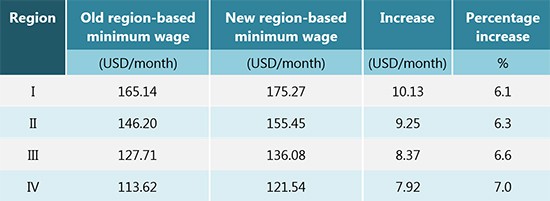
As such, by January 1, 2018, the average minimum wage will increase by about 6.5 percent.
 

Adjusted Regions

As mentioned above, the minimum wages vary across four geographical regions. The number of regions remains unchanged in the new decree, but there are slight adjustments to the list of cities/provinces which each region covers.

Under Decree 141, Region I spans the urban areas of Hanoi and Ho Chi Minh City. Region II covers the rural areas of Hanoi and Ho Chi Minh City, in addition to the urban localities of Can Tho City, Da Nang City, and Hai Phong City. Region III comprises the provincial cities of Bac Ninh Province, Bac Giang Province, Hai Duong Province, and Vinh Phuc Province, while Region IV covers the remaining localities. Some cities/provinces are moved up from Region II to Region I, from Region III to Region II, and from Region IV to Region III, while some others are moved down a level.

Reasons and Impacts

According to the Ministry of Labor, Invalids and Social Affairs, the level of minimum wage increase was calculated based on the necessary compensation for daily living expenses in 2017 to ensure that employees meet their minimum needs. Once Decree 141 comes into effect, the new minimum wages should help meet about 92-96% of the minimum living demands of employees and their families, depending on the region.

The above-mentioned adjustment plan was given taking into account the impacts of minimum wage increase on various matters such as jobs, unemployment, difficulties in manufacturing and trading, conditions of enterprises, minimum living requirements of employees and their dependents, etc. In particular, the adjustment plan was also affected by the new provisions which expand the range of employees who are subject to the statutory social insurance contribution (according to which employees with a labor contract of one month or more must participate in the social insurance scheme, as opposed to those with a contract of three months and more as presently), and the new salary will be used as the basis for payment of statutory insurance contributions.

As a result, the raise will meet basic living costs and certainly improve the living standards of employees and their families. However, on the other hand, the expenditures of enterprises will increase, as they must not only adjust the monthly salary of their workers, but must also increase their statutory insurance contributions.

RELATED INSIGHTS​ 

August 12, 2024
With the growing prominence of ESG (Environmental, Social, and Governance) factors, businesses in Vietnam are increasingly recognizing their importance in driving global demand, societal impact, and economic value. A comprehensive acknowledgment of ESG-related legal requirements is critical for investors and companies operating in Vietnam to meet stakeholder expectations and ensure compliance. Our guide provides a basic overview of the rapidly evolving ESG landscape in Vietnam, covering a range of key issues for companies doing business in the country: What is ESG, and what does the ESG legal framework look like in Vietnam? Who needs to follow ESG regulations in Vietnam? What are the benefits of ESG compliance? How can enterprises enhance ESG best practices in Vietnam? Please click on the link below to view the full article.
August 2, 2024
On July 17, 2024, Thailand issued the Ministerial Regulation under the Revenue Code regarding Revenue Tax No. 394 (B.E. 2567) to increase the personal income tax exemption amount on severance pay for terminated employees. Under this ministerial regulation, terminated employees are exempt from personal income tax on their severance pay up to a severance pay amount equivalent to their last 400 days’ wages, capped at THB 600,000. This tax exemption does not apply to severance pay relating to retirement or the expiration of a fixed-term employment agreement. Previously, this exemption, which has been in effect since 1998, only applied to an amount equivalent to their last 300 days’ wages, capped at THB 300,000. This aligned with the maximum severance pay rate specified in the Labour Protection Act B.E. 2541 (LPA). However, when the LPA was amended in 2019, the maximum severance pay rate was increased from a rate equal to employees’ last 300 days’ wages for those who have worked for 10 years or more, to a rate equal to employees’ last 400 days’ wages for those who have worked for 20 years or more. The recent ministerial regulation was enacted accordingly to align with the updated severance pay rate and account for Thailand’s rising inflation rate. The new exemption rate applies to assessable income received from January 1, 2023, onward. For any excess severance pay withheld in 2023 and filed in 2024, individuals may request a tax refund from the Revenue Department, according to Revenue Department clarification. This should be done according to the applicable procedure within three years of the income tax return filing deadline. For more information on severance pay exemptions, or any aspect of employment law in Thailand, please contact Pimvimol (June) Vipamaneerut at [email protected], Ketnut Pukahuta at [email protected], Dusita Khanijou at [email protected], or Chomanut
June 20, 2024
“Forced labor” has many incarnations. Some forms are shocking, such as a case in 2021 where Vietnamese guest workers were brought to a Chinese-owned factory in Serbia that manufactured tires sold to European car companies. The guest workers allegedly had their passports taken away and were subjected to horrible living conditions, including a lack of food, forcing them to resort to hunting small animals in the nearby forest to survive. However, forced labor more often takes subtler forms, so that most people do not even recognize it as such. For example, a factory may receive an order with an extremely short production deadline, and the workers are instructed to work overtime hours. If the employees refuse to do so and stop working when their regular shift ends, they receive warning letters the next day. While less shocking than the situation of the guest workers forced to hunt squirrels to survive, it is also forced labor. ILO Convention No. 29 on Forced Labor defines forced labor as “all work or service…extracted from any person under the menace of any penalty and for which the said person has not offered…[them]self voluntarily.” The ILO names 11 indicators of forced labor: abuse of vulnerability, deception; restriction of movement, isolation, physical/sexual violence, intimidation and threats, retention of identity documents, withholding of wages, debt bondage, abusive working or living conditions, and excessive overtime. Excessive overtime in particular is common in the manufacturing sector in Southeast Asia, and debt bondage is also prevalent. Some companies demand employees provide a “training deposit” when they commence their employment, which they will have repaid provided they continue working for a minimum period. However, these common practices may soon be eradicated due to new supply chain due diligence legislation. Two such examples demonstrating this greater focus on forced labor within
April 12, 2024
On April 10, 2024, new minimum wage rates for workers in certain hotels in Thailand were published in the Government Gazette, taking effect on April 13, 2024. Under the Notification of the National Wage Committee on Minimum Wage Rate for the Hotel Industry, the new minimum wage rate is THB 400 per day, applicable to employees working in four-star (and above) hotels that have at least 50 employees and are located in the following specific areas: Bangkok: Pathumwan and Wattana districts Krabi: Ao Nang Subdistrict Administrative Organization areas Chon Buri: Pattaya city Chiang Mai: Chiang Mai municipality Prachuap Khiri Khan: Hua Hin municipality Phang-nga: Khukkhak sub-district municipality Phuket: Whole province Rayong: Phe subdistrict Songkhla: Hat Yai municipality Surat Thani: Koh Samui municipality Rationale The increase in the minimum wage is to drive and stimulate the economy in Thailand’s tourism industry, which is critical to the overall economy of the country. The ten areas identified above are those that earn a significant portion of their revenue from tourism. The decision underwent a public hearing process involving stakeholders. Although there were objections from some hotels claiming they were not yet ready to bear the increased costs, the law was enacted, taking effect on April 13, 2024. For more information on Thailand’s minimum wage regulations, or on any aspect of employment law in Thailand, please contact Pimvimol (June) Vipamaneerut at [email protected], Ketnut Pukahuta at [email protected], Dusita Khanijou at [email protected], or Chomanut Arif at [email protected].