
You are using an outdated browser and your browsing experience will not be optimal. Please update to the latest version of Microsoft Edge, Google Chrome or Mozilla Firefox. Install Microsoft Edge

December 28, 2017

New Decree on Minimum Wage Increases in Vietnam

On December 7, 2017, the government issued Decree No. 141/2017/ND-CP stipulating new minimum wage requirements for employees working under labor contracts (Decree 141). Under the provisions of Decree 141, which will apply from January 1, 2018, the monthly minimum wage will be increased by VND 180,000 to 230,000 (USD 7.92 to 10.13), depending on the region.

Levels of Increase  

Decree 141 determines four minimum wage rates in Vietnam for four different regions (cumulatively covering the whole country). Each region is evaluated according to its socio-economic development, costs of living, and location. The specific level of minimum wage increase applied in each region is summarized in the table below:
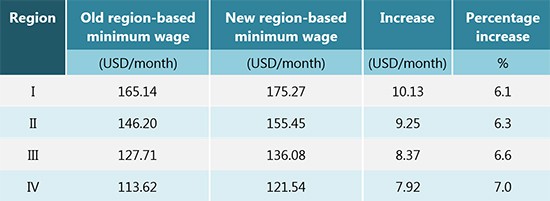
As such, by January 1, 2018, the average minimum wage will increase by about 6.5 percent.
 

Adjusted Regions

As mentioned above, the minimum wages vary across four geographical regions. The number of regions remains unchanged in the new decree, but there are slight adjustments to the list of cities/provinces which each region covers.

Under Decree 141, Region I spans the urban areas of Hanoi and Ho Chi Minh City. Region II covers the rural areas of Hanoi and Ho Chi Minh City, in addition to the urban localities of Can Tho City, Da Nang City, and Hai Phong City. Region III comprises the provincial cities of Bac Ninh Province, Bac Giang Province, Hai Duong Province, and Vinh Phuc Province, while Region IV covers the remaining localities. Some cities/provinces are moved up from Region II to Region I, from Region III to Region II, and from Region IV to Region III, while some others are moved down a level.

Reasons and Impacts

According to the Ministry of Labor, Invalids and Social Affairs, the level of minimum wage increase was calculated based on the necessary compensation for daily living expenses in 2017 to ensure that employees meet their minimum needs. Once Decree 141 comes into effect, the new minimum wages should help meet about 92-96% of the minimum living demands of employees and their families, depending on the region.

The above-mentioned adjustment plan was given taking into account the impacts of minimum wage increase on various matters such as jobs, unemployment, difficulties in manufacturing and trading, conditions of enterprises, minimum living requirements of employees and their dependents, etc. In particular, the adjustment plan was also affected by the new provisions which expand the range of employees who are subject to the statutory social insurance contribution (according to which employees with a labor contract of one month or more must participate in the social insurance scheme, as opposed to those with a contract of three months and more as presently), and the new salary will be used as the basis for payment of statutory insurance contributions.

As a result, the raise will meet basic living costs and certainly improve the living standards of employees and their families. However, on the other hand, the expenditures of enterprises will increase, as they must not only adjust the monthly salary of their workers, but must also increase their statutory insurance contributions.

RELATED INSIGHTS​ 

September 30, 2025
Over the past several years, during and after the COVID-19 pandemic, Thai employees and labor unions have faced reductions in benefits and welfare from their employers. Consequently, they have pursued various strategies to enhance their compensation packages. One such approach involves establishing employee committees to negotiate with employers regarding benefits and welfare. Additionally, companies with existing unions typically nominate representatives to serve on these employee committees. Many employers, however, remain unfamiliar with both the committee’s role and the heightened procedural requirements that apply when disciplinary measures are contemplated against committee members. Because any violation of a committee member’s statutory rights can expose the employer—and its directors or authorized representatives—to criminal liability, a clear understanding of the relevant legal framework is essential. The Labor Relations Act B.E. 2518 (LRA) provides the statutory foundation for establishing employee committees. The purpose of the committee is to promote harmonious industrial relations and create a formal channel through which employees and employers can discuss workplace matters on a regular basis. Any workplace that employs at least fifty employees must, upon request by employees or the labor union, facilitate the creation of a committee. Members may be elected directly by employees or, where applicable, appointed by the labor union. Each member serves a three-year term. The LRA prescribes minimum committee sizes based on the employer’s headcount, as shown in the table below. If union members constitute more than 20 percent of the total workforce, the union must appoint at least one more committee member than the number of nonunion members elected by the general workforce. If union membership exceeds 50 percent of the workforce, the union acquires the exclusive right to appoint every committee member. Where multiple unions exist and their combined appointments would exceed the statutory committee size, the employer may lawfully refuse to
September 25, 2025
Tilleke & Gibbins’ labor and employment team in Hanoi and Ho Chi Minh City has contributed the Vietnam chapter to Labor and Employment Disputes 2026. Drawing on the expertise of three of the firm’s employment specialists, the chapter provides practical guidance for navigating employment disputes in Vietnam and covers: Pre-action considerations: key requirements, third-party funding, contingency fee arrangements Issuing a claim: forum, territorial jurisdiction, standing, commencing claims, fees, service, defendants and legal personality, types of claims, time limits, counterclaims Case management: procedure, rules, amendments to claims, adding parties, consolidating proceedings, class and collective actions, evidence, witnesses, tactical considerations Interim relief: availability, requirements Trial: hearings conduct and time frames, confidentiality and public access, media reporting, elements of successful claims and burden of proof Alternative dispute resolution: available types, requirements and expectations, enforcement Collective employment and labor rights: enforcement and standing Remedies and enforcement: available remedies, assessing compensation, enforcement mechanisms Appeals: procedure, time frames, other means of challenge Updates and trends: recent cases and developments, technology developments, other issues The Vietnam chapter is available for download below. Tilleke & Gibbins also contributed the Cambodia and Thailand chapters to Labor and Employment Disputes 2026. Readers can also gain 30 days of complementary access to the full Labor and Employment Disputes 2026 guide and the rest of Lexology Panoramic’s varied offerings through this link.
September 25, 2025
In the Thailand contribution to Labor and Employment Disputes 2026, four members of Tilleke & Gibbins’ Bangkok labor and employment team outline key aspects of dispute resolution in Thailand. Their analysis, part of Lexology Panoramic’s comparative guide covering jurisdictions worldwide, addresses the following areas: Pre-action considerations: key requirements, third-party funding, contingency fee arrangements Issuing a claim: forum, territorial jurisdiction, standing, commencing claims, fees, service, defendants and legal personality, types of claims, time limits, counterclaims Case management: procedure, rules, amendments to claims, adding parties, consolidating proceedings, class and collective actions, evidence, witnesses, tactical considerations Interim relief: availability, requirements Trial: hearings conduct and time frames, confidentiality and public access, media reporting, elements of successful claims and burden of proof Alternative dispute resolution: available types, requirements and expectations, enforcement Collective employment and labor rights: enforcement and standing Remedies and enforcement: available remedies, assessing compensation, enforcement mechanisms Appeals: procedure, time frames, other means of challenge Updates and trends: recent cases and developments, technology developments, other issues The complete Thailand chapter can be downloaded below. Tilleke & Gibbins also contributed the Cambodia and Vietnam chapters to Labor and Employment Disputes 2026. Readers can also gain 30 days of complementary access to the full Labor and Employment Disputes 2026 guide and the rest of Lexology Panoramic’s varied offerings through this link.
September 25, 2025
Four of Tilleke & Gibbins’ labor and employment specialists in Phnom Penh have authored the Cambodia chapter of Labor and Employment Disputes 2026, the latest edition of Lexology Panoramic’s global guide to handling labor and employment disputes. The chapter provides practical insights on a wide range of dispute resolution issues, including: Pre-action considerations: key requirements, third-party funding, contingency fee arrangements Issuing a claim: forum, territorial jurisdiction, standing, commencing claims, fees, service, defendants and legal personality, types of claims, time limits, counterclaims Case management: procedure, rules, amendments to claims, adding parties, consolidating proceedings, class and collective actions, evidence, witnesses, tactical considerations Interim relief: availability, requirements Trial: hearings conduct and time frames, confidentiality and public access, media reporting, elements of successful claims and burden of proof Alternative dispute resolution: available types, requirements and expectations, enforcement Collective employment and labor rights: enforcement and standing Remedies and enforcement: available remedies, assessing compensation, enforcement mechanisms Appeals: procedure, time frames, other means of challenge Updates and trends: recent cases and developments, technology developments, other issues The full Cambodia chapter is available for download below. Tilleke & Gibbins also contributed the Thailand and Vietnam chapters to Labor and Employment Disputes 2026. Readers can also gain 30 days of complementary access to the full Labor and Employment Disputes 2026 guide and the rest of Lexology Panoramic’s varied offerings through this link.