
You are using an outdated browser and your browsing experience will not be optimal. Please update to the latest version of Microsoft Edge, Google Chrome or Mozilla Firefox. Install Microsoft Edge

December 28, 2017

New Decree on Minimum Wage Increases in Vietnam

On December 7, 2017, the government issued Decree No. 141/2017/ND-CP stipulating new minimum wage requirements for employees working under labor contracts (Decree 141). Under the provisions of Decree 141, which will apply from January 1, 2018, the monthly minimum wage will be increased by VND 180,000 to 230,000 (USD 7.92 to 10.13), depending on the region.

Levels of Increase  

Decree 141 determines four minimum wage rates in Vietnam for four different regions (cumulatively covering the whole country). Each region is evaluated according to its socio-economic development, costs of living, and location. The specific level of minimum wage increase applied in each region is summarized in the table below:
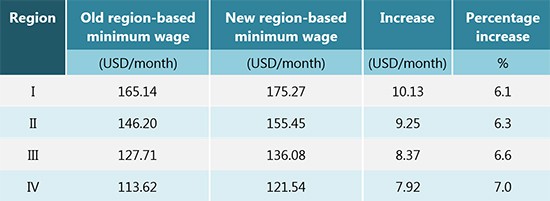
As such, by January 1, 2018, the average minimum wage will increase by about 6.5 percent.
 

Adjusted Regions

As mentioned above, the minimum wages vary across four geographical regions. The number of regions remains unchanged in the new decree, but there are slight adjustments to the list of cities/provinces which each region covers.

Under Decree 141, Region I spans the urban areas of Hanoi and Ho Chi Minh City. Region II covers the rural areas of Hanoi and Ho Chi Minh City, in addition to the urban localities of Can Tho City, Da Nang City, and Hai Phong City. Region III comprises the provincial cities of Bac Ninh Province, Bac Giang Province, Hai Duong Province, and Vinh Phuc Province, while Region IV covers the remaining localities. Some cities/provinces are moved up from Region II to Region I, from Region III to Region II, and from Region IV to Region III, while some others are moved down a level.

Reasons and Impacts

According to the Ministry of Labor, Invalids and Social Affairs, the level of minimum wage increase was calculated based on the necessary compensation for daily living expenses in 2017 to ensure that employees meet their minimum needs. Once Decree 141 comes into effect, the new minimum wages should help meet about 92-96% of the minimum living demands of employees and their families, depending on the region.

The above-mentioned adjustment plan was given taking into account the impacts of minimum wage increase on various matters such as jobs, unemployment, difficulties in manufacturing and trading, conditions of enterprises, minimum living requirements of employees and their dependents, etc. In particular, the adjustment plan was also affected by the new provisions which expand the range of employees who are subject to the statutory social insurance contribution (according to which employees with a labor contract of one month or more must participate in the social insurance scheme, as opposed to those with a contract of three months and more as presently), and the new salary will be used as the basis for payment of statutory insurance contributions.

As a result, the raise will meet basic living costs and certainly improve the living standards of employees and their families. However, on the other hand, the expenditures of enterprises will increase, as they must not only adjust the monthly salary of their workers, but must also increase their statutory insurance contributions.

RELATED INSIGHTS​ 

February 22, 2021
Following the recent imposition of sanctions on Myanmar individuals and companies by the US, the UK and Canada have now imposed new sanctions. As with the US sanctions, these new measures impact UK and Canadian citizens and companies, and non-UK and non-Canadian companies and citizens with interests in those jurisdictions. The EU has indicated that it is planning to issue similar sanctions in the near future. New UK Sanctions In addition to the 16 individuals already sanctioned by the UK government, on February 18, 2021, the UK government announced that three individuals have been sanctioned for serious human rights violations and are now subject to asset freezes and travel bans. The full list of Myanmar individuals and companies sanctioned by the UK is available on the website of the Office of Financial Sanctions Implementation. Breaches of UK financial sanctions are criminal offences punishable in the UK by up to 7 years imprisonment and heavy fines. New Canadian Sanctions Also on February 18, timed to coincide with the UK sanctions, new Canadian sanctions were imposed on nine individuals. As with the UK, Canada already had a number of individuals in the Myanmar military on its sanctions list, and the new additions bring the total number of individuals sanctioned by Canada to 54. All assets of these individuals in Canada are now frozen, and they are banned from travelling to Canada. Canadian businesses or entities may not do business with any of the 54 individuals. Full details of the impact of the sanctions are available on the Government of Canada’s website, as is a database of the Myanmar individuals and companies subject to them. Breach of Canadian sanctions carries with it up to 5 years’ imprisonment in Canada and/or a large fine. Other Countries The EU is reportedly drawing up sanctions
January 26, 2021
On January 1, 2021, the government of Vietnam issued Decree No. 152/2020/ND-CP dated December 30, 2020, providing guidance concerning foreigners working in Vietnam (Decree 152). Foreign investors and expatriates should be aware of some notable new points.
January 12, 2021
Due to the resurgence of the COVID-19 pandemic in Thailand since December, 2020, Thailand’s Ministry of Labor recently published two regulations under the Social Security Act (SSA) in the Government Gazette: The Regulation on Entitlement to Compensatory Benefits in the Event of Unemployment Due to Force Majeure from the Pandemic of Dangerous Communicable Disease Under Relevant Law Relating to Communicable Diseases B.E. 2563 (2020) (the Force Majeure Regulation); and The Regulation on Determination of the Amount of Contributions to the Social Security Funds B.E. 2563 (2020) (the SSF Contribution Regulation). Details of the two regulations are provided below. The Force Majeure Regulation This regulation is similar to a previous regulation from April, 2020, during the first wave of the pandemic, stating that the definition of force majeure under the Social Security Act B.E. 2533 (1990) (the SSA) includes hazards from pandemics of dangerous communicable diseases (including COVID-19). This definition therefore affords protection to insured persons (i.e., employees) in the event that the COVID-19 pandemic results in their being unable to work, or their employers being unable to operate their business normally. This regulation allows the Social Security Office (SSO) to pay compensation to employees who: are insured persons who qualify to receive compensatory benefit in case of unemployment in accordance with the SSA; have to cease working temporarily during the period from December 19, 2020 onwards; and do not receive wages from their employer during the temporary cessation. This applies only if the circumstances above result from the following force majeure events related to hazards from COVID-19 (or other pandemics of dangerous communicable diseases that affect the public under the Communicable Diseases Act B.E. 2558 (2015)): The employee cannot work, or the employer does not allow the employee to work, because of quarantine or to comply with a COVID-19
November 3, 2020
Many Thai and international companies have expanded rapidly into Myanmar in recent years, in what had seemed to be an unstoppable expansion of cross-border trade resulting from the country’s emergence back onto the global stage. For those companies, the COVID-19 situation in Myanmar has been a cause for much concern and uncertainty—doubly so for those who had hired staff in the jurisdiction, as a lack of clarity regarding their obligations as employers was compounded by a lack of information on the situation on the ground.