
You are using an outdated browser and your browsing experience will not be optimal. Please update to the latest version of Microsoft Edge, Google Chrome or Mozilla Firefox. Install Microsoft Edge

December 28, 2017

New Decree on Minimum Wage Increases in Vietnam

On December 7, 2017, the government issued Decree No. 141/2017/ND-CP stipulating new minimum wage requirements for employees working under labor contracts (Decree 141). Under the provisions of Decree 141, which will apply from January 1, 2018, the monthly minimum wage will be increased by VND 180,000 to 230,000 (USD 7.92 to 10.13), depending on the region.

Levels of Increase  

Decree 141 determines four minimum wage rates in Vietnam for four different regions (cumulatively covering the whole country). Each region is evaluated according to its socio-economic development, costs of living, and location. The specific level of minimum wage increase applied in each region is summarized in the table below:
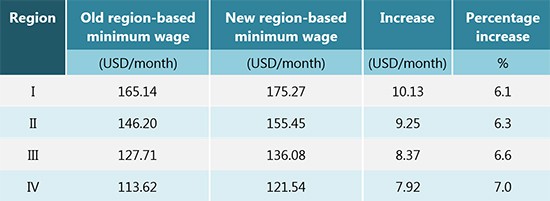
As such, by January 1, 2018, the average minimum wage will increase by about 6.5 percent.
 

Adjusted Regions

As mentioned above, the minimum wages vary across four geographical regions. The number of regions remains unchanged in the new decree, but there are slight adjustments to the list of cities/provinces which each region covers.

Under Decree 141, Region I spans the urban areas of Hanoi and Ho Chi Minh City. Region II covers the rural areas of Hanoi and Ho Chi Minh City, in addition to the urban localities of Can Tho City, Da Nang City, and Hai Phong City. Region III comprises the provincial cities of Bac Ninh Province, Bac Giang Province, Hai Duong Province, and Vinh Phuc Province, while Region IV covers the remaining localities. Some cities/provinces are moved up from Region II to Region I, from Region III to Region II, and from Region IV to Region III, while some others are moved down a level.

Reasons and Impacts

According to the Ministry of Labor, Invalids and Social Affairs, the level of minimum wage increase was calculated based on the necessary compensation for daily living expenses in 2017 to ensure that employees meet their minimum needs. Once Decree 141 comes into effect, the new minimum wages should help meet about 92-96% of the minimum living demands of employees and their families, depending on the region.

The above-mentioned adjustment plan was given taking into account the impacts of minimum wage increase on various matters such as jobs, unemployment, difficulties in manufacturing and trading, conditions of enterprises, minimum living requirements of employees and their dependents, etc. In particular, the adjustment plan was also affected by the new provisions which expand the range of employees who are subject to the statutory social insurance contribution (according to which employees with a labor contract of one month or more must participate in the social insurance scheme, as opposed to those with a contract of three months and more as presently), and the new salary will be used as the basis for payment of statutory insurance contributions.

As a result, the raise will meet basic living costs and certainly improve the living standards of employees and their families. However, on the other hand, the expenditures of enterprises will increase, as they must not only adjust the monthly salary of their workers, but must also increase their statutory insurance contributions.

RELATED INSIGHTS​ 

April 3, 2023
Most employers know that terminating employees for poor job performance is not easy. But it is actually legally possible—if employers have the right approach and take specific precautionary measures. However, failing to take these precautions can mean that an employer is either stuck with an incompetent employee or on the losing end of a lawsuit for unfair termination. This article will lay out some essential considerations for employers in Thailand regarding termination of employment for poor performance. First, understand that “poor work performance” is a lack of performance or ability, or an inability to work with other employees. It does not constitute a violation of work rules or regulations. In some cases, however, an employee’s failure to act in accordance with lawful instructions or commands of the employer, resulting in poor work performance, could also be considered a violation of work rules or regulations. This may be the case if the work rules or regulations clearly state that an employee must strictly comply with the employer’s instructions or commands. Second, an employer can, in fact, terminate an employee due to poor work performance. For example, this may be possible in the following scenarios: Records show that an employee’s work performance has fallen below the employer’s required standards, and the employee has not tried to improve his or her work performance for three consecutive years. In addition, it does not appear that the employer was biased when giving ratings or scores for the employee’s work performance. The job description of the employee includes coordination with employees in other departments, but the employee has not been able to do so. Therefore, the employee was reassigned to a new job function, but the employee still did not improve. This suggests that the employee has a lack of interpersonal skills and is not
March 23, 2023
On March 19, 2023, Thailand’s new work-from-home (WFH) legislation amending the Labour Protection Act (No. 8) B.E. 2566 (2023) was published in the Government Gazette. It will come into effect on April 18, 2023. The amendment aims to enhance employee protections to accord with current global standards, provide alternative working arrangements for employers and employees, increase workforce efficiency, and strengthen employees’ job security and a better quality of life. As we detailed previously, the new WFH legislation allows employers and employees to reach agreements that permit employees to work remotely. Since there are no accompanying criminal punishments relating to this new provision, and the legislation incorporates the term “may agree,” it appears that this WFH provision is not mandatory but is primarily intended to facilitate and encourage remote working agreements between employers and employees. For more details on the WFH legislation, or on any aspect of employment law in Thailand, please contact Tilleke & Gibbins at [email protected].
February 24, 2023
Many companies have moved to Southeast Asia to benefit from the advantages of this vibrant and diverse market. The region is already a manufacturing hub for a multitude of industries—computer and automotive products in Thailand, textiles in Cambodia, and footwear and electrical goods in Vietnam, to name a few—and an increasing number of companies worldwide are reconfiguring their supply chains to include regional suppliers. A key challenge is keeping up to date with employment law trends in these jurisdictions to ensure compliance with local regulations—and avoid costly, time-consuming business interruption. Here we outline trends and recent regulatory developments in Cambodia, Thailand, and Vietnam, and consider what they mean for employers. Cambodia The Ministry of Labour and Vocational Training (MLVT) is likely to pursue a more proactive enforcement strategy in 2023. Last May, the MLVT announced companies would be required to submit a twice yearly self-declaration on labour compliance through a new online system. The self-declaration form requires companies to confirm and upload evidence of compliance, and the MLVT online system—through which the ministry can easily determine if a company is compliant –generates a report that lists all fines. Companies should comply with the self-declaration requirement and carefully review the form to understand what fines will apply for non-compliance. On 1 October 2022, regulations relating to the National Social Security Fund (NSSF) pension system came into effect, and employers and employees began making NSSF pension contributions. Over the next five years, total compulsory pension contributions will amount to 4% of an employee’s wage, half of which is paid by the employer and half deducted from the employee’s salary. The contribution wage is capped at KHR 1.2m (USD 300). Employers are currently required to pay a relatively small amount (KHR 24,000, or around USD 6). This will increase to 10.75% over
January 19, 2023
The Thai parliament has passed the so-called Work from Home Bill—formally known as Labour Protection Act (No. 8) B.E. 2566 (2023)—which amends the country’s Labour Protection Act (LPA) to reflect current circumstances. The accompanying legislative remark states that the proposed amendments to the LPA will provide additional options for work arrangements between employers and employees, upgrade the level of labor protection, increase work stability, and improve quality of life for employees in Thailand. The legislation adds a single section to the LPA providing that an employer and an employee “may agree in the employment contract” that the employee is allowed “to bring work . . . to perform at home or at the residence of the employee or anywhere that the employee can work remotely through information technology, if the nature of the work permits.” The provision further provides that employers are responsible for ensuring that remote work agreements are in writing, either physically or electronically, and may include the following details: Period of the agreement; Normal working hours, rest periods, and overtime work; Criteria for overtime work, holiday work, and various types of leave; Scope of work and control or supervision by the employer; and Responsibility for arranging supplies and equipment, including necessary costs relating to the work. The amended LPA gives employees who work from home the right to refuse contact from the employer or the supervisor beyond working hours. In addition, employers must treat remote employees equally to on-premise employees. The most notable question surrounding this legislation is whether employers must allow employees to work remotely. The phrase “may agree” suggests that employers do not have to agree to allow an employee to work remotely. Another important aspect of the amendment is that there is no criminal punishment attached to it, which suggests that the legislation