
You are using an outdated browser and your browsing experience will not be optimal. Please update to the latest version of Microsoft Edge, Google Chrome or Mozilla Firefox. Install Microsoft Edge

January 16, 2019

New Administrative Sanctions in Civil Aviation in Vietnam

On November 30, 2018, the Vietnamese government issued Decree No. 162/2018/ND-CP on administrative sanctions in civil aviation (Decree 162). Decree 162 amends and supplements Decree No. 147/2013/ND-CP (the Old Decree), and took effect on January 15, 2019.

Key changes in Decree 162 include the following:

1. New Actions that Are Considered Violations

While most of the Old Decree’s provisions are preserved, Decree 162 adds new conduct that is subject to fines. The added violations are summarized in the table below.
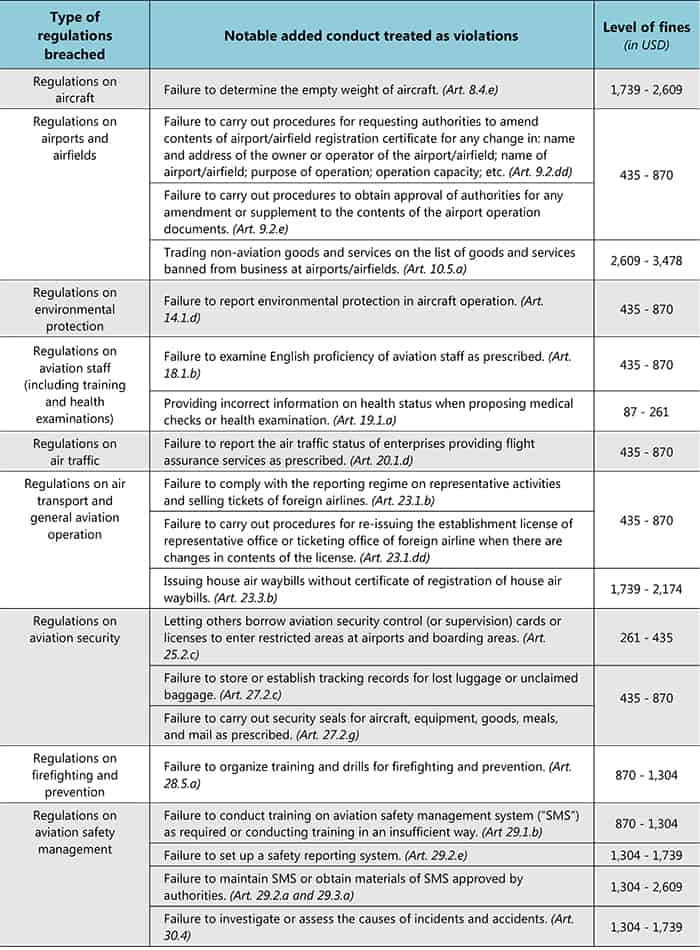
Notes on the table:

– The specified range of fines applies to organizations (e.g., companies). For individuals committing violations, the applied sanction is half the amount imposed on organizations (except for exceptions stated in Article 3.1 of Decree 162).

– Sanctions are listed in VND and converted to USD at the exchange rate of USD 1 = VND 23,000.

2. New Remedial Measures

In addition to amending and supplementing the monetary fines, Decree 162 adds new remedial measures. The new remedial measures aim to address both violations previously provided in the Old Decree and newly added violations in Decree 162. The new remedial measures, which may be applied in cases such as falsifying health examination results, failing to maintain aviation buildings according to an approved plan, or failing to establish aircraft maintenance records as prescribed, include the following:

  • Compulsory return of land which has been encroached upon or occupied, or compulsory return of premises;
  • Compulsory building maintenance;
  • Compulsory organization of re-inspection or retest;
  • Compulsory rescindment of inspection or test results;
  • Compulsory revocation of granted certificates of practice;
  • Compulsory rescindment of health examination results;
  • Compulsory return of illegally obtained profits;
  • Compulsory maintenance and documentation of aircraft maintenance.

3. Change in Entity Subject to Sanctions

The fines specified in Decree 162 are directly applied to organizations instead of individuals (as under the Old Decree). Thus, based on the provisions of Decree 162, administrative sanctions in civil aviation seem to directly and primarily govern organizational operations.

In light of the changes in Decree 162, air operators, MROs, ticketing agencies, and others in the aviation industry should assess their practices and ensure they are in compliance with the law.

RELATED INSIGHTS​ 

May 8, 2021
The COVID-19 pandemic has caused the aviation industry to face arguably the most challenging time in its history. Airlines across the world, including in Southeast Asia, have been deeply affected by the prolonged and universal halt to international air travel. Domestic flights have provided some much-needed revenue to local carriers. But with multiple and unforeseen waves of new virus cases, lockdowns and other travel restrictions, and a public generally fearful of travelling, domestic flights have not been enough to make up for the massive shortfall in revenue lost from international air travel. Despite all the current gloom for the aviation industry, there may be light at the end of the tunnel as the world glimpses life after the pandemic. This is mainly down to vaccinations. With people confined to their homes for over a year in many Western countries, there is pent-up demand to travel. As those people are vaccinated, they will want to get out of their houses and fly somewhere. Moreover, household savings have increased for those fortunate enough to be working throughout the pandemic in their homes, and with few options to go out and spend. This combination of travel demand and increased disposable income is a strong combination for positive growth in the post-pandemic aviation industry. In the context of Vietnam, which to date has managed to minimize outbreaks from occurring in the country, from around the middle of September 2020 airlines announced to fly again and increase the frequency of many domestic flights. Airlines also sought to restore some international commercial routes to meet the needs of passengers, contribute to connecting trade, and maintaining production and business activities. However, despite domestic demand, true recovery and economic success can only occur when passengers can again travel internationally, both inbound and outbound. As such, the critical
April 19, 2021
Thailand has made significant changes to its statutory interest rate framework for the first time in almost a century. Since 1925, the statutory interest rate codified in Thailand’s Civil and Commercial Code (the CCC) has remained at 7.5% per year. But with Covid-19 having an unprecedented impact on the Thai economy, the Thai Government, via emergency decree, has reduced the statutory rate. While the decree is largely aimed at providing relief to hard-hit SMEs and individual debtors, the amendments have broader implications for doing business in Thailand. Main Changes The new interest rate revisions are contained within the Emergency Decree Amending the Civil and Commercial Code B.E. 2564 (2021) (the Emergency Decree), which was published in the Government Gazette on April 10, 2021 and came into effect on April 11, 2021. The Emergency Decree amends Sections 7 and 224 of the CCC, which stated the previous statutory interest rate of 7.5% per year. The Emergency Decree makes three major changes. The first involves a reduction of the statutory interest rate from 7.5% per year to 3% per year in Section 7. The new 3% annual rate is subject to review every three years by the Ministry of Finance. The interest rate is subject to further change later by a royal decree. The second change concerns money debts under Section 224 of the CCC. The previous version of Section 224 stated, among other things, that a money debt based on a default bears interest of 7.5% per year. Under the Emergency Decree, the new actual statutory default interest rate is the statutory interest rate stated in Section 7 with an additional rate of 2% per year. The result is a 5% annual statutory default interest rate. Since the statutory default interest rate is based in part on the Section 7
February 23, 2021
As many are already aware, following the change of government in Myanmar on February 1, 2021, a draft Cyber Security Law was proposed which attracted widespread criticism. However, less attention has been paid to significant amendments to two existing laws, some of which have a similar effect to parts of the draft Cyber Security Law. In other words, while the draft Cyber Security Law has not progressed further and is under public scrutiny, significant elements of it have found their way into law in Myanmar by other routes. Because these amendments are already law, it is very important that individuals and businesses in Myanmar understand their implications. Amendments to the Law Protecting the Privacy and Security of Citizens The Law Protecting the Privacy and Security of Citizens (2017), or the “Privacy Law,” was amended on February 13, 2021, less than two weeks after the military government came into power. These amendments chiefly address the power of the government to conduct searches, seizures, and arrests; to extend detention without judicial oversight; and to carry out broad surveillance and investigation activities that could intrude on individual privacy. The amendments accomplish this by suspending various sections of the Privacy Law for as long as the State Administration Council (the military body now governing Myanmar) is in power. The suspended sections include the following: Section 5: Search, seizure, and arrest without civilian observation The relevant part of Section 5 of the Privacy Law states, “The responsible authorities shall … when acting in accordance with existing law, not enter into a person’s residence or a room used as a residence, or a building, compound or building in a compound, for the purpose of search, seizure, or arrest, unless accompanied by minimum of two witnesses who should comprise Ward or Village Tract Administrators…”. The suspension
February 22, 2021
Following the recent imposition of sanctions on Myanmar individuals and companies by the US, the UK and Canada have now imposed new sanctions. As with the US sanctions, these new measures impact UK and Canadian citizens and companies, and non-UK and non-Canadian companies and citizens with interests in those jurisdictions. The EU has indicated that it is planning to issue similar sanctions in the near future. New UK Sanctions In addition to the 16 individuals already sanctioned by the UK government, on February 18, 2021, the UK government announced that three individuals have been sanctioned for serious human rights violations and are now subject to asset freezes and travel bans. The full list of Myanmar individuals and companies sanctioned by the UK is available on the website of the Office of Financial Sanctions Implementation. Breaches of UK financial sanctions are criminal offences punishable in the UK by up to 7 years imprisonment and heavy fines. New Canadian Sanctions Also on February 18, timed to coincide with the UK sanctions, new Canadian sanctions were imposed on nine individuals. As with the UK, Canada already had a number of individuals in the Myanmar military on its sanctions list, and the new additions bring the total number of individuals sanctioned by Canada to 54. All assets of these individuals in Canada are now frozen, and they are banned from travelling to Canada. Canadian businesses or entities may not do business with any of the 54 individuals. Full details of the impact of the sanctions are available on the Government of Canada’s website, as is a database of the Myanmar individuals and companies subject to them. Breach of Canadian sanctions carries with it up to 5 years’ imprisonment in Canada and/or a large fine. Other Countries The EU is reportedly drawing up sanctions