
You are using an outdated browser and your browsing experience will not be optimal. Please update to the latest version of Microsoft Edge, Google Chrome or Mozilla Firefox. Install Microsoft Edge

January 16, 2019

New Administrative Sanctions in Civil Aviation in Vietnam

On November 30, 2018, the Vietnamese government issued Decree No. 162/2018/ND-CP on administrative sanctions in civil aviation (Decree 162). Decree 162 amends and supplements Decree No. 147/2013/ND-CP (the Old Decree), and took effect on January 15, 2019.

Key changes in Decree 162 include the following:

1. New Actions that Are Considered Violations

While most of the Old Decree’s provisions are preserved, Decree 162 adds new conduct that is subject to fines. The added violations are summarized in the table below.
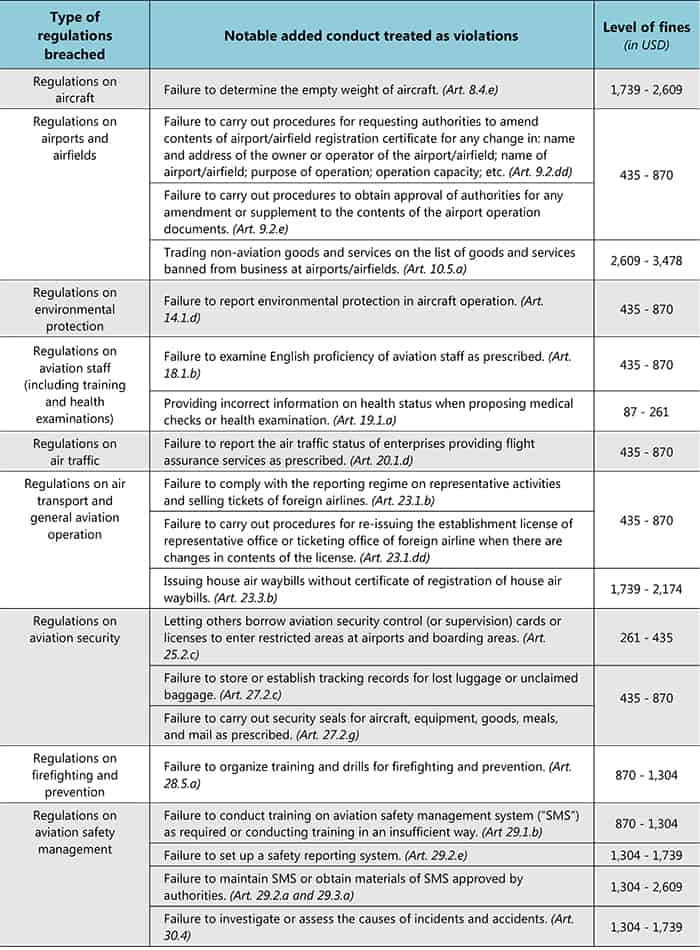
Notes on the table:

– The specified range of fines applies to organizations (e.g., companies). For individuals committing violations, the applied sanction is half the amount imposed on organizations (except for exceptions stated in Article 3.1 of Decree 162).

– Sanctions are listed in VND and converted to USD at the exchange rate of USD 1 = VND 23,000.

2. New Remedial Measures

In addition to amending and supplementing the monetary fines, Decree 162 adds new remedial measures. The new remedial measures aim to address both violations previously provided in the Old Decree and newly added violations in Decree 162. The new remedial measures, which may be applied in cases such as falsifying health examination results, failing to maintain aviation buildings according to an approved plan, or failing to establish aircraft maintenance records as prescribed, include the following:

  • Compulsory return of land which has been encroached upon or occupied, or compulsory return of premises;
  • Compulsory building maintenance;
  • Compulsory organization of re-inspection or retest;
  • Compulsory rescindment of inspection or test results;
  • Compulsory revocation of granted certificates of practice;
  • Compulsory rescindment of health examination results;
  • Compulsory return of illegally obtained profits;
  • Compulsory maintenance and documentation of aircraft maintenance.

3. Change in Entity Subject to Sanctions

The fines specified in Decree 162 are directly applied to organizations instead of individuals (as under the Old Decree). Thus, based on the provisions of Decree 162, administrative sanctions in civil aviation seem to directly and primarily govern organizational operations.

In light of the changes in Decree 162, air operators, MROs, ticketing agencies, and others in the aviation industry should assess their practices and ensure they are in compliance with the law.

RELATED INSIGHTS​ 

August 17, 2023
Attorneys from Tilleke & Gibbins’ offices in Vietnam have provided the Vietnam chapter for the Aviation Finance & Leasing 2023 guide from Chambers and Partners. The guide covers the most important legal developments affecting aircraft lessors, lessees, and financiers in 32 jurisdictions worldwide. In addition to the Vietnam chapter, Tilleke & Gibbins also contributed the Thailand chapter for Aviation Finance & Leasing 2023. Each chapter provides in-depth details on the legal regimes affecting all aspects of aircraft sale and purchase, aircraft and engine leasing, and aircraft debt finance, including sale and lease agreement terms; taxation; lease registration and enforcement; lease assignment/novation; insurance and reinsurance; debt structuring; securities; liens; and many others that affect the day-to-day operations of leading players in the aviation industry. Chambers and Partners’ Global Practice Guides provide in-house counsel with expert legal commentary focusing on practical legal issues affecting business, enabling readers to compare legislation and relevant procedures across a range of key jurisdictions. The Vietnam chapter of Aviation Finance & Leasing 2023 is available as a PDF through the button below, courtesy of Chambers and Partners. The full guide is accessible for free on the Chambers and Partners website.
August 17, 2023
Aviation specialists from Tilleke & Gibbins’ Bangkok office have contributed the Thailand chapter for Aviation Finance & Leasing 2023 from Chambers and Partners. The guide covers the most important legal developments affecting aircraft lessors, lessees, and financiers in 32 jurisdictions worldwide. In addition to the Thailand chapter, Tilleke & Gibbins also provided the Vietnam chapter for Aviation Finance & Leasing 2023. Each chapter provides in-depth details on the legal regimes affecting all aspects of aircraft sale and purchase, aircraft and engine leasing, and aircraft debt finance, including sale and lease agreement terms; taxation; lease registration and enforcement; lease assignment/novation; insurance and reinsurance; debt structuring; securities; liens; and many others that affect the day-to-day operations of leading players in the aviation industry. Chambers and Partners’ Global Practice Guides provide in-house counsel with expert legal commentary focusing on practical legal issues affecting business, enabling readers to compare legislation and relevant procedures across a range of key jurisdictions. The Thailand chapter of Aviation Finance & Leasing 2023 is available as a PDF through the button below, courtesy of Chambers and Partners. The full guide is accessible for free on the Chambers and Partners website.
June 20, 2023
Thailand is not a signatory to the Cape Town Convention. This means that upon an airline-lessee’s default, a lessor cannot present an Irrevocable Deregistration and Export Authorization (IDERA) document to easily repossess an aircraft. However, Thai law does allow for lessors to obtain aircraft deregisteration without the need to go to court. Pursuant to Clause 12 of the Civil Aviation Authority of Thailand (CAAT) Regulation No. 23 (Reg. 23), the Director General of CAAT has the authority to deregister an aircraft when the possessory right to the aircraft under a lease agreement has expired for any of the following reasons: The lease agreement has expired due to the lease term; The lease agreement has been terminated by either the lessor or the lessee in accordance with its termination clause; The lessor and lessee agree to terminate the lease agreement; The lessor notifies the termination of the lease agreement and submits an irrevocable deregistration power of attorney together with an application requesting the exportation of the aircraft, and the lessor or its agent submits an application for deregistration of the aircraft to the Director General. Under Reg. 23, a lessor can submit a deregistration application to CAAT asking CAAT to deregister. The deregistration application consists of evidence of the lease termination, a deregistration power of attorney (DPOA), the applicant’s certificate of incorporation, and the aircraft’s certificate of airworthiness and Certificate of Registration. CAAT will review the application and ask the lessee if it consents to the deregistration. If the lessee does not consent, CAAT may invite the lessor and lessee to one or more administrative hearings to give evidence on the dispute. If CAAT concludes that the lease has been validly terminated and the lessee no longer has possessory rights, CAAT will deregister the aircraft. Under Thai law, a lessor
November 24, 2021
Attorneys from Tilleke & Gibbins have provided the latest update to the Thailand contribution to Doing Business in…, a Q&A-style guide published by Thomson Reuters Practical Law that presents an overview of the legal framework for doing business in 63 jurisdictions worldwide. The Thailand chapter of the guide outlines Thailand’s legal system and key laws applicable to foreign companies doing business in the country. The chapter specifically covers the following main topics: Legal system: Thailand’s court system and codified legal system. Foreign investment: Lists of reserved business activities, restrictions on doing business with certain jurisdictions, exchange controls and currency regulations, and grants and incentives available to investors. Business vehicles: Ordinary partnerships, registered ordinary partnerships, limited partnerships, private limited companies, and public companies. Environment: Main laws and regulations, factory operation. Employment: Laws, employment contract requirements, work permits, and termination and redundancy. Tax: Taxes on employment, tax and nontax resident employees and businesses, corporate income tax, value added tax, special business tax, municipal tax, stamp duty, dividends, interest, intellectual property royalties. Competition: Important aspects of Thailand’s regulatory regime surrounding competition, centered around the updated Trade Competition Act. Antibribery and corruption: Laws, compliance requirements, regulatory authority. Intellectual property: Patents, trademarks, registered and unregistered designs, and copyright. Marketing agreements and advertising: Regulation of marketing agreements, Thailand’s Consumer Protection Act, direct marketing, role of the Consumer Protection Board and Food and Drug Administration. E-commerce: E-commerce laws and regulations, marketing and sales via online platforms. Data protection: An outline of Thailand’s Personal Data Protection Act. Product liability: Procedures and regulations for product liability and product safety, including the Unsafe Goods Liability Act and the Consumer Case Procedure Act. Product liability: Key regulatory authorities for trade competition, environmental issues, and financial services. To browse, download, or print the Thailand chapter, please visit the Practical Law website.