
You are using an outdated browser and your browsing experience will not be optimal. Please update to the latest version of Microsoft Edge, Google Chrome or Mozilla Firefox. Install Microsoft Edge

December 6, 2018

Myanmar Releases Updated Regulations on Car Importation for 2019

Informed Counsel

On October 26, 2018, the Supervisory Committee for Motor Vehicle Import, a branch of the Ministry of Commerce, released Notification No. 1/2018 in regard to the importation of vehicles in Myanmar in 2019. Under the new legislation (which is largely similar to the 2018 notification that it replaces) only left-hand drive vehicles, or machines that cannot be classified as either right-hand or left-hand drive, will be permitted for importation. In addition, the updated law stresses the importance of importing new vehicles by classifying permitted vehicles based on their year of manufacture.
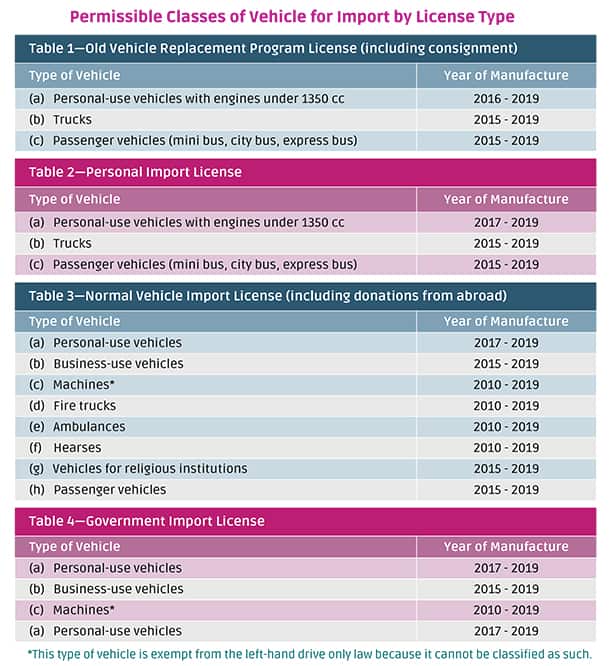
The Notification sets out the following exceptions for permissible vehicle import:

  1. Imports of ambulances and fire trucks that are being donated to the country are permitted only if the vehicle is manufactured in, or after, the year 2007.
  2. Excavators, bulldozers, wheel loaders, vibratory rollers, clamp loaders, motor graders, road-roller compactors, bridge cranes, gantry cranes, tower cranes, pilling machines, crawler drills/cranes, overhead-traveling cranes, mobile cranes, rough-terrain cranes, forklifts, boom lifts, and asphalt finishers that are not going to be driven on public roads, are permitted for importation if the vehicle was manufactured within the last 15 years.
  3. International non-governmental organizations are only allowed to buy from sale centers/showrooms as prescribed above in Table 1 and Table 2.  

The new regulations will come into effect in January 2019, and it is important for companies to take note of the revisions and prepare accordingly.    

Though often considered unpopular, the mandate to only allow the importation of left-hand drive cars is ultimately in the interest of public safety. As a country that drives on the right, left-hand drive cars are safer and more suitable for the people of Myanmar than right-hand drive cars, and their adoption is for the public benefit.

RELATED INSIGHTS​

April 19, 2022
On December 30, 2021, Vietnam’s Ministry of Education and Training issued Circular No. 40/2021/TT-BGDDT promulgating the Regulations on Organization and Operation of Private Primary Schools, Secondary Schools, High Schools, and Multi-level Schools (Circular 40), which took effect on February 14, 2022, replacing Circular No. 13/2011/TT-BGDDT. Circular 40 sets forth provisions for the organization and operation of private primary and secondary schools, including regulations on school organization and management; teachers, administrators, staff, and students; facilities, finances and assets; inspection, examination, and accreditation of education quality, rewards, and handling of violations. School Board Circular 40 has replaced the term “Board of Management” of the school, which had previously caused much confusion and misunderstanding under Circular 13, with the term “School Board.” Similarly, to avoid any confusion and inconsistency, Circular 40 also has removed regulations on “members’ councils,” which would typically be subject to the laws on enterprises, but are not under the regulations on schools. The provisions related to the School Board, summarized below, are the most significant changes introduced by Circular 40. Establishment and Composition Circular 40 affirms that the School Board of a private high school is the governing body of the school. The members of the School Board of a private school comprise representatives of the investors and members within and outside the school who are elected or decided upon by a meeting of the investors, and recognized by the competent authority (e.g., chairperson of the district or provincial People’s Committee, depending on the level of the school). Any changes to the members of the School Board must be submitted annually to the competent authority for recognition. The term of the School Board is five years. In a new requirement under Circular 40, the School Board must have an odd number of members, with at least five and
March 8, 2022
On February 15, 2022, Thailand’s cabinet approved in principle a package of incentives to promote electric vehicle (EV) adoption in Thailand, with the aim of making the country an EV manufacturing hub in Asia. A week later, the cabinet approved further draft regulations including specific information on customs duty reductions and exemptions for certain types of imported EVs. The plan includes both tax and non-tax incentives from 2022 until 2025. In the first two years (2022–2023), the package incentivizes the widespread use of EVs in Thailand by providing exemption or reduction of import duties and excise tax, as well as subsidies to increase the demand for EVs and attract investment in the EV industry. These incentives will cover the importation of completely built up (CBU) cars and motorcycles, and the local manufacturing of completely knocked down (CKD) vehicles in Thailand. For the following two years (2024–2025), the plan promotes the use of domestically produced EVs by eliminating the exemption or reduction of import duties for CBU vehicles while maintaining the other incentives (e.g., reduced excise tax rates, and subsidies). The aim of this is to make the cost of CBU vehicles higher than locally produced vehicles to encourage operators to produce EVs in the country to meet increasing demand. Additional measures encourage the manufacturing of EVs in Thailand, including exemption of import duties for parts imported between 2022 and 2025, and treatment of the value of imported battery cells as a cost of local manufacturing (up to 15% of an EV’s retail price). This is beneficial to local manufacturers of EVs, as their activities will be entitled to a more generous incentive package than importation of EVs. At their meeting on February 22, 2022, Thailand’s cabinet further approved draft subordinate regulations, including specific reductions and exemptions of customs duty
March 7, 2022
Attorneys from Tilleke & Gibbins wrote the Thailand chapter for Licensing 2022, a comprehensive guide from Lexology Getting the Deal Through to licensing in 17 countries around the world. Two specialists from Tilleke & Gibbins’ Bangkok office—Alan Adcock, partner and deputy director of intellectual property, and Kasama Sriwatanakul, senior associate—authored the Licensing 2021 Thailand chapter, which covers the following topics: Laws: Unfair Contract Terms Act, Trade Competition Act, pre-contractual disclosure, registration of international licensing, implied obligations, Civil and Commercial Code, Trademark Act, Patent Act, and Trade Secrets Act. Intellectual property issues: Paris Convention for the Protection of Industrial Property, PCT, TRIPs. Contesting the validity of licensor’s IP rights, invalidity and expiry of IP rights, evidence of use, licensing unregistered IP, opposability requirements, sub-licensing, co-owners, trade secrets, and copyright. Software licensing: Perpetual licensing, import/export restrictions, improvements and modifications, user restrictions, and legal developments. Competition law: Trade Competition Act, specific restrictions on licensing agreements, and significant court decisions. Indemnification, disclaimers, and damages: Prevalence and enforceability of indemnity provisions and contractual waivers of damages. Termination: Conditions, indemnity, agency, and impact on sub-licenses. Bankruptcy: Impact of licensee bankruptcy on licensor and vice versa, protection, and rights to terminate. Dispute resolution: Governing law, arbitration, enforcement, injunctions, contractual waivers Royalties and payments: Currency conversion, tax, remittance restrictions, and jurisdiction-specific payments. The Thailand chapter is available below as a PDF. Tilleke & Gibbins also contributed the Vietnam chapter to Licensing 2022. To browse all 17 jurisdictions covered by the guide, please visit the Getting the Deal Through website.
March 7, 2022
Attorneys from Tilleke & Gibbins have written the Vietnam chapter for Licensing 2022, a comparative guide from Lexology Getting the Deal Through to licensing law and practice in 17 countries around the world. Licensing 2022, a guide that provides an overview of a wide range of licensing relationships, including licensing of copyrights, trademarks, and patents; software licenses; technology transfer agreements; and franchise agreements. The book also addresses issues of royalties and other payments, taxes, competition law, and termination of licensing relationships. The Vietnam chapter was authored by Linh Thi Mai Nguyen, partner and head of Tilleke & Gibbins’ trademark team in Vietnam; Son Thai Hoang, trademark executive; and Chi Lan Dang, associate, of Tilleke & Gibbins’ trademark team, along with corporate and commercial senior associate Tu Ngoc Trinh, who has extensive experience in franchising and competition law. The Vietnam chapter is available below as a PDF. Tilleke & Gibbins also contributed the Thailand chapter to Licensing 2022. To browse all 17 jurisdictions covered by the guide, please visit the Getting the Deal Through website.