
You are using an outdated browser and your browsing experience will not be optimal. Please update to the latest version of Microsoft Edge, Google Chrome or Mozilla Firefox. Install Microsoft Edge

December 6, 2018

Myanmar Releases Updated Regulations on Car Importation for 2019

Informed Counsel

On October 26, 2018, the Supervisory Committee for Motor Vehicle Import, a branch of the Ministry of Commerce, released Notification No. 1/2018 in regard to the importation of vehicles in Myanmar in 2019. Under the new legislation (which is largely similar to the 2018 notification that it replaces) only left-hand drive vehicles, or machines that cannot be classified as either right-hand or left-hand drive, will be permitted for importation. In addition, the updated law stresses the importance of importing new vehicles by classifying permitted vehicles based on their year of manufacture.
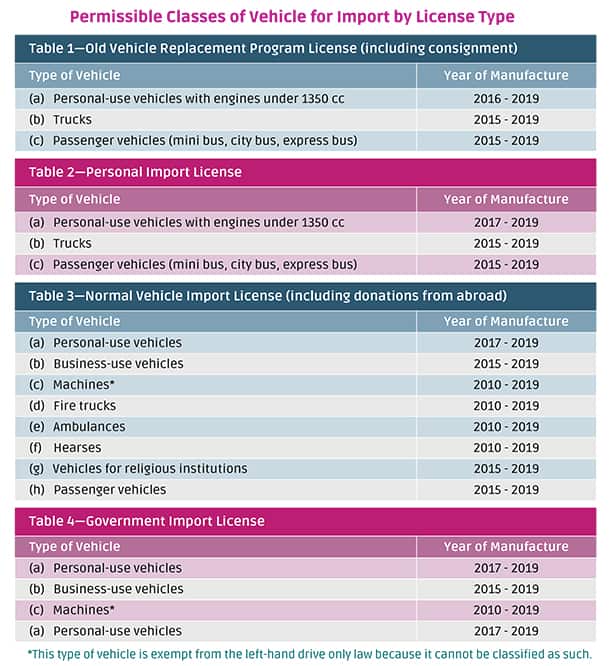
The Notification sets out the following exceptions for permissible vehicle import:

  1. Imports of ambulances and fire trucks that are being donated to the country are permitted only if the vehicle is manufactured in, or after, the year 2007.
  2. Excavators, bulldozers, wheel loaders, vibratory rollers, clamp loaders, motor graders, road-roller compactors, bridge cranes, gantry cranes, tower cranes, pilling machines, crawler drills/cranes, overhead-traveling cranes, mobile cranes, rough-terrain cranes, forklifts, boom lifts, and asphalt finishers that are not going to be driven on public roads, are permitted for importation if the vehicle was manufactured within the last 15 years.
  3. International non-governmental organizations are only allowed to buy from sale centers/showrooms as prescribed above in Table 1 and Table 2.  

The new regulations will come into effect in January 2019, and it is important for companies to take note of the revisions and prepare accordingly.    

Though often considered unpopular, the mandate to only allow the importation of left-hand drive cars is ultimately in the interest of public safety. As a country that drives on the right, left-hand drive cars are safer and more suitable for the people of Myanmar than right-hand drive cars, and their adoption is for the public benefit.

RELATED INSIGHTS​ 

August 29, 2025
On August 15, 2025, Laos’ Immigration Police Department introduced a pilot online arrival registration system for foreign passport holders entering the country. Under the new system, visitors to Laos will be able to register their arrival online up to three days in advance and will be exempt from filling out paper forms at the border. Starting September 1, 2025, online registrations will be accepted at four major international border checkpoints: Wattay International Airport in Vientiane, Luang Prabang International Airport, Pakse International Airport in Champasak Province, and the First Lao-Thai Friendship Bridge linking Vientiane and Nong Khai Province in Thailand. Foreign passport holders arriving in Laos from this date onward will be able to complete the online registration via the official website of the Department of Immigration: http://www.immigration.gov.la/. Upon successful registration, travelers will receive a QR code valid for three days, which must be presented to border authorities upon arrival to verify the registration. During the pilot phase, which is expected to run until early 2026, travelers who have not registered online will still have the option to complete a paper form at the checkpoint. After the pilot phase, the online registration system will become mandatory nationwide, and paper forms will no longer be accepted. This initiative marks a significant step toward modernizing Laos’ immigration procedures. Transitioning from traditional paper-based entry forms to a streamlined digital system will greatly enhance efficiency at border checkpoints. The submission of traveler information ahead of arrival is expected to drastically reduce processing times and alleviate congestion at arrival counters, especially during peak travel periods.
August 27, 2025
Myanmar’s Directorate of Investment and Company Administration (DICA) has issued an announcement reinforcing compliance obligations under the Myanmar Companies Law (MCL). This follows recent updates to reporting requirements and signals increased regulatory scrutiny regarding registered office addresses and directors’ residential information submitted online via MyCO, Myanmar’s company registration system. Key Compliance Areas Under the MCL, every company must maintain a registered office for official communication and legal correspondence. Any change to this address must be reported to the DICA registrar. In April 2023, DICA introduced additional reporting obligations for newly incorporated companies. The additional rules require companies to submit their Annual Return accompanied by verification documents within two months of incorporation. These documents include a recommendation letter from the relevant township police station or ward administrator confirming the operational status and physical location of the registered office. Directors’ residential addresses must also be verified through similar documentation, and foreign directors are required to submit the arrival notification form issued by the Immigration Department. For companies operating through a virtual office, clarification from a DICA official indicates that the virtual office address must correspond with the registered address submitted via MyCO. A recommendation letter confirming the validity and operational status of the virtual office must be submitted. Legal Consequences The recent announcement signals that DICA will begin enforcing these requirements in earnest. Failure to comply with the additional reporting obligations may result in inspections and enforcement actions by the DICA registrar, or complaints from third parties. It may also lead to penalties or other legal consequences as prescribed under the MCL. Recommended Actions It is strongly advised that all newly incorporated companies and their directors: Review their MyCO submissions for accuracy. Secure the required supporting documents within the Annual Return deadline. Ensure that all address information reflects the company’s actual
August 19, 2025
On August 6, 2025, Myanmar’s National Defence and Security Council (NDSC) issued Order No. 20/2025, announcing a change in the composition of the country’s Foreign Exchange Supervisory Committee (FESC). The prime minister has been appointed committee chair of the FESC, and five other individuals were appointed to the committee. The order took immediate effect. Originally established in April 2022, the FESC is responsible for approving foreign currency conversion, granting exemptions to foreign exchange restrictions, and permitting overseas transfers of foreign currency. The FESC supervises the flow of foreign currencies for domestic and foreign investment, manufacturing, exports and imports, and service businesses (including education- and health-related initiatives). The FESC is specifically responsible for considering and approving the use of foreign currency for the following: Importing machinery, vehicles, equipment, and raw materials essential for foreign investment and manufacturing projects; Importing fuel, medicine, cooking oil, fertilizer, insecticide, and construction materials not readily available on the domestic market; Covering Myanmar citizens’ needs abroad, such as medical treatment, education, or religious activities; Facilitating imports of general goods, loan repayments, interest payments to foreign lenders, service payments, and profit repatriation from investments; and Importing luxury products, including brand-name goods, jewelry, sports cars, and watches. The FESC is empowered to carry out further duties related to foreign exchange management as assigned by the NDSC Importers, exporters, investors, and business owners are encouraged to consult the most current FESC guidelines and approval lists before conducting transactions in Myanmar. For more details on these FESC composition developments, or on any aspect of financial regulations in Myanmar, please contact Tilleke & Gibbins at [email protected].
August 1, 2025
Tilleke & Gibbins has contributed the Vietnam chapter to Corporate Governance 2025, part of the International Comparative Legal Guides (ICLG) series published by Global Legal Group. This respected guide offers comprehensive, jurisdiction-specific overviews of corporate governance laws and practices around the world. Each jurisdictional chapter follows a clear Q&A format, providing practical insights into critical issues such as: Sources of corporate governance regulation Shareholders’ rights, powers, and responsibilities Structure and duties of management bodies Stakeholder involvement in governance Transparency and reporting requirements ESG and sustainability-related obligations Cybersecurity and technology-related disclosures The Vietnam chapter was authored by Tram Ngoc Bich Nguyen, Truc Thi Thanh Tran, Dung Thi Phuong Le, and Quang Minh Vu, members of Tilleke & Gibbins’ corporate and commercial team in Ho Chi Minh City. The authors provide detailed analysis of Vietnam’s corporate governance framework, including recent developments such as the 2025 amendments to the Law on Enterprises requiring disclosure of ultimate beneficial ownership and the increasing emphasis on sustainable business practices and responsible corporate conduct. The chapter also discusses practical considerations for foreign investors in Vietnam, such as overlapping signing authorities between key company officers, enforcement of shareholders’ agreements, and disclosure obligations related to ownership and management roles. The complete Vietnam chapter is available as a PDF below. The Vietnam chapter—and the full Corporate Governance 2025 guide—are also freely available on the ICLG website.