
You are using an outdated browser and your browsing experience will not be optimal. Please update to the latest version of Microsoft Edge, Google Chrome or Mozilla Firefox. Install Microsoft Edge

December 6, 2018

Myanmar Releases Updated Regulations on Car Importation for 2019

Informed Counsel

On October 26, 2018, the Supervisory Committee for Motor Vehicle Import, a branch of the Ministry of Commerce, released Notification No. 1/2018 in regard to the importation of vehicles in Myanmar in 2019. Under the new legislation (which is largely similar to the 2018 notification that it replaces) only left-hand drive vehicles, or machines that cannot be classified as either right-hand or left-hand drive, will be permitted for importation. In addition, the updated law stresses the importance of importing new vehicles by classifying permitted vehicles based on their year of manufacture.
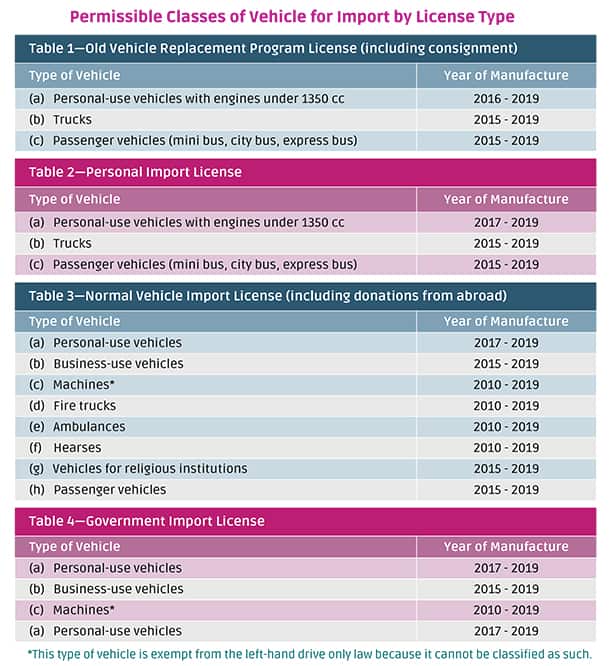
The Notification sets out the following exceptions for permissible vehicle import:

  1. Imports of ambulances and fire trucks that are being donated to the country are permitted only if the vehicle is manufactured in, or after, the year 2007.
  2. Excavators, bulldozers, wheel loaders, vibratory rollers, clamp loaders, motor graders, road-roller compactors, bridge cranes, gantry cranes, tower cranes, pilling machines, crawler drills/cranes, overhead-traveling cranes, mobile cranes, rough-terrain cranes, forklifts, boom lifts, and asphalt finishers that are not going to be driven on public roads, are permitted for importation if the vehicle was manufactured within the last 15 years.
  3. International non-governmental organizations are only allowed to buy from sale centers/showrooms as prescribed above in Table 1 and Table 2.  

The new regulations will come into effect in January 2019, and it is important for companies to take note of the revisions and prepare accordingly.    

Though often considered unpopular, the mandate to only allow the importation of left-hand drive cars is ultimately in the interest of public safety. As a country that drives on the right, left-hand drive cars are safer and more suitable for the people of Myanmar than right-hand drive cars, and their adoption is for the public benefit.

RELATED INSIGHTS​ 

September 29, 2025
In September 2019, the government of Vietnam issued Decree No. 75/2019/ND-CP on Administrative Sanctions in the Field of Competition (Decree 75) to address the urgent need for clear sanctioning mechanisms following the implementation of the new Law on Competition in July 2019. However, after five years of enforcement, various gaps and inconsistencies have been exposed that hinder its application. These shortcomings have reduced the deterrent effect of the sanctioning regime, and created legal uncertainty for market participants. A recent case involving Duc Giang – Lao Cai Chemicals’ acquisition of another chemical company—one of the first cases of economic concentration violation to be sanctioned by the National Competition Commission (NCC) since the Law on Competition took effect—highlights the practical difficulties under Vietnam’s competition law enforcement regime. In this case, although the transaction exceeded the statutory notification thresholds of economic concentration set out in the law, the parties failed to submit the required notification. This violation resulted in the NCC imposing aggregate fines of VND 1,423,982,880 (approximately USD 54,770) on the companies in September 2024. On appeal, Duc Giang – Lao Cai Chemicals argued that the chairman of the NCC was legally entitled to issue a warning as the key punishment instead of a monetary penalty. However, the chairman rejected the appeal, citing Article 14 of Decree 75, under which the specific penalty and level for “failure to notify economic concentration” is a fine, not a warning. While the chairman of the NCC is generally empowered to impose penalties, a warning cannot be applied if the specific regulation for a particular violation does not provide for it as a sanction. This example shows the inadequacy and inconsistency of the regulations on penalties for violations of competition law, and underscores the need for an amendment of Decree 75 to resolve such conflicts
September 26, 2025
As Vietnam accelerates its digital transformation, data centers have emerged as critical infrastructure supporting the shift toward a digital government, digital economy, and digital society. For businesses targeting Vietnam’s rapidly growing data center market, a clear understanding of the evolving regulatory landscape, compliance obligations, and government incentives is key to successful market entry and operation. This article provides a strategic overview of investment opportunities and key compliance requirements in Vietnam’s dynamic data center sector. Investment Incentives to Boost Data Center Growth Since July 1, 2024, organizations and individuals across all economic sectors have been encouraged to invest in and contribute to the development of data centers. By law, there are no restrictions on shareholding ratios, capital contributions, or foreign investor participation in data center and cloud computing services under business cooperation contracts. Currently, investment in AI data centers is classified as a specially incentivized industry, qualifying for preferential treatments and incentives in terms of investment, taxation, land use, and other related areas. Large-scale data centers, together with AI and cloud computing, are currently considered as strategic technologies and products for which Vietnam offers significant fiscal, tax, and land incentives to promote investment. Additionally, these large-scale projects may receive direct financial support from local development budgets for facility construction, technical infrastructure, and equipment procurement, subject to state budget provisions and applicable laws. AI data center construction projects also enjoy preferential treatment under customs regulations. Regulatory Approvals for Providing Data Center Services The 2023 Telecom Law and its guiding documents marked a significant milestone by classifying data center services as value-added telecom services. Under the law, a data center service is defined as a telecom service that enables users to process, store, and retrieve information via a telecom network through the leasing of part or all of a data center. A
September 19, 2025
Over the past two years—particularly since Thailand announced incentives for EVs, including tax exemptions and reductions—there has been a clear trend of manufacturers relocating their facilities to Thailand. This shift is reshaping the country’s industrial landscape and creating significant opportunities in the real estate sector for companies looking to establish or expand EV manufacturing operations in Southeast Asia. Incentive-Driven Market Transformation The government’s tax exemptions and reductions have proven effective in attracting foreign investment, with Chinese manufacturers currently dominating the market. Most EV parts and car manufacturers operating in Thailand are from China, reflecting the prominence of Chinese EV brands that have already established a presence in the country. The sector encompasses manufacturers of electrical equipment as well as companies seeking to establish facilities for producing electric vehicle components, parts, and accessories. The surge in activity is evident across Thailand’s EV manufacturing sector, with legal practices handling these transactions experiencing unprecedented demand. Industrial Real Estate Framework and Market Dynamics Thailand’s industrial real estate framework provides compelling advantages for foreign manufacturers, who typically face restrictions on foreign land ownership under the Land Code. However, foreign investors can benefit from exemptions to these restrictions if the land is located within industrial real estate zones designated by the Industrial Estate Authority of Thailand (IEAT) or they obtain investment promotion from the Board of Investment (BOI) if the land is located outside an industrial estate area governed by the IEAT. Both the IEAT and BOI provide special tax and nontax incentives, including foreign land ownership, with even greater incentives available for land situated within the country’s Eastern Economic Corridor (EEC). This regulatory advantage has sparked a parallel trend in land development. Industrial real estate developers in the EEC are actively consolidating land into large plots to develop new industrial estate projects, recognizing that
September 17, 2025
M&A specialists at Tilleke & Gibbins have contributed the Vietnam chapter to Private M&A 2025, a newly released guide from Lexology Panoramic. The publication provides practical insights into private mergers and acquisitions frameworks in jurisdictions worldwide. The Vietnam chapter addresses key aspects of private M&A transactions, including: Structure and process, legal regulation, and required consents Advisers, negotiation, and documentation Due diligence and disclosure obligations Pricing, consideration, and financing Conditions, preclosing covenants, and termination rights Representations, warranties, indemnities, and postclosing covenants Taxation of transfers Employees, pensions, and benefits Recent legal, regulatory, and market practice developments The chapter highlights how Vietnam’s legal framework governs private acquisitions and disposals, outlines typical transaction processes and structures, and provides guidance on common regulatory and practical considerations. It also notes recent trends, including increased scrutiny of merger control filings by the Vietnam Competition Commission and regulatory changes affecting M&A approvals. The full Vietnam chapter is available as a PDF through the button below. Readers can also gain 30 days of complimentary access to Private M&A 2025 and Lexology Panoramic’s full library of resources through this link.